You find a half-finished bottle of pills in the back of your cabinet and realize they expired six months ago. Your throat is sore, and you're tempted to just take them to save a trip to the doctor. It seems like a shortcut, but with antibiotics, a "close enough" dose can actually be dangerous. While most medications don't turn into poison the moment they hit their expiration date, antibiotics are a different beast entirely because of how they fight bacteria.
Expiration dates on medication are the final day a manufacturer guarantees that the drug is 100% potent and safe, provided it was stored correctly. They aren't "best by" dates like you see on a yogurt cup; they are based on strict stability testing required by regulations, such as those set by the U.S. Food and Drug Administration (FDA).
The Big Difference Between Pills and Liquids
Not all medications degrade at the same speed. If you're looking at a solid tablet, the news is generally better than if you're looking at a syrup. Solid dosage forms, like capsules and tablets, are chemically more stable. In fact, a massive study called the Shelf Life Extension Program (SLEP), conducted by the U.S. Department of Defense, found that about 90% of drugs maintained at least 90% of their potency for up to 15 years past their expiration date when stored in ideal conditions.
However, liquid formulations are a completely different story. If you have an amoxicillin oral suspension-the kind that's mixed with water and kept in the fridge-it can lose its punch incredibly fast. Research shows that these liquids can lose up to 95% of their effectiveness within just a few weeks after the expiration date. For a child's infection, taking a liquid that is 50% degraded isn't just ineffective; it's a recipe for failure.
| Formulation | Typical Stability Post-Expiration | Risk Level |
|---|---|---|
| Solid Tablets/Capsules | High (often 85-92% potency at 12 months) | Moderate |
| Reconstituted Liquids | Very Low (rapid degradation within days/weeks) | High |
| Injectables/IV | Moderate to Low (depends on refrigeration) | High |
The Danger of "Almost" Working
The biggest risk isn't that the pill will make you sick, but that it won't kill all the bacteria. When you take a full-strength antibiotic, it wipes out the colony. But when you take an expired version with reduced potency, you might only kill the weakest bacteria. This creates a "survival of the fittest" scenario where the strongest bacteria survive and mutate.
This is how antimicrobial resistance happens. The Infectious Diseases Society of America (IDSA) has warned that using sub-therapeutic doses-basically, doses that are too low to finish the job-is a public health threat. It turns a treatable infection into a resistant one that requires much stronger, more expensive, and more toxic drugs to fix. In one analysis, expired pediatric antibiotics showed a staggering 98.7% resistance rate against Escherichia coli, compared to only 14.3% for fresh medication.
Can You Tell if a Pill Has Gone Bad?
Many people believe that if a pill doesn't look, smell, or taste funny, it's still good. Unfortunately, that's a dangerous assumption. A study in the Journal of Pharmaceutical Sciences revealed that nearly 90% of degraded antibiotics showed absolutely no detectable change in appearance, taste, or smell, even after losing 40-75% of their potency. You can't trust your eyes to tell you if the medicine is still working.
That said, there are "red flags" that mean you should definitely toss the bottle immediately:
- The tablets are crumbling or falling apart.
- There is a noticeable change in color (yellowing or spotting).
- The liquid has become cloudy or has visible particles floating in it.
- The pills have a strong, unusual odor.
Where You Store Your Meds Actually Matters
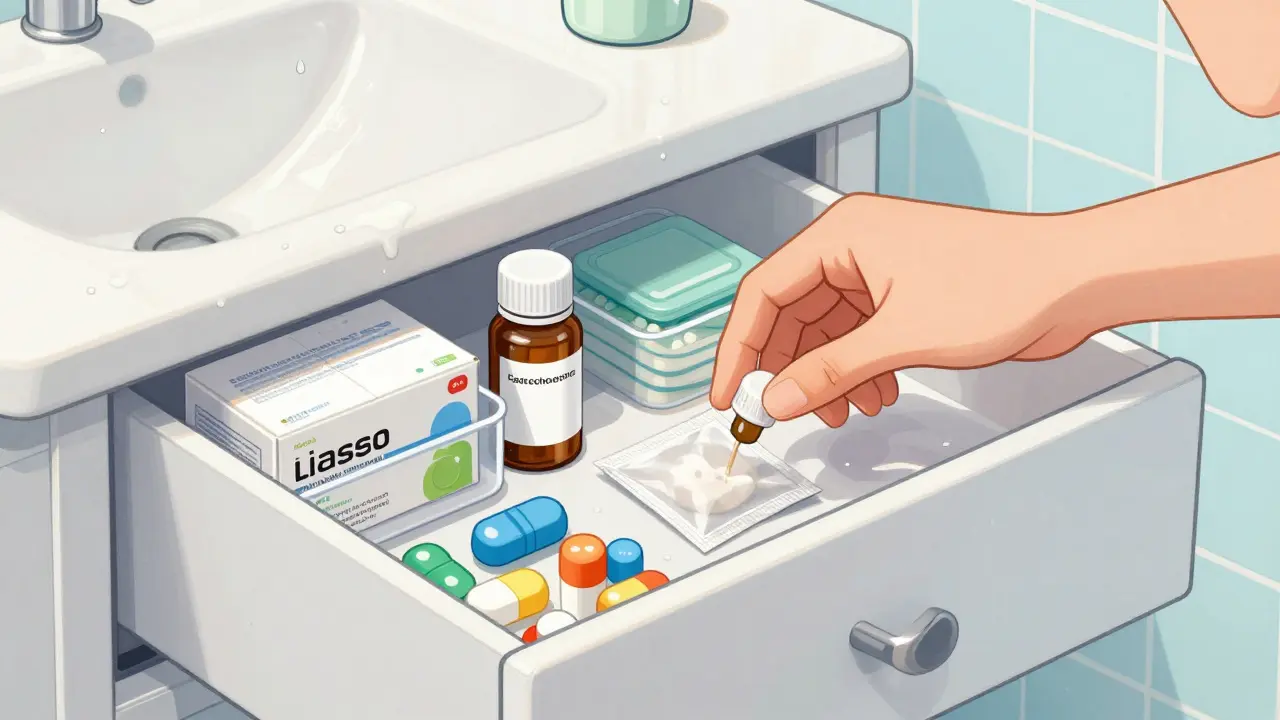
Most of us keep our medicine in the bathroom cabinet. From a chemistry perspective, that's the worst place possible. Bathrooms are humid and experience frequent temperature swings from the shower. Heat and moisture are the primary enemies of antibiotic stability, especially for beta-lactam antibiotics like penicillins, which are prone to hydrolysis (breaking down when exposed to water).
According to stability testing, antibiotics kept in original containers with desiccants (those little "do not eat" packets) in a cool, dry place (15-25°C) stay potent about 37% longer than those kept in a humid bathroom. If you're storing meds for a long-term need, move them to a linen closet or a bedroom drawer instead.
When is it "Okay" to Use Expired Meds?
In a perfect world, you'd never use an expired drug. But the reality is that drug shortages happen. The European Medicines Agency (EMA) acknowledges that solid dosage forms might be acceptable for 6-12 months past expiration if they were stored perfectly. Some hospitals even have protocols to extend the dates of critical antibiotics during severe shortages using high-tech testing.
However, this is for emergency scenarios, not for convenience. You should never use expired antibiotics for life-threatening infections like meningitis, sepsis, or endocarditis. In those cases, a 10% drop in potency could be the difference between recovery and death.
Will taking expired antibiotics make me sick?
Generally, most antibiotics don't become toxic as they age. The main issue isn't toxicity, but a loss of potency. The danger isn't that the drug will poison you, but that it won't be strong enough to kill the infection, which can lead to the bacteria becoming resistant to treatment.
Can I use an expired antibiotic for a minor infection?
It's not recommended. Even for minor infections, using a sub-potent drug can lead to treatment failure or the development of antibiotic-resistant bacteria. It is always safer to get a fresh prescription that is guaranteed to work.
How should I dispose of expired antibiotics?
Do not flush them down the toilet or throw them in the trash where they can leak into the water supply. The best method is to take them to a local pharmacy that offers a drug take-back program. This prevents antibiotics from entering the environment and contributing to community-wide resistance.
Do liquid antibiotics expire faster than pills?
Yes, significantly. Liquid suspensions are much more unstable than solid tablets. Once reconstituted (mixed with water), many liquid antibiotics lose a massive amount of their effectiveness within weeks, making them far riskier to use past their expiration date.
What if the pills are only a few days past the date?
For solid tablets, a few days likely won't result in a significant drop in potency. However, for liquids, even a few days can be impactful. Because there is no way to test the potency at home, the safest move is to contact your pharmacist for a replacement.
Next Steps and Precautions
If you are currently staring at an expired bottle, the best move is to call your pharmacist. They can tell you if that specific drug is known for rapid degradation or if it's relatively stable. If you are in a region experiencing a critical drug shortage, consult your doctor before attempting to use an older supply, as they can perform a risk-benefit assessment based on your specific infection.
To avoid this in the future, set a calendar reminder to purge your medicine cabinet every six months. Always store your medications in a cool, dry place-away from the steam of the shower-to ensure they last until the date on the bottle.
dallia alaba
April 19, 2026 AT 23:13It's really crucial to mention that taking antibiotics for a viral infection, like a common cold or the flu, is a huge mistake regardless of the expiration date.
People often confuse a sore throat with a bacterial infection, but if it's viral, antibiotics won't do a thing and you're just inviting side effects or resistance for no reason. Definitely encourage everyone to get a rapid strep test before diving into any meds.
julya tassi
April 20, 2026 AT 10:54I had no idea about the bathroom cabinet thing! 😮 I've always kept mine there. Definitely moving my stuff to the bedroom drawer now. Thanks for the tip! ✨
Lesley Wimbush
April 20, 2026 AT 13:25Honestly, it's just basic common sense to not keep a pharmacy in your bathroom. I've been telling people for years that humidity ruins everything, but apparently, some people need a full-blown article to understand that. It's just... embarrassing that we're still discussing this in this day and age. But hey, at least some of you are finally catching up! 💅
Wendy Ajurín
April 21, 2026 AT 14:35The mention of the Shelf Life Extension Program is quite relevant here. It provides a necessary nuance to the conversation regarding solid dosage forms. However, the risk of antimicrobial resistance remains the most significant concern for the broader community, making the caution against sub-therapeutic dosing absolutely imperative.
Olushola Adedoyin
April 22, 2026 AT 16:30You really trust those 'expiration dates' from Big Pharma? They just want you to throw away perfectly good pills so you go back and spend more money!
It's a giant scam to keep us paying. They tell you it's 'dangerous' just so you keep feeding the machine. Open your eyes people, the system is rigged from the start! 💊💸
Brigid Prosser
April 22, 2026 AT 22:59Absolute madness that some folks actually consider taking old liquids. Just bin it and get a fresh one, for goodness sake. Don't be a lazy git and gamble with your health over a trip to the chemist. It's a complete joke to think a half-dead syrup is going to do anything but make you feel worse. Get it sorted properly or don't bother at all.
Aman Tomar
April 24, 2026 AT 21:15This is so tragick that people risk their health like this. I realy feel for those who cannot afford the doctor and feel forced to use old medisins. It is a very sad state of affairs when a simple infection becomes a disaster because the pill was old. We must find a way to make healthcare more accesible for everyone so nobody has to guess if their meds work!!
Truman Media
April 26, 2026 AT 09:57It is truly a blessing that we have such knowledge to guide us. 🌟 We must all walk the path of caution and care for our bodies, which are our only true homes. Let us be mindful of the science and the wisdom of the healers. Small changes in where we keep our medicine can lead to a much healthier life for all of us. Be well and stay positive! 😊
William Young
April 26, 2026 AT 11:44Just toss them.