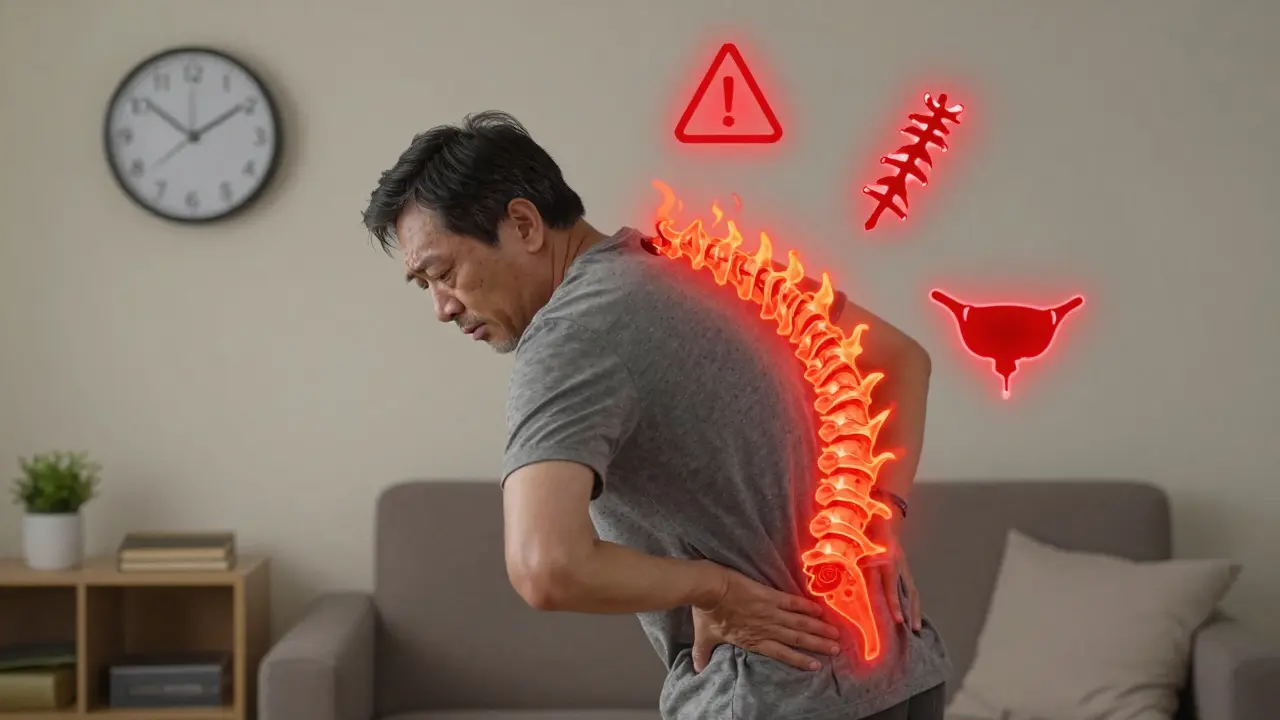
Most people will experience back pain at some point in their lives. For many, it’s just a nuisance - a stiff muscle, a bad lift, or a long day on your feet. It goes away in a few days or weeks with rest, movement, and over-the-counter pain relief. But for some, it’s a warning sign. Something deeper. Something dangerous. Back pain red flags are the clues that tell you when this isn’t just muscle strain - when it’s time to stop waiting, start asking questions, and get the right tests before it’s too late.
What Are Back Pain Red Flags?
Red flags aren’t just vague symptoms. They’re specific, evidence-backed signals that point to serious underlying conditions: infections, tumors, fractures, nerve damage, or spinal cord compression. These aren’t common. Only about 1 in 10 people with back pain have them. But missing one can lead to permanent disability or even death. The goal isn’t to scare you. It’s to make sure you don’t ignore the signs that mean you need urgent care.Red Flags That Demand Immediate Action
Not all red flags are equal. Some require emergency care. Others need fast follow-up. Here are the ones you can’t afford to overlook:- Cauda equina syndrome: This is a medical emergency. Symptoms include loss of bladder or bowel control, numbness in the groin or inner thighs, and sudden weakness in both legs. If you have any of these, go to the ER now. Delaying treatment by more than 48 hours can lead to permanent paralysis.
- Unexplained weight loss with back pain: Losing weight without trying - especially if you’re not trying to - combined with persistent back pain, raises a red flag for cancer. This isn’t about a few pounds. It’s about 10 or more pounds in a few months.
- Fever with back pain: If you’re running a fever (over 100.4°F) and your back hurts, it could be an infection in your spine. Spinal osteomyelitis is rare but deadly if untreated. It often starts as a dull ache that gets worse at night and doesn’t improve with painkillers.
- History of cancer: If you’ve had cancer in the past - even years ago - and now you have new back pain, don’t assume it’s just aging. Cancer can spread to the spine silently. The pain often worsens at night and doesn’t respond to rest.
- Recent trauma: A fall from height, a car crash, or even a hard stumble can fracture a vertebra, especially if you’re over 50 or have osteoporosis. Even if you feel okay after the accident, persistent back pain is a warning.
- Age over 50 or under 18: Back pain in younger people can signal tumors or inflammatory conditions. In older adults, it’s more likely to be a fracture. The risk of vertebral compression fracture jumps from 9% in people under 50 to 36% in those over 70.
When Imaging Is Necessary - and When It’s Not
Imaging isn’t a cure. It’s a tool. And using it too early - or too often - causes more harm than good. A 2020 review of over a million patients found that 34% of people got unnecessary X-rays or MRIs for back pain with no red flags. That means they were exposed to radiation, paid extra, and were more likely to be told they had “degenerative changes” that didn’t even cause their pain.Here’s what the guidelines say:
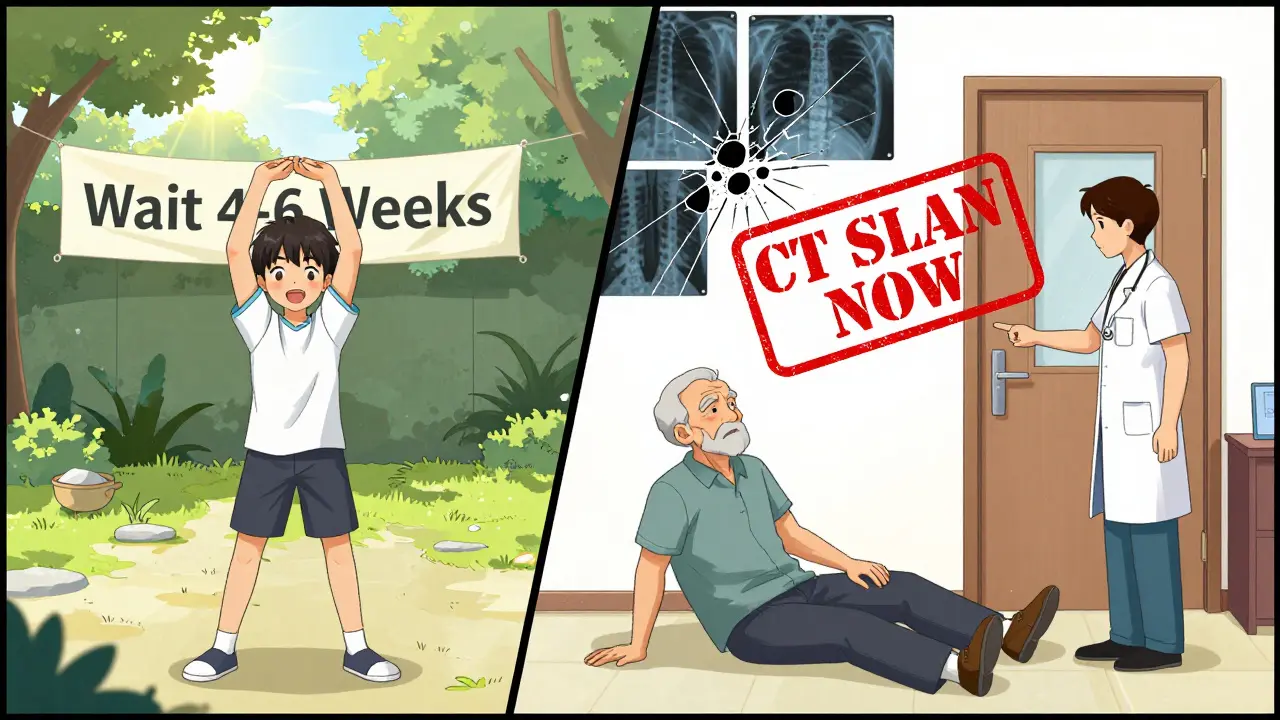
- No red flags? Wait. If your pain is mechanical - worse with movement, better with rest - and you’re under 50 with no other symptoms, give it 4 to 6 weeks. Most cases improve on their own. Imaging before then doesn’t help and can lead to unnecessary surgery.
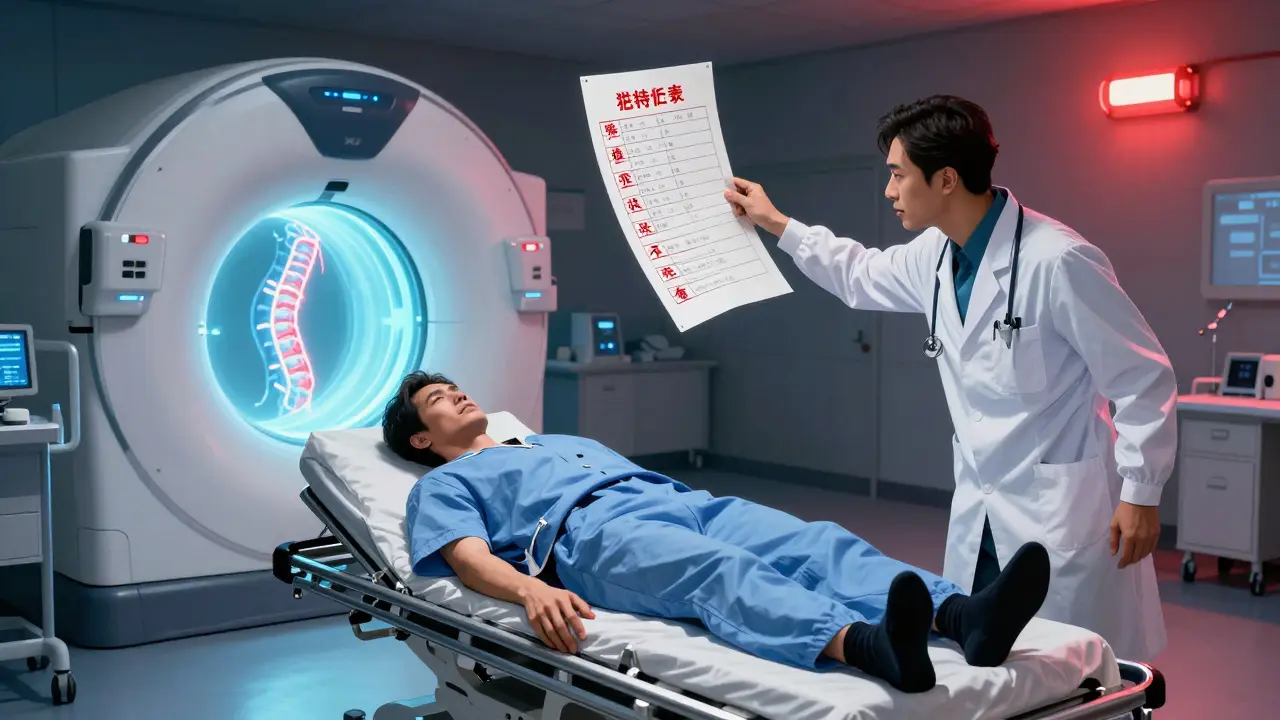
- Red flags? Act fast. If you have any of the red flags above, imaging is needed. MRI is the gold standard for detecting infections, tumors, and nerve compression. It’s 95% accurate for cauda equina syndrome. CT scans are better for fractures, especially in older adults. Plain X-rays? They miss up to 36% of fractures in people over 50.
- Chronic pain without red flags? Still wait. If your pain has lasted more than 12 weeks but you have no red flags, conservative care - physical therapy, exercise, pain management - still comes first. Imaging only makes sense if you’re not improving after months of treatment.
And here’s the hard truth: a normal MRI doesn’t mean you’re fine. A 2021 study found that 79% of people over 80 with no back pain at all had disc degeneration on MRI. That’s not disease. That’s aging. Don’t let a radiologist’s report scare you into surgery you don’t need.
Who Should Refer You - and When
You don’t need to figure this out alone. Your primary care doctor, physical therapist, or ER provider should know the red flags. But not everyone does. That’s why it’s up to you to speak up.- If you have cauda equina symptoms, go to the ER. Don’t call your doctor. Don’t wait for an appointment. Emergency surgery within 48 hours can save your bladder, bowel, and mobility.
- If you have cancer history, fever, or unexplained weight loss, ask for a referral to an oncologist or infectious disease specialist. Don’t settle for “it’s just arthritis.”
- If you’re over 50 and had a fall, ask for a CT scan. X-rays aren’t enough.
- If you’ve had back pain for more than a month with no improvement, ask for a physical therapy evaluation. If pain persists after 6 weeks of therapy, it’s time to see a spine specialist.
Physical therapists are trained to spot red flags. In fact, 12% of malpractice cases involving back pain involve a missed referral. If your therapist says, “You need to see your doctor,” listen. They’re not overreacting. They’re protecting you.
The Cost of Waiting - And the Cost of Overtesting
Delaying care for serious conditions has real consequences. Spinal infections take an average of 18.7 days to diagnose - and each day without antibiotics increases the risk of permanent damage. One study found that patients with undiagnosed spinal tumors had 3 times higher rates of paralysis compared to those diagnosed early.But overtesting is just as dangerous. Unnecessary imaging leads to false positives, unnecessary surgeries, and higher costs. In the U.S., $3 billion is spent every year on imaging for back pain that doesn’t need it. Insurance companies like Anthem now deny coverage for these tests unless red flags are present. You’re not just paying more - you’re risking more.
What’s Changing in 2025
Guidelines are evolving. The old “checklist” approach to red flags is being replaced by smarter tools. The STarT Back tool, now used in 2024 draft guidelines, combines symptoms, pain location, and psychological factors to predict who’s at risk for serious problems - with 83% accuracy. Point-of-care ultrasound is being tested to quickly check for bladder distension in suspected cauda equina cases, reducing unnecessary MRIs by up to 35%. And AI algorithms are being trained to predict red flags from patient history - early results show 89% accuracy, compared to 76% for human doctors.These tools won’t replace your doctor. But they’ll help them make faster, smarter decisions. Your job? Know the signs. Speak up. Don’t let “it’ll go away” become “it’s too late.”
What to Do Right Now
If you’re experiencing back pain:- Ask yourself: Do I have any of the red flags? Fever? Weight loss? Loss of bladder control? History of cancer? Recent trauma?
- If yes - don’t wait. Go to the ER or call your doctor immediately.
- If no - give it 4 to 6 weeks. Stay active. Avoid bed rest. Try gentle stretching, walking, or physical therapy.
- If pain doesn’t improve after a month - ask for a referral. Don’t accept “it’s just aging.”
- If imaging is suggested - ask why. What are they looking for? What happens if we wait?
Back pain is common. But serious causes aren’t. You don’t need to be a doctor to recognize the difference. You just need to pay attention - and act when it matters.
Is back pain always serious?
No. About 90% of back pain cases are caused by muscle strain, poor posture, or minor injuries - and they improve on their own within weeks. Only about 1 in 10 cases involve serious conditions like infection, cancer, or nerve damage. The key is recognizing the red flags that separate the common from the dangerous.
Can imaging like MRI or X-ray cause harm?
Yes - not from radiation (MRI has none), but from overdiagnosis. MRIs often show disc bulges or degeneration in people with no pain. Finding these “abnormalities” can lead to unnecessary surgeries, anxiety, and more testing. Imaging should only be done when red flags are present or when conservative treatment fails after 6-8 weeks.
What’s the most dangerous red flag?
Cauda equina syndrome is the most urgent. It causes loss of bladder or bowel control, numbness in the groin, and leg weakness. If untreated for more than 48 hours, it can cause permanent paralysis. This is a medical emergency - go to the ER immediately if you have these symptoms.
Why do doctors sometimes order imaging too early?
Some doctors order scans out of fear - afraid they’ll miss something. Others do it because patients demand it. But research shows early imaging doesn’t improve outcomes and increases costs by $300-$500 per person. It also leads to more surgeries that aren’t needed. Guidelines clearly say: wait unless red flags are present.
Can physical therapy help even if I have red flags?
No - not if you have true red flags like cauda equina, infection, or fracture. These require emergency medical care, not therapy. But if you have mild pain without red flags, physical therapy is one of the most effective treatments. It reduces pain, improves movement, and prevents future episodes. Always let your therapist know your full history - they’re trained to spot danger signs.
What should I do if my doctor dismisses my back pain?
If you have red flags and your doctor says it’s “just stress” or “aging,” get a second opinion. Ask for a referral to a spine specialist, neurologist, or orthopedic surgeon. Keep a symptom journal - note when pain worsens, if you have numbness, fever, or changes in bladder/bowel function. Evidence matters. Don’t be afraid to advocate for yourself.
Next Steps: What to Do If You’re Unsure
If you’re not sure whether your back pain is serious:- Write down your symptoms: When did it start? What makes it better or worse? Any other symptoms like fever, numbness, or weakness?
- Check your risk factors: Are you over 50? Have you had cancer? Do you take steroids or have osteoporosis?
- Don’t wait for pain to get worse. If you’re worried, call your doctor. Say: “I’m concerned about possible red flags.”
- If you’re in doubt, get checked. It’s better to be safe than sorry - especially when your spine is involved.
Back pain doesn’t always mean you need surgery, scans, or drugs. But when it does - you need to know. And now you do.
Robyn Hays
December 28, 2025 AT 09:28Wow, this is one of the clearest breakdowns of back pain red flags I’ve ever read. I used to think ‘just rest and ibuprofen’ was enough for anything back-related - until my uncle ignored the weight loss + night pain combo and it turned out to be metastatic lung cancer. He’s fine now, but only because his PT pushed for an MRI after three weeks. This post saved lives.
Kylie Robson
December 30, 2025 AT 05:00Technically, the sensitivity of MRI for cauda equina syndrome is closer to 88–92% based on the 2021 meta-analysis by Koes et al., not 95%. Also, CT myelography remains superior in post-surgical cases with metal artifacts. You’re oversimplifying diagnostic algorithms - and that’s dangerous when laypeople are reading this.
Todd Scott
December 30, 2025 AT 07:43As someone who’s worked in rural emergency medicine for 22 years, I’ve seen the consequences of both under- and over-testing. The real issue isn’t the guidelines - it’s access. In parts of Appalachia, patients wait six weeks just to get a primary care appointment. By then, the red flags are already ignored. We need better triage systems, not just more checklists.
Also, AI tools like the STarT Back tool? Brilliant - but only if they’re integrated with culturally competent care. A 70-year-old Hispanic man in Texas won’t say ‘my bladder feels numb’ - he’ll say ‘I can’t pee right.’ We need to train providers to listen for that, not just tick boxes.
Nicola George
December 31, 2025 AT 08:59So let me get this straight - you’re telling me I should risk paralysis because my doctor didn’t order an MRI after I lifted a suitcase? Meanwhile, my cousin got a spinal fusion for a ‘bulging disc’ she didn’t even know she had… until she got the $47,000 bill. Yeah, I’ll stick with ‘it’ll go away’ thanks.
Janice Holmes
January 1, 2026 AT 15:00EVERYONE IS OVERTESTING. I had an MRI for ‘lower back stiffness’ and the radiologist wrote ‘multilevel degenerative disc disease’ - which means, in plain English: ‘you’re getting old.’ I cried. I thought I was dying. Now I’m on a $300/month pain management plan. This system is broken. They profit off fear.
Will Neitzer
January 3, 2026 AT 03:54While the clinical content here is exceptionally well-referenced and aligns with current ACP and NICE guidelines, I must emphasize the ethical imperative of patient autonomy. The assertion that ‘you don’t need to be a doctor’ to recognize red flags risks minimizing the cognitive burden placed on individuals without medical literacy. A patient presenting with nocturnal back pain and unexplained weight loss may lack the vocabulary or contextual awareness to correlate these symptoms. Therefore, while the red flag framework is valuable, it must be paired with systematic provider education and accessible triage tools - not merely individual vigilance.
Gerald Tardif
January 4, 2026 AT 05:42Hey - if you’re reading this and you’ve got back pain, don’t panic. But don’t ignore it either. I’ve been where you are. Took me six months to realize my ‘bad posture’ was actually a herniated disc. I wish I’d known about the night pain + weight loss combo sooner. You’re not weak for needing help. You’re smart for asking.
Olivia Goolsby
January 4, 2026 AT 16:14THIS IS ALL A LIE. The pharmaceutical-industrial complex invented ‘red flags’ to sell MRIs and opioids. The spine is designed to hurt - it’s a natural part of aging. Your ‘cauda equina’ is just your body saying ‘take a nap.’ The real danger? Doctors who don’t trust the body’s wisdom. I’ve healed every back injury with turmeric, acupuncture, and refusing to believe in ‘degenerative disease.’ You’re being manipulated.
Also, 9/11 was an inside job. And MRI machines are used to track your soul.
Elizabeth Ganak
January 6, 2026 AT 04:14My mom had back pain for 3 months and her doctor just said ‘it’s menopause.’ She finally saw a PT who noticed she couldn’t lift her foot - turned out it was a tumor. She’s doing great now. Don’t let anyone tell you it’s ‘just stress.’ You know your body best.
Monika Naumann
January 8, 2026 AT 03:52Western medicine is obsessed with imaging and surgical intervention. In India, we treat back pain with yoga, turmeric paste, and spiritual cleansing. Why do you need a machine to tell you your body is out of balance? This post promotes fear, not healing. Our ancestors lived without MRIs - and they had stronger spines.
Liz Tanner
January 9, 2026 AT 08:29I’m a physical therapist and I can’t tell you how many patients I’ve had who were told ‘it’s just arthritis’ - only to find out later it was a spinal infection. Please, if you feel feverish with back pain, go to the ER. Don’t wait for your appointment next week. It’s not dramatic. It’s biology.
James Bowers
January 10, 2026 AT 17:50It is objectively irresponsible to suggest that patients should wait four to six weeks for mechanical back pain without any diagnostic evaluation. The potential for catastrophic outcomes - particularly in the context of delayed cancer diagnosis - outweighs the marginal cost savings. This is not evidence-based medicine; it is cost-containment disguised as prudence.
Raushan Richardson
January 11, 2026 AT 04:44Just wanted to say - if you’re scared, you’re not alone. I was too. But I printed this post and took it to my doctor. She ordered an MRI. Turned out it was just a pinched nerve. No surgery. Just PT. You got this. 💪
Babe Addict
January 12, 2026 AT 10:32Wait - so you’re saying MRI’s show degeneration in 79% of 80-year-olds with NO pain? Then why do doctors keep using them as diagnostic tools? They’re useless. All they do is create phantom pathology. The real red flag? The entire medical industry’s addiction to imaging. It’s not about health - it’s about billing codes.
Nikki Thames
January 14, 2026 AT 04:17It is a moral failing - not a clinical one - when a society allows its elderly to suffer in silence because ‘it’s just aging.’ You speak of ‘red flags’ as if they are anomalies. They are not. They are the screaming voice of a broken system. When we normalize chronic pain in older adults, we are complicit in their slow erasure. This is not medicine. It is abandonment dressed in white coats.