
When you're breastfeeding and fighting a cold or allergies, the last thing you want is to choose between feeling better and keeping your baby safe. Many common cough and allergy meds seem harmless - they're available over the counter, and you've taken them before. But during lactation, what's safe for you isn't always safe for your baby. The real danger isn't just drowsiness - it's infant sedation, which can lead to breathing problems, poor feeding, and in rare but documented cases, death.
Why Some Medications Are Riskier Than Others
Not all medications cross into breast milk the same way. What matters isn't just the dose you take, but how your body breaks it down, how much ends up in your milk, and how your baby’s immature liver handles it. Babies under two months are especially vulnerable because their livers and kidneys can't process drugs the way older children or adults can. Take codeine, for example. It was once a go-to for postpartum pain and cough. But in 2017, the FDA issued a black box warning - the strongest safety alert - after at least 10 infant deaths were linked to codeine use by breastfeeding mothers. The problem? Some people are ultra-rapid metabolizers. That means their bodies turn codeine into morphine way too fast. One study found these mothers can produce up to 20 times more morphine in their milk than normal metabolizers. Even a single 30 mg dose can push infant blood morphine levels into the dangerous range. A 13-day-old baby in the UK died after his mother took codeine for pain. That case wasn't an outlier. The Breastfeeding Network now says codeine should be avoided entirely during lactation.First-Generation Antihistamines: The Silent Sleepers
Diphenhydramine (Benadryl), chlorpheniramine, and hydroxyzine are common in allergy and cold formulas. They work - but they also make babies sleepy. A Motherisk study found 1.6% of infants exposed to diphenhydramine through breast milk became noticeably drowsy. That might sound low, but in a population of thousands of breastfeeding moms, that’s dozens of babies each year who struggle to wake up for feeds. One Reddit user, 'NewMom2023,' described her 6-week-old becoming so sleepy he missed two feedings after she took one Benadryl. The ER confirmed it was likely medication-related. These drugs also have a milk-to-plasma ratio of 0.2 to 1.0, meaning they concentrate in breast milk. That’s not a small amount. And because they’re long-acting, they stick around. Even if you take it right after nursing, the drug is still in your system hours later. That’s why experts say these meds aren’t recommended - not because they’re always dangerous, but because the risk isn't worth it when safer options exist.The Safer Alternatives: What You Can Take Instead
The good news? You don’t have to suffer. There are effective, low-risk options that won’t make your baby drowsy. Second-generation antihistamines like cetirizine (Zyrtec), loratadine (Claritin), and fexofenadine (Allegra) are the new standard. These drugs transfer into breast milk at very low levels - as little as 0.04% of your dose for loratadine. Multiple studies and expert groups, including the American Academy of Pediatrics and the Cleveland Clinic, classify them as L1 (safest) for breastfeeding. One mother on BabyCenter reported using Zyrtec daily for months with no change in her 3-month-old’s behavior. That’s the kind of outcome you want. For coughs, dextromethorphan is the preferred cough suppressant. It transfers into milk at only 0.1% of your dose. Unlike codeine, it doesn’t turn into something toxic in your body. It’s classified as L1, and there are no documented cases of sedation in nursing infants from standard doses. For nasal congestion, skip pseudoephedrine (Sudafed). It doesn’t sedate babies - but it can cut your milk supply by 24% within 24 hours, according to a 2003 study. Instead, use nasal steroids like fluticasone (Flonase) or budesonide (Rhinocort). These sprays are absorbed so little into your bloodstream (less than 0.1%) that virtually none reaches your milk. They’re safe, effective, and don’t touch your supply.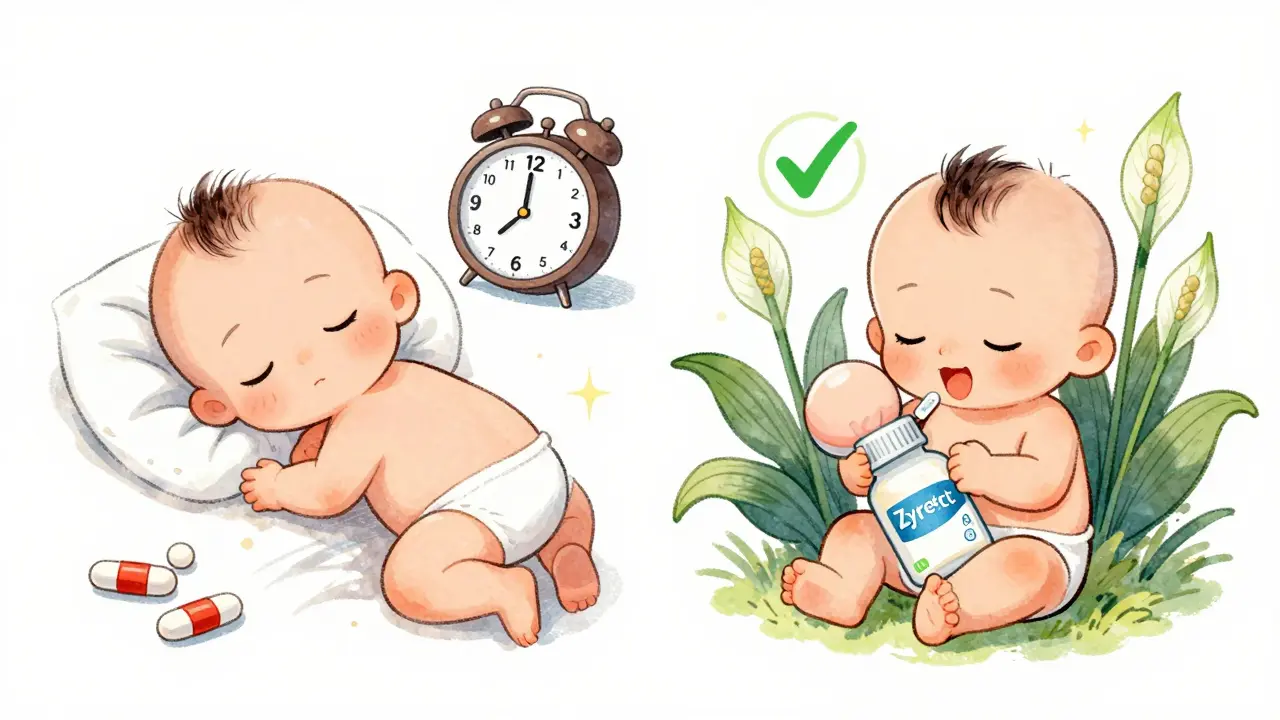
Timing and Dosing: How to Minimize Risk Even If You Must Use a Riskier Med
Sometimes, you need to take something that’s not ideal. Maybe your doctor insists on a short course of a first-gen antihistamine. Or maybe you’ve already taken it and are now worried. Here’s what to do. Take the medication right after you nurse. That gives your body time to break down the drug before the next feeding. For drugs like diphenhydramine, which has a half-life of 4-6 hours, waiting 3-4 hours before nursing again cuts infant exposure by half. The InfantRisk Center recommends this timing strategy for all sedating meds. Use the lowest dose possible. One pill is enough. Don’t double up because you’re still feeling bad. And don’t take it daily unless absolutely necessary. Repeated exposure increases the chance of buildup in your baby’s system. Don’t pump and dump unless you’re taking something truly dangerous, like codeine. Pumping doesn’t speed up clearance - it just wastes milk and can hurt your supply. The exception? If you accidentally took codeine, pump and discard for 24 hours, then resume breastfeeding after that window.What to Watch For in Your Baby
Even with the safest meds, keep an eye out for signs of sedation:- Excessive sleepiness - your baby sleeps longer than usual and won’t wake for feeds
- Difficulty waking up - you have to shake or rub their feet to get them to nurse
- Shallow or irregular breathing
- Decreased feeding frequency or poor latch
- Unusual fussiness or limpness

What Experts Agree On
Dr. Thomas Hale, author of the go-to reference Medications and Mothers’ Milk, says codeine’s risks far outweigh any benefit for breastfeeding mothers. The American Academy of Pediatrics says first-gen antihistamines should be avoided when possible. Dr. Ruth Lawrence, a leading breastfeeding expert, reminds us that infants under 2 months are at highest risk - not because the drugs are stronger, but because their bodies can’t handle them. The data is clear: second-gen antihistamines and dextromethorphan are safe. Nasal steroids are better than oral decongestants. Codeine is not worth the risk. And timing matters - even with safer meds, giving your baby time between exposure and feeding makes a real difference.What’s Changed Since 2020
The landscape has shifted. In 2018, only 9 cough and allergy meds had sedation warnings in the LactMed database. Today, there are 17. The FDA now requires black box warnings on codeine products. Over-the-counter brands have responded: 68% of allergy meds now offer non-drowsy versions, up from 42% in 2015. New tools like the LactaMap app give real-time, personalized safety ratings based on your baby’s age and your medication. The message is no longer vague. It’s specific: avoid sedating meds. Choose safer alternatives. Time your doses. Watch your baby. You don’t have to suffer - but you do have to be smart.Is it safe to take Benadryl while breastfeeding?
Benadryl (diphenhydramine) can make your baby drowsy, especially if they’re under 2 months old. While not every baby reacts, studies show about 1.6% of infants become noticeably sleepy after exposure through breast milk. It’s not recommended as a first choice. Safer alternatives like Zyrtec or Claritin exist and don’t cause sedation. If you must use Benadryl, take it right after nursing and wait at least 3-4 hours before the next feed.
Can codeine cause death in breastfed babies?
Yes. At least 10 infant deaths have been linked to codeine use by breastfeeding mothers. The risk comes from ultra-rapid metabolizers - people whose bodies turn codeine into morphine too quickly. This can lead to dangerously high morphine levels in breast milk, causing respiratory depression in babies. The FDA issued a black box warning in 2017, and organizations like the Breastfeeding Network now advise against any codeine use during lactation.
What cough medicine is safe while breastfeeding?
Dextromethorphan is the safest cough suppressant for breastfeeding mothers. It transfers into breast milk at only 0.1% of your dose and has no known sedation risks in infants. Avoid cough syrups that contain codeine, hydrocodone, or first-gen antihistamines. Always check the label - many combo products include hidden sedating ingredients.
Do allergy pills reduce milk supply?
Most antihistamines don’t reduce milk supply - but pseudoephedrine (found in Sudafed) does. It can cut your milk production by up to 24% within 24 hours. First-gen antihistamines like Benadryl may have a mild effect in some women, but it’s not consistent. Second-gen antihistamines like Zyrtec and Claritin do not affect supply. For congestion, use nasal steroids like Flonase instead - they’re effective and don’t touch your milk production.
Should I pump and dump after taking allergy medicine?
For most medications, no. Pumping and dumping doesn’t remove the drug faster - your body clears it naturally over time. It can also hurt your supply. Only consider it if you’ve taken a high-risk drug like codeine. In that case, pump and discard for 24 hours, then resume. For safer meds like loratadine or cetirizine, there’s no need to pump and dump at all.
Roshan Aryal
January 3, 2026 AT 18:34This entire post is a classic example of overmedicalized parenting paranoia. Babies have been exposed to maternal meds for centuries without catastrophic outcomes. The FDA's black box warning on codeine was based on a handful of cases in genetically rare individuals - not a population-wide crisis. We're turning breastfeeding into a high-stakes pharmacology exam when we should be trusting biology and common sense. If your baby dies from Benadryl, you probably weren't paying attention anyway.
Jack Wernet
January 4, 2026 AT 01:09Thank you for this meticulously researched and compassionate guide. As a pediatrician in rural Ohio, I've seen too many new mothers agonize over whether to take a single antihistamine. The distinction between first- and second-generation antihistamines is critical, and your emphasis on timing and dosing is clinically sound. This is exactly the kind of evidence-based clarity that empowers, rather than frightens, parents.
bob bob
January 5, 2026 AT 17:08Just wanted to say I used Zyrtec daily for 5 months while nursing my daughter and she never even blinked. I also took dextromethorphan for a nasty cough last winter and she slept like a angel. Honestly, the fear-mongering around meds in breastfeeding is wild. We're not poisoners. We're just trying to get through a cold without crying in the shower. Thank you for the clear info.
Abhishek Mondal
January 7, 2026 AT 05:29Oluwapelumi Yakubu
January 7, 2026 AT 15:17My friend in Lagos gave her newborn paracetamol and codeine combo for fever - baby slept like a king for three days. No hospital, no panic. Africa doesn't have the luxury of L1 ratings and LactaMap apps. We use what works. The real issue isn't the meds - it's the Western obsession with controlling nature like it's a lab experiment. Babies are tougher than we think. And mothers? They're smarter than the algorithm lets on.
Jennifer Glass
January 8, 2026 AT 16:13I appreciate how this breaks down the science without fearmongering. I was terrified to take anything after my son was born, but after reading this, I switched to loratadine and felt like I could breathe again - literally and emotionally. The timing advice was a game-changer. I started taking it right after his 2 a.m. feed and didn't even think about it after that. It's not about avoiding meds - it's about using them wisely.
Joseph Snow
January 8, 2026 AT 16:32Let’s be honest - this is corporate-driven fear. Who benefits from convincing mothers that their own bodies are dangerous? Pharma companies selling non-drowsy Zyrtec at 10x the price of Benadryl. The FDA's black box warning was pushed by litigation, not data. And why are nasal steroids 'safe'? Because they’re patented. Meanwhile, diphenhydramine - a century-old, generic drug - is vilified. This isn't medicine. It's market control disguised as safety.
Akshaya Gandra _ Student - EastCaryMS
January 10, 2026 AT 09:39en Max
January 12, 2026 AT 08:59It is imperative to underscore, with clinical precision, that the pharmacokinetic profile of first-generation antihistamines - particularly their high milk-to-plasma ratio, prolonged half-life, and CNS depressant activity - constitutes a Class I risk in neonates under 60 days of age. The data from LactMed, AAP, and Hale’s reference text converge on a single, evidence-based conclusion: non-sedating alternatives are not merely preferable - they are the standard of care. Failure to adhere to this paradigm constitutes a deviation from established maternal-fetal pharmacological ethics. Furthermore, the assertion that 'pumping and dumping' is ineffective is not only accurate - it is physiologically incontrovertible. The hepatic clearance of xenobiotics is governed by enzymatic metabolism, not mechanical expression. Therefore, the strategic timing of dosing - aligned with the infant’s feeding schedule - remains the sole viable risk-mitigation protocol in the absence of absolute contraindications.