
Imagine being told you can’t take penicillin because of an allergy. For decades, that label might have followed you around, limiting your antibiotic options and forcing doctors to prescribe stronger, broader-spectrum drugs. But what if that allergy was never real? What if it was just a mild side effect from childhood, or a misdiagnosis based on a rash that wasn't allergic at all? This is where drug allergy skin testing comes in. It is not just a medical curiosity; it is the gold standard for figuring out exactly which medications trigger your immune system and which ones are safe.
For many patients, the idea of having a drug injected into their skin sounds scary. Will I go into shock? Will it hurt? The reality is far less dramatic and much more empowering. When performed correctly by trained specialists, these tests are safe, quick, and incredibly accurate. They allow you to shed unnecessary allergy labels, opening the door to safer, cheaper, and more effective treatments.
Why Do You Need Drug Allergy Skin Testing?
The primary goal of this testing is simple: safety and clarity. When you report an adverse reaction to a medication, doctors need to know if it was a true IgE-mediated allergy (the kind that causes hives, swelling, or breathing trouble) or something else entirely. Skin testing helps distinguish between these scenarios.
According to data from the Centers for Disease Control and Prevention (CDC), about 10% of people in the U.S. report being allergic to penicillin. However, when those same people undergo proper evaluation, roughly 90% of them can actually tolerate the drug. That means millions of people are avoiding first-line antibiotics unnecessarily. This leads to the use of broader-spectrum antibiotics, which are often more expensive, have more side effects, and contribute to antibiotic resistance. By getting tested, you help protect your own health and public health.
Is drug allergy skin testing painful?
Most patients describe the prick test as feeling like tiny mosquito bites. The intradermal test involves a small needle injection, which may cause a brief stinging sensation lasting a few minutes. Overall, discomfort is minimal compared to the benefit of knowing your true allergies.
The Three Main Types of Skin Tests
Not all skin tests are created equal. Depending on the type of reaction you had previously, your allergist will choose one or more methods. Here is how they work:
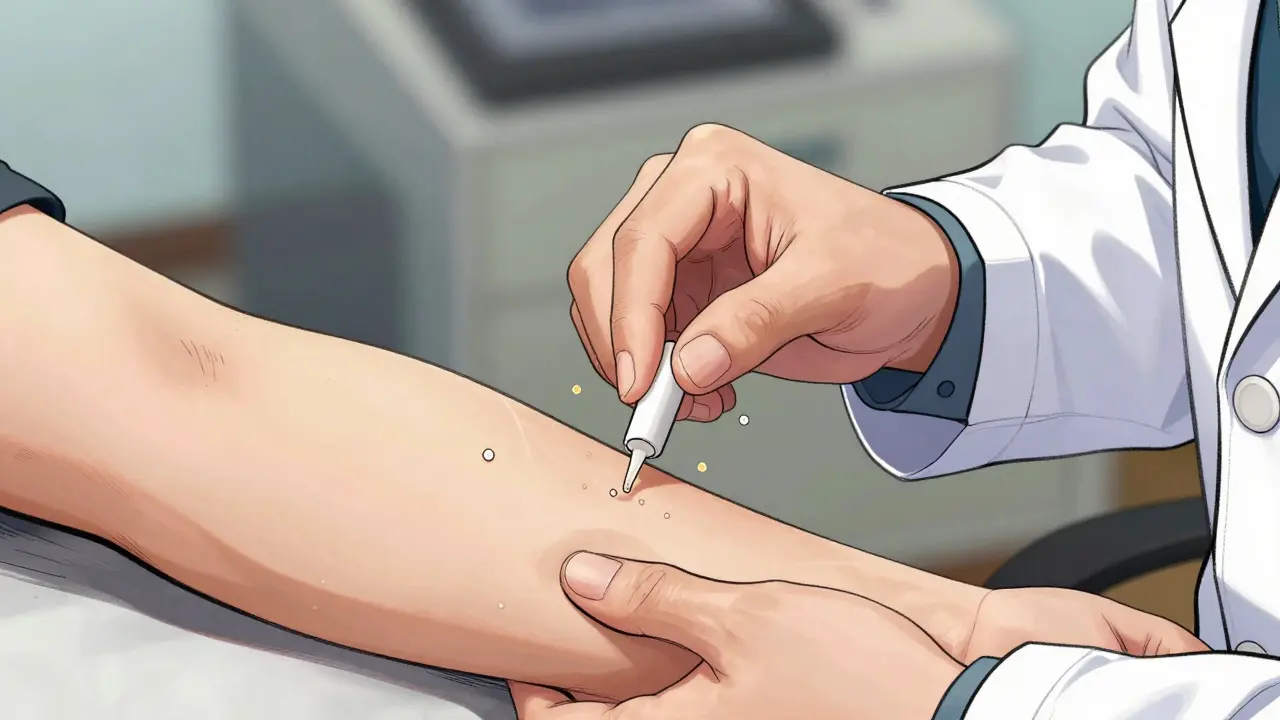
- Skin Prick Test (SPT): A drop of the suspected drug allergen is placed on your forearm or back. The doctor then uses a lancet to lightly prick the skin, allowing the substance to enter the top layer. This is the safest and easiest method, usually showing results within 15 to 20 minutes.
- Intradermal Test (IDT): If the prick test is negative but suspicion remains, a tiny amount of the drug (0.02-0.05 ml) is injected just under the skin surface. This creates a small bump or 'bleb.' It is more sensitive than the prick test but carries a slightly higher risk of reaction, so it is done with caution.
- Patch Test: Used for delayed reactions (those that appear hours or days after taking a drug). Patches containing the drug are stuck to your back for 48 to 96 hours. This is common for diagnosing reactions to topical medications or certain antibiotics that cause rashes later on.
Each method targets different parts of the immune response. The prick and intradermal tests look for immediate hypersensitivity (Type I reactions), while patch tests identify delayed cellular responses (Type IV reactions).
Preparing for Your Test: What You Must Know
Preparation is critical. If you skip this step, your test results could be inaccurate, leading to false negatives. Here is what you need to do before your appointment:
- Stop Antihistamines: Most antihistamines (like loratadine, cetirizine, or diphenhydramine) block the very reaction the test is trying to measure. You typically need to stop these medications 5 to 7 days before testing. Always check with your doctor about how long to stop specific drugs, including nasal sprays or eye drops.
- Avoid Topical Steroids: Do not apply steroid creams to the area where the test will be done (usually the forearm or back) for at least a week prior.
- Wear Loose Clothing: Since the test sites are often on your arms or back, wear a loose-fitting shirt that is easy to roll up or remove.
- Bring Your Medication List: Bring the actual pill bottle or a detailed list of all medications and supplements you take. This helps the specialist prepare the correct reagents.
One patient on Reddit shared a frustrating experience: "No one told me I couldn't take antihistamines for 72 hours prior-I had to reschedule my test." Don't let that happen to you. Ask your clinic for specific prep instructions when you book.
What Happens During the Procedure?
The procedure itself is straightforward and takes about 45 to 60 minutes. Here is a step-by-step breakdown of what to expect:
- Marking the Sites: The clinician will mark spots on your skin at least 2.5 cm apart using a permanent marker. This ensures each drug is tested in a separate zone.
- Applying Controls: Two control substances are always used. A positive control (histamine) should cause a small itchy bump, proving your skin reacts normally. A negative control (saline) should show no reaction, ensuring the skin isn't overly sensitive to physical pressure.
- Prick Testing: The allergen drops are applied, and the skin is pricked. You wait 15-20 minutes.
- Intradermal Testing (if needed): If the prick test is negative, the doctor may inject diluted amounts of the drug under the skin. Another 20-minute wait follows.
- Reading Results: The clinician measures the size of any wheals (raised bumps). A positive result is typically defined as a wheal that increases in diameter by 3 mm or more compared to the negative control.
Throughout the process, you are monitored closely. The clinic is equipped to handle any rare systemic reactions, though these are extremely uncommon during controlled testing.
| Feature | Skin Prick Test (SPT) | Intradermal Test (IDT) | Patch Test |
|---|---|---|---|
| Best For | Immediate reactions (hives, anaphylaxis) | Immediate reactions if SPT is negative | Delayed reactions (rashes, contact dermatitis) |
| Sensitivity | d>Moderate to High | High | Variable (depends on drug) |
| Specificity | High | Moderate (more false positives) | High for delayed reactions |
| Time to Result | 15-20 minutes | 20 minutes | 48-96 hours |
| Comfort Level | Very comfortable (tiny prick) | Mild sting (injection) | Inconvenient (must keep dry/still) |
Understanding Your Results: Positive vs. Negative
Interpreting skin test results requires expertise. A positive result suggests you are likely allergic to that drug. However, a negative result is not always a clear "you're fine."
For beta-lactam antibiotics like penicillin, a negative skin test has a high negative predictive value (85-90%). This means if both the prick and intradermal tests are negative, there is a very low chance you are truly allergic. In such cases, doctors may proceed with a supervised oral challenge-giving you a small dose of the drug to confirm safety.
However, for other drugs like cephalosporins, vancomycin, or NSAIDs, skin tests are less reliable. Sensitivity can be as low as 30-50%. A negative test here doesn't completely rule out allergy. In these cases, the clinical history becomes even more important, and challenges may be approached with greater caution.
Remember: a positive test does not automatically mean you must avoid the drug forever. Sometimes, desensitization protocols can be used if the drug is essential for your treatment (e.g., for cancer chemotherapy or severe infections).
Who Should Avoid Skin Testing?
While generally safe, skin testing is not appropriate for everyone. You should postpone or avoid testing if:
- You are currently experiencing an active allergic reaction to the drug.
- You have severe, uncontrolled asthma.
- You have widespread skin conditions (like eczema or psoriasis) that cover the testing areas.
- You are pregnant (though this is sometimes considered on a case-by-case basis).
- You cannot stop taking antihistamines due to other medical conditions.
In these situations, your allergist may rely more heavily on blood tests (specific IgE assays) or detailed clinical history instead.
Real-Life Impact: Why De-labeling Matters
Getting tested isn't just about academic curiosity. It has tangible benefits. Hospitals with formal allergy testing programs have seen a 22% reduction in Clostridioides difficile (C. diff) infections. Why? Because when patients aren't falsely labeled as allergic to penicillin, they get narrower-spectrum antibiotics. Narrower antibiotics preserve your gut microbiome better, reducing the risk of C. diff.
Additionally, removing false allergy labels saves money. Broad-spectrum alternatives are often significantly more expensive. For a family managing chronic conditions, this can add up over time.
How long do drug allergy skin test results last?
Skin test results reflect your current immune status. If you remain sensitized, the test will likely stay positive. However, allergies can wane over time. If years pass without exposure, re-testing may be recommended before assuming continued safety.
Can I drive myself home after the test?
Yes, in most cases. Since the risk of severe systemic reaction is very low, driving is usually permitted. However, if you feel dizzy or unwell during the observation period, inform the staff immediately. They may advise you to rest longer or arrange transport.
What if I have a positive result?
A positive result confirms an allergy. Your doctor will update your medical records to reflect this avoidance. They may also discuss alternative medications or, if necessary, desensitization protocols for future treatments.
Are there standardized kits for all drugs?
Standardized commercial kits exist primarily for penicillin and some other beta-lactams. For many other drugs, allergists must prepare custom dilutions from the original medication, requiring specialized training and adherence to strict safety guidelines.
Does insurance cover drug allergy skin testing?
Coverage varies by insurer and region. Many plans cover it if deemed medically necessary, especially if it impacts antibiotic stewardship or treatment options. Check with your provider beforehand to understand potential out-of-pocket costs.
Next Steps After Your Test
If your test is negative, ask your doctor about a supervised oral challenge to fully de-label you. Get a copy of your results and ensure your primary care physician and pharmacists are updated. Carry a new allergy card if you still have confirmed allergies.
If your test is positive, work with your allergist to create an avoidance plan. Discuss emergency action plans if accidental exposure occurs. Remember, knowledge is power. Understanding your true allergy profile allows you to navigate healthcare with confidence and safety.