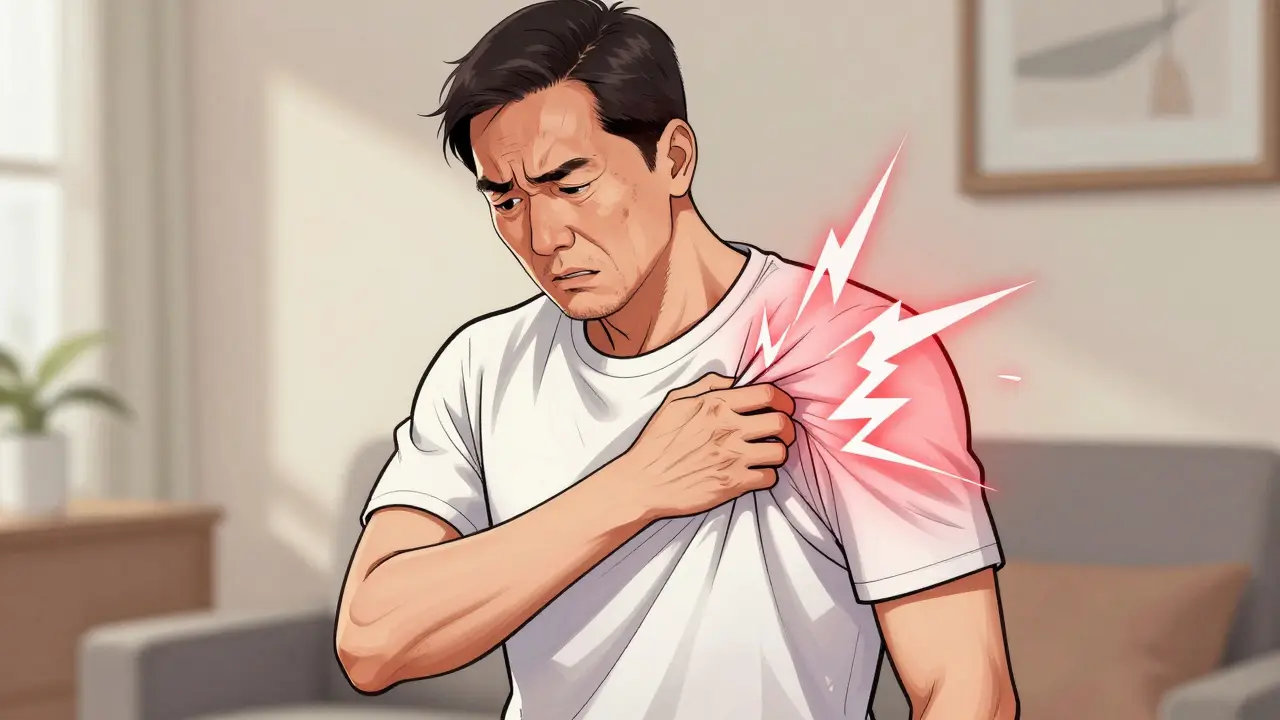
Imagine waking up one morning and realizing you can't reach your seatbelt or pull your shirt over your head without a sharp, stabbing pain. For many, this is the sudden reality of frozen shoulder is a musculoskeletal condition where the connective tissue surrounding the shoulder joint becomes thick and tight, severely restricting movement. Known medically as Adhesive Capsulitis, it isn't actually caused by "glue-like" adhesions, but rather by a contraction of the joint capsule. While it can feel like your arm is permanently locked, this condition is self-limiting, meaning it will eventually get better-though without the right strategies, that process can take years.
The Quick Summary: What You Need to Know
- The Pattern: You'll lose external rotation (turning your arm outward) first and most severely.
- The Timeline: Recovery naturally takes 1-3 years, but targeted mobilization can cut that down to 6-12 months.
- The Risk: Pushing too hard too early during the "freezing" phase can actually increase inflammation and pain.
- The Key: Consistency with gentle, pain-tolerant stretching is more effective than occasional aggressive sessions.
Why Does This Happen? The Science of the "Freeze"
Your shoulder is a ball-and-socket joint. To keep things stable, the joint is wrapped in a capsule. In adhesive capsulitis, this capsule becomes inflamed and thickens. Research shows the joint capsule volume can shrink by about 45%, dropping from a normal 30-35 mL down to just 10-15 mL. This shrinkage is why you feel that "hard stop" when trying to move your arm.
Certain people are more prone to this. While it affects about 2-5% of the general population, if you have Diabetes Mellitus, your risk jumps to between 10-20%. The inflammation typically starts in the coracohumeral ligament and the axillary recess, creating a cycle of pain and stiffness that makes you move your arm less, which in turn makes the joint even stiffer.
The Three Stages of Frozen Shoulder
Understanding where you are in the timeline is the difference between a successful recovery and a painful setback. You can't treat the "freezing" stage the same way you treat the "thawing" stage.
- The Freezing Stage (6 weeks to 9 months): This is the inflammatory phase. Pain is the dominant symptom, especially at night. You'll notice a gradual loss of motion. The goal here is pain management and very gentle movement to prevent further locking.
- The Frozen Stage (4 to 6 months): The sharp pain often settles down, but the stiffness is at its peak. Your shoulder feels like it's hit a wall. This is when more assertive mobilization strategies begin to work.
- The Thawing Stage (6 months to 2 years): The capsule begins to relax. Range of motion slowly returns. This is the time to push for full functional recovery through consistent physical therapy.
Mobilization Strategies: How to Get Your Movement Back
The goal of mobilization is to stretch the contracted capsule without triggering more inflammation. If you force a joint that is currently in an acute inflammatory state, you might actually make the condition last longer.
Low-Impact Early Interventions
During the freezing phase, avoid "no pain, no gain" mentalities. Instead, focus on these low-stress moves:
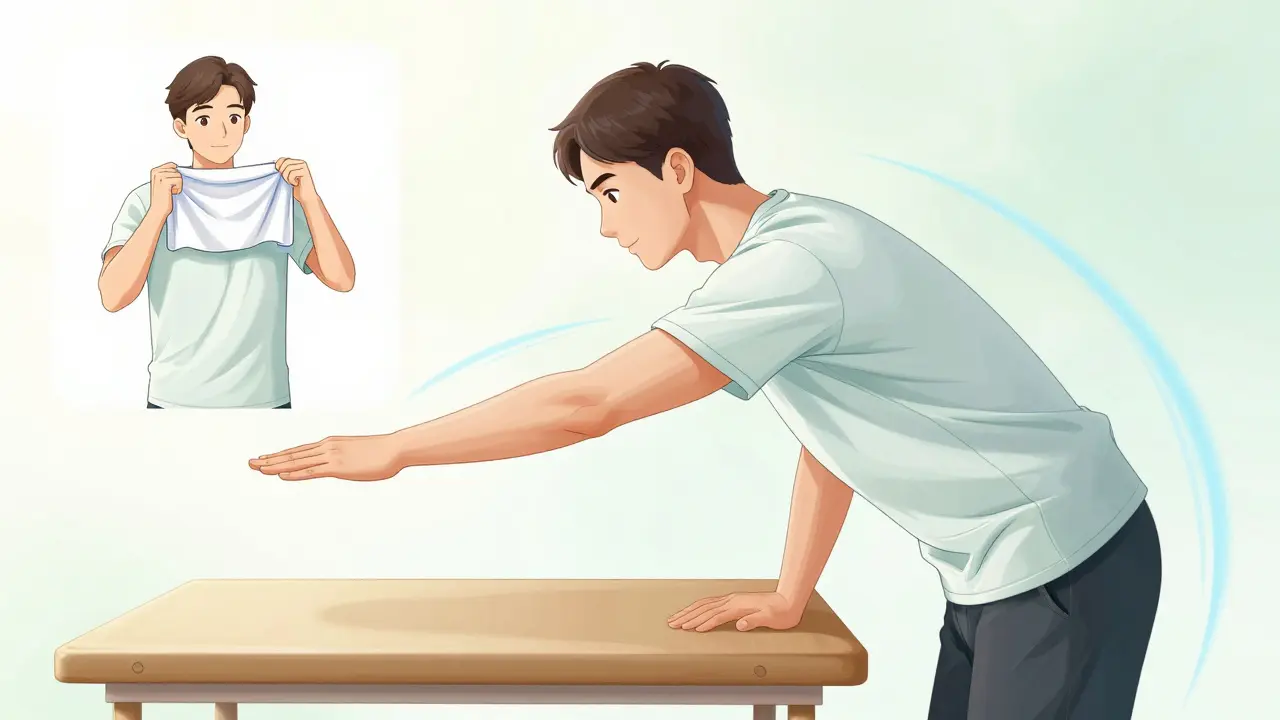
- Pendulum Exercises: Lean over a table, let your arm hang completely limp, and gently swing it in small circles. This uses gravity to create a tiny bit of space in the joint without using the muscles.
- Towel Stretches: Holding a towel behind your back, use your good arm to gently pull the affected arm upward, encouraging internal rotation.
- Wand Exercises: Using a broomstick or PVC pipe, use the stronger arm to push the affected arm into a comfortable stretch.
Advanced Mobilization for the Frozen/Thawing Phase
Once the acute pain has subsided, you can move toward more structural stretches. A doorway stretch-where you place your arm on a frame and lean forward-is excellent for opening the chest and improving external rotation. The key is to apply heat to the shoulder for 10-15 minutes before these exercises to make the tissue more pliable.
| Feature | Frozen Shoulder | Rotator Cuff Tear | Osteoarthritis |
|---|---|---|---|
| Passive Motion | Severely Limited | Mostly Preserved | Gradually Limited |
| Primary Symptom | Stiffness & Pain | Weakness & Pain | Grinding & Stiffness |
| Rotation Loss | External Rotation First | Varies by Tear | Global Loss |
| Onset | Insidious/Slow | Acute or Wear-and-Tear | Very Slow/Chronic |
Avoiding the Common Pitfalls
Many people make the mistake of trying to "break" the frozen shoulder through aggressive stretching too early. There are documented cases where forcing a cross-body stretch during the freezing phase caused pain levels to spike from a manageable 4/10 to a debilitating 8/10 for several weeks. This happens because you're stretching an inflamed tissue, which leads to more scarring (fibrosis).
Another common error is relying solely on home exercises without professional guidance. Evidence suggests that supervised physical therapy leads to a 28% faster recovery rate than doing it alone. A therapist can identify the "capsular pattern"-the specific order in which you lose motion-and tailor the stretches to target the most restricted areas first.
Medical Interventions and Their Trade-offs
When stretching and heat aren't enough, medical options come into play. However, they aren't one-size-fits-all. Corticosteroid injections are a common go-to for short-term pain relief, typically lasting 4 to 8 weeks. While they help you get through the night and allow you to start physical therapy, some clinical guidelines suggest they don't provide a significant long-term improvement in function at the 12-week mark.
For those who fail six months of conservative management, Manipulation Under Anesthesia is an option. This is where a doctor manually moves the shoulder while you're asleep to break the stiffness. It's effective but carries risks, such as potential fractures or soft tissue damage if done prematurely. It should be the last resort, not the first step.

Living With a Frozen Shoulder: Daily Tips
Since about 78% of patients struggle with night pain, your sleep setup is crucial. Instead of lying directly on the affected shoulder, try propping the arm up with a pillow or using a recliner. This prevents the shoulder from dropping backward, which pulls on the tight capsule and wakes you up in pain.
If you're managing this at home, keep a simple kit: a towel, a PVC pipe or wooden dowel, and a heating pad. The goal isn't to hit a specific degree of motion in one day, but to gain a few millimeters of movement every week. Tracking your progress-such as how far you can reach up your back-can provide the mental boost needed to stay consistent over the long recovery period.
How long does frozen shoulder actually take to heal?
Naturally, it often takes 1 to 3 years to resolve on its own. However, with a combination of supervised physical therapy and consistent mobilization, many people see significant improvement and functional recovery within 6 to 12 months.
Can I just push through the pain to stretch it out faster?
No. Pushing through severe pain, especially during the "freezing" phase, can increase inflammation and lead to more fibrosis (scarring). You should stretch within your pain tolerance; a gentle pull is good, but sharp pain is a signal to stop.
Why is external rotation the first thing I lose?
This is known as the "capsular pattern." The inflammation typically hits the anterior-superior part of the joint capsule and the coracohumeral ligament first, which directly restricts the arm's ability to rotate outward.
Are there any "red flags" that mean it's not a frozen shoulder?
Yes. If your shoulder pain is accompanied by fever, night sweats, or unexplained weight loss, it could indicate a neoplastic or autoimmune condition. You should see a doctor immediately if these symptoms appear.
Do I need surgery for adhesive capsulitis?
Most people (around 87%) recover through conservative management like physical therapy and mobilization. Surgery or manipulation under anesthesia is typically reserved for the 13% of persistent cases that don't respond to therapy after six months.
Next Steps for Recovery
If you suspect you have a frozen shoulder, your first move should be a professional diagnosis to rule out rotator cuff tears or arthritis. Once confirmed, spend the first 2-4 weeks in supervised physical therapy to learn the correct form for your stretches. From there, transition to a daily home routine involving heat, gentle pendulum swings, and gradual stretching. If you notice your pain is increasing after exercise, dial back the intensity and focus on pain management before trying again.
Nikki Grote
April 19, 2026 AT 11:10The emphasis on the coracohumeral ligament is spot on. From a clinical perspective, managing the inflammatory cascade during the initial phase is paramount to prevent excessive fibrosis of the joint capsule. I've seen so many patients trigger a flare-up by attempting aggressive passive range of motion too early, which just exacerbates the synovitis. Using a multimodal approach with heat and gentle oscillations is definitely the way to go for optimal glenohumeral joint restoration.
Anmol Garg
April 19, 2026 AT 14:33Dealing with this is such a mental battle as much as a physical one. It's like your body is suddenly keeping a secret from you, locking away a part of yourself. Just take it slow and be kind to your mind while your shoulder finds its way back to freedom.
ira fitriani
April 20, 2026 AT 22:44Omg the part about not being able to reach the seatbelt is literally my life right now!! 😫 It's so incredibly frustrating but I'm staying positive and doing my pendulums every single day! We got this everyone! 💪✨
Tama Weinman
April 21, 2026 AT 14:12Sure, follow the "official" guidelines and wait years for a natural thaw. Meanwhile, the pharmaceutical companies are just waiting for you to fail conservative management so they can push those steroid shots that barely work. It's all a cycle designed to keep you dependent on the system while your joint basically shrinks into nothing.
Autumn Bridwell
April 23, 2026 AT 03:57I actually tried a doorway stretch yesterday without heat and I think I felt something pop! Now my arm is throbbing and I can't even put on my bra without screaming! This is an absolute nightmare and I feel like I'm trapped in my own skin!
Nikki Grote
April 24, 2026 AT 22:07That sounds like an acute inflammatory response to excessive mechanical stress. You really need to pivot back to grade I or II joint mobilizations and maybe some cryotherapy to settle the inflammation before you try any more capsular stretching.
Dana Chichirita Nicoleta
April 26, 2026 AT 08:33Oh my goodness, it is simply heartbreaking to read about the struggle of losing such basic mobility, but I am absolutely convinced that with a shimmering amount of patience and a dedicated adherence to these wonderful guidelines, every single one of us can reclaim the full use of our arms and return to our favorite activities with a joyful heart!
Kim Hyunsoo
April 26, 2026 AT 15:10the way it's described as a "hard stop" is such a vivid way to put it... makes me wonder if other joints do this too in a less dramatic way (。-_-。)
Cheryl C
April 27, 2026 AT 00:28usa healthcare is so mid’ lol just go to a real PT and get it fixed fast 🇺🇸🇺🇸🇺🇸
Richard Moore
April 28, 2026 AT 12:08Actually disagree on the steroid point. For some of us, that window of pain relief is the only thing that makes PT possible 🙄🔥. If you can't move because of the pain, you can't stretch, period.
Rob Schlautman
April 29, 2026 AT 08:30i mean really the whole concept of a three year recovery is just absurd and honestly whoever thinks a pvc pipe is a medical device is delusional but whatever i guess we just wait and hope the shoulder decides to unfreeze itself because the alternatives are just too much effort for most of us anyway
Nell O'Leary
April 29, 2026 AT 11:13I've found that incorporating proprioceptive neuromuscular facilitation (PNF) techniques during the thawing phase really accelerates the regain of external rotation (^_^)v
Nathan Berlin
May 1, 2026 AT 02:25Typical western medicine nonsense trying to complicate a simple joint issue with 50 page guides 🙄🇮🇳 we have better ways to handle this in the east anyway 💅