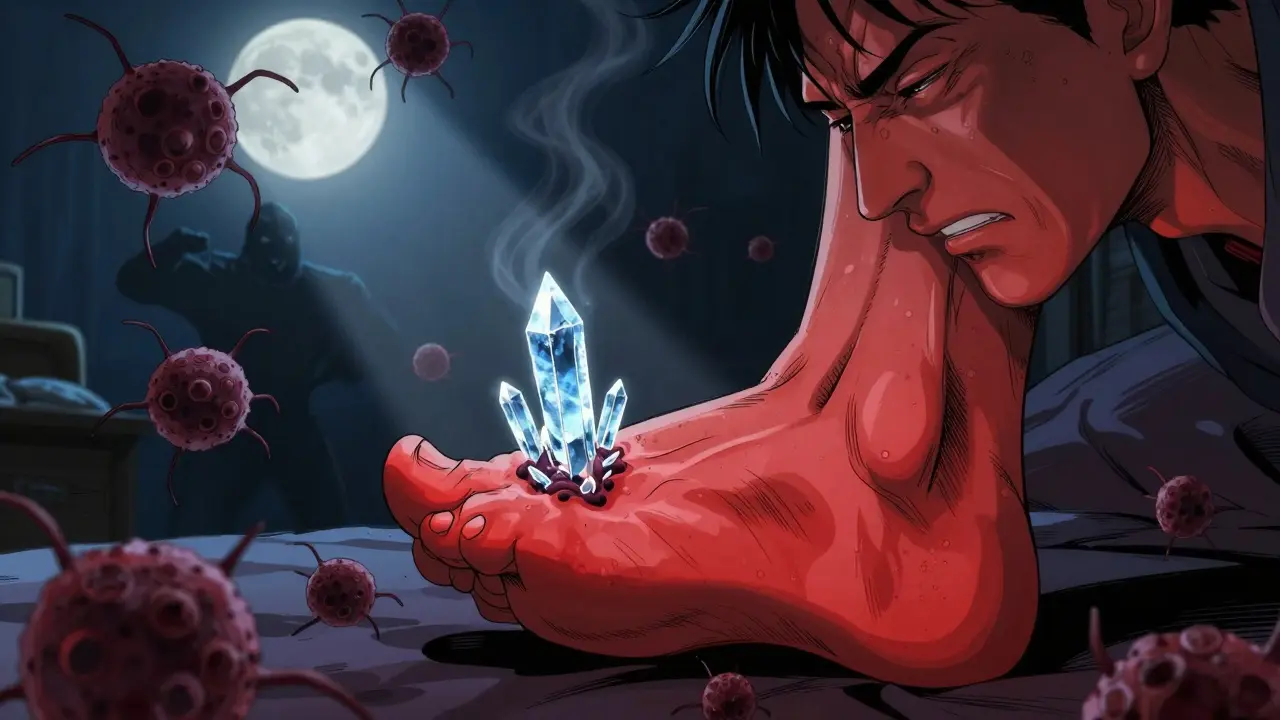
When your big toe suddenly swells up, turns red, and feels like it’s on fire-even the weight of a bedsheet feels unbearable-you’re not just having a bad night. You’re having a gout attack. This isn’t just "bad arthritis." It’s your body’s immune system going into overdrive because of tiny, sharp crystals forming inside your joint. And the root cause? Too much uric acid in your blood.
What Exactly Is Uric Acid Doing in Your Body?
Uric acid is a waste product your body makes when it breaks down purines-natural substances found in your cells and certain foods. Most people handle it just fine. Their kidneys filter it out, and it leaves through urine. But if your body makes too much or your kidneys can’t flush it out fast enough, uric acid builds up. At levels above 6.8 mg/dL, it starts turning into sharp, needle-like crystals called monosodium urate. These crystals don’t just sit there quietly. They trigger a massive inflammatory response.Think of it like throwing sand into a gear mechanism. Your immune system sees these crystals as invaders. Special cells called macrophages jump in and activate something called the NLRP3 inflammasome. This sets off a chain reaction that floods the joint with chemicals like interleukin-1β, causing swelling, heat, and pain so intense it wakes you up at 3 a.m.
What’s strange is that humans and great apes are among the only mammals that can get gout. Most animals have an enzyme called uricase that breaks down uric acid into something harmless. But we lost that gene during evolution. So, for us, high uric acid isn’t just a risk-it’s almost inevitable if we don’t manage it.
Why Do Gout Attacks Happen When They Do?
Gout doesn’t strike randomly. There’s a trigger. And it’s often something you didn’t think would matter.One of the biggest triggers? A sudden drop-or even a sudden rise-in uric acid levels. That’s right. Starting a medication like allopurinol to lower your uric acid can actually spark an attack in the first few months. Why? Because as crystals begin to dissolve, they release fragments that your immune system sees as new threats. That’s why doctors now insist on taking low-dose colchicine for at least six months when you start urate-lowering therapy. It’s not to treat the pain-it’s to stop your body from overreacting.
Other common triggers:
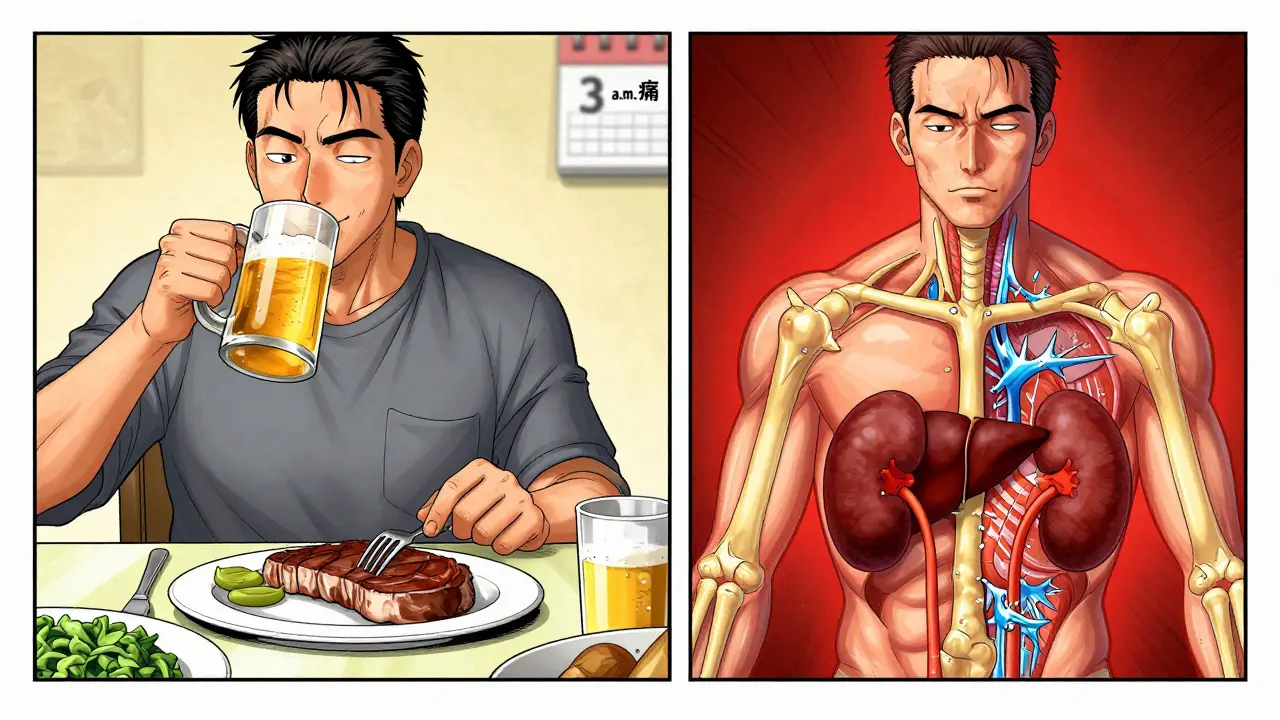
- Beer-not just because it’s alcohol, but because it’s loaded with purines. One 12-ounce serving increases your risk by nearly 50%.
- Red meat and organ meats-liver, kidneys, and sweetbreads have 300-500 mg of purines per 3-ounce serving. That’s a lot.
- Sugary drinks-especially those with high-fructose corn syrup. Fructose makes your body produce more uric acid. Just one soda a day can raise your risk by 20-30%.
- Dehydration-when you’re not drinking enough water, your kidneys can’t flush out uric acid. Aim for at least 2 liters a day.
- Joint injury-even a minor bump or twist can cause crystals to break loose from hidden deposits in the joint.
- Medications-thiazide diuretics (water pills), low-dose aspirin, and some cancer drugs can all raise uric acid levels.
Here’s the thing: you don’t have to eat a steak and drink three beers to trigger an attack. Sometimes, it’s just one thing-like skipping water all day, then going for a long walk. Your body doesn’t need a big insult. Just a small shift in uric acid balance is enough.
How Doctors Treat a Gout Attack
When the pain hits, you need fast relief. The goal isn’t to fix your uric acid levels right then-it’s to calm the inflammation.There are three main options, and your doctor will pick based on your health, other medications, and kidney function:
- NSAIDs-like indomethacin or naproxen. These are the first choice for most people. Indomethacin is often given at 50 mg three times a day for a few days. But if you have stomach ulcers, heart problems, or kidney issues, these aren’t safe.
- Colchicine-a drug that blocks the immune system’s response to crystals. The modern dose is much lower than in the past: 0.6 mg two or three times a day for a few days. Higher doses cause serious diarrhea. Don’t take more than prescribed.
- Corticosteroids-either as pills (like prednisone, 30-40 mg daily for 5 days) or injected directly into the joint. These are used when NSAIDs and colchicine aren’t options. They work fast and are very effective.
Important: Never stop your long-term gout medication during an attack. People often think, "I’m in pain, so allopurinol must be making it worse." That’s wrong. Stopping it makes future attacks more likely. Keep taking it. Just add a short-term anti-inflammatory on top.
Long-Term Strategy: Lowering Uric Acid for Life
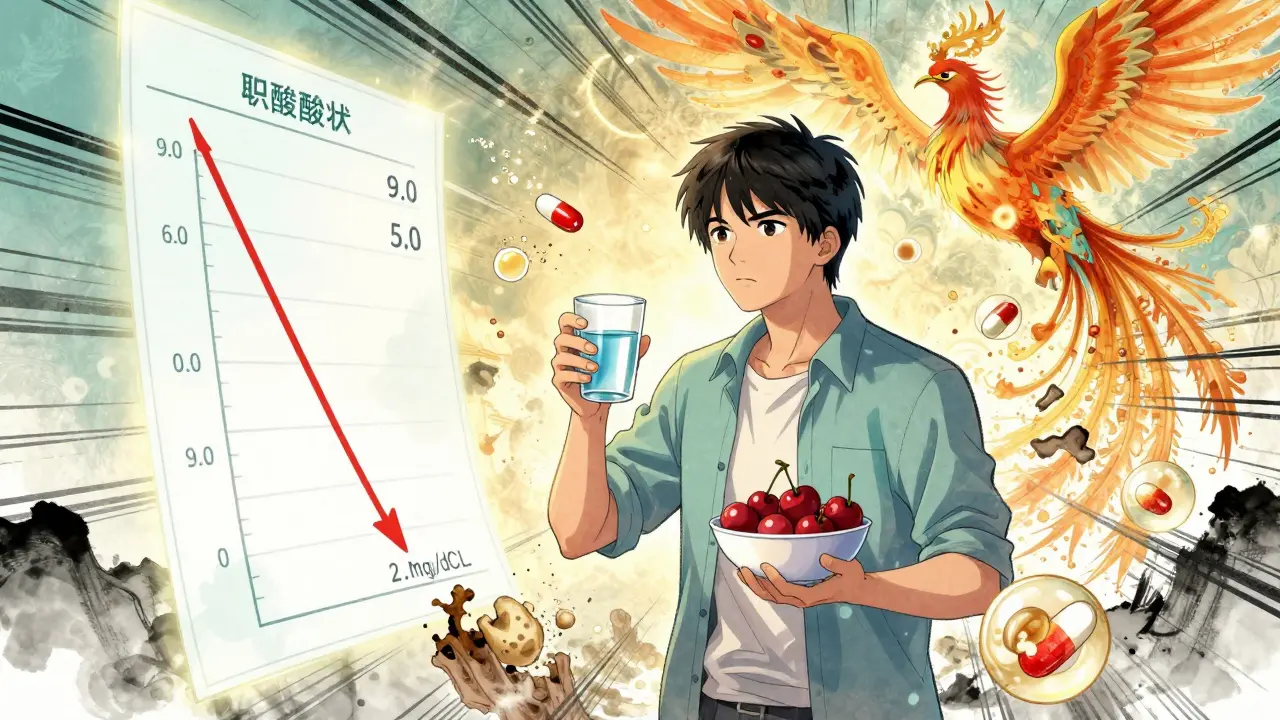
Treating attacks is like putting out fires. But if you want to stop gout from coming back, you need to stop the sparks.Doctors now aim to keep your serum uric acid below 6 mg/dL. For people with tophi (those visible lumps under the skin from crystal buildup), the target is even lower-5 mg/dL. Why? Because research shows that at 5 mg/dL, tophi shrink and disappear over time. At 6 mg/dL, they might just sit there.
The main drugs for this:
- Allopurinol-the first-line treatment. It blocks uric acid production. Start low-100 mg daily-and increase by 100 mg every few weeks until you hit your target. Most people need 300-600 mg daily. Some need up to 800 mg. Don’t stop if you don’t feel better right away. It takes months to clear crystals from joints.
- Febuxostat-used if allopurinol causes a rash or other side effects. It works similarly but is processed by the liver, so it’s safer for people with kidney problems.
- Probenecid-this helps your kidneys flush out more uric acid. But it only works if your kidneys are still functioning well (glomerular filtration rate above 50 mL/min). It’s not good for people with kidney stones.
Studies show that only 40-60% of people reach their target with allopurinol alone. That’s why many need higher doses or a combo approach. And if you miss even a few doses, your uric acid bounces back within two to four weeks. Consistency matters more than you think.
Diet and Lifestyle: What Actually Helps
You’ve heard the old advice: "Avoid shellfish and red meat." That’s true-but it’s not the whole story.Here’s what the data says works:
- Low-fat dairy-one or two servings a day (like milk, yogurt, or cottage cheese) cuts your gout risk by 43%. The proteins in dairy seem to help your kidneys excrete uric acid.
- Cherries-eating about 10-12 cherries a day has been linked to a 35% lower risk of attacks. Not because of vitamin C-it’s something else in the fruit that may reduce inflammation.
- Water-drink enough to make your urine light yellow. That’s about 2-3 liters a day. It helps your kidneys flush out uric acid.
- Limit alcohol-beer is the worst. Spirits are moderate. Wine? Not linked to gout in most studies. But if you’re prone to attacks, skip it all.
- Weight loss-losing 5-10% of your body weight can lower uric acid by 1-2 mg/dL. It’s not about being thin-it’s about reducing fat tissue, which produces more uric acid.
Don’t fall for fads like "alkaline diets" or lemon water. They don’t change your blood pH or uric acid levels. Stick to what science shows: dairy, water, cherries, and cutting out the worst offenders.
What No One Tells You About Gout
Most people think gout is just a "rich man’s disease" from too much steak and wine. That’s outdated. Today, it’s tied to obesity, high blood pressure, diabetes, and kidney disease. It’s a metabolic disorder, not a lifestyle flaw.And here’s the biggest myth: "I haven’t had an attack in a year, so I can stop my pills." No. If you stop allopurinol or febuxostat, your uric acid climbs back up. Within weeks, crystals start forming again. Attacks return. Tophi grow. And the damage to your joints gets worse.
Another surprise: gout isn’t just in your toes. It can hit your knees, wrists, fingers, and even your spine. And if left untreated, those crystals can erode bone and destroy cartilage. That’s why regular blood tests every 6 months are non-negotiable.
There’s also new hope on the horizon. Drugs that block the NLRP3 inflammasome-like dapansutrile-are in late-stage trials. They don’t lower uric acid. They stop the inflammation at its source. If approved, they could change how we treat attacks entirely.
When to See a Doctor
If you’ve had one gout attack, you’re at high risk for more. Don’t wait for the next one to get worse.See a rheumatologist if:
- You’ve had two or more attacks in a year
- You have visible lumps under your skin (tophi)
- Your joints are becoming stiff or deformed
- You’re on medication but still getting flares
- You have kidney stones or chronic kidney disease
Early, consistent management can stop gout from becoming disabling. It’s not about avoiding pain-it’s about protecting your joints for life.
Can gout be cured?
Gout can’t be "cured" in the traditional sense, but it can be fully controlled. With consistent urate-lowering therapy and lifestyle changes, most people stop having attacks entirely. Tophi shrink and disappear. Joint damage halts. The goal isn’t to eliminate uric acid-it’s to keep it low enough so crystals don’t form. That’s lifelong management, not a short-term fix.
Why does gout attack at night?
Nighttime attacks are common because your body temperature drops while you sleep, especially in your feet. Lower temperatures make uric acid less soluble, so crystals form more easily. Also, you’re more dehydrated after hours without water, and your kidneys are less active. These factors combine to create the perfect storm for a flare.
Is it safe to take ibuprofen for gout?
Yes, ibuprofen is a type of NSAID and can be effective for gout pain. But it’s not always the best choice. Indomethacin and naproxen have stronger evidence for gout specifically. Also, ibuprofen can be harder on the kidneys and stomach. Always check with your doctor before using NSAIDs long-term or if you have high blood pressure, heart disease, or kidney issues.
Does coffee affect gout?
Moderate coffee consumption (1-4 cups a day) is linked to lower uric acid levels and fewer gout attacks. It’s not the caffeine-it’s likely other compounds in coffee that help the kidneys excrete uric acid. Decaf coffee has similar benefits, so it’s not just about caffeine. But don’t rely on coffee alone. It’s a helper, not a treatment.
Can I drink alcohol if I have gout?
Beer is the worst-it’s high in purines and alcohol, both of which raise uric acid. Spirits increase risk too, but less than beer. Wine doesn’t seem to raise risk significantly in most studies. But if you’ve had multiple attacks, the safest choice is to avoid alcohol entirely. Even small amounts can trigger a flare in sensitive people.
How long does it take for allopurinol to work?
Allopurinol doesn’t relieve pain right away. It takes weeks to months to lower uric acid enough to dissolve crystals. Most people start seeing fewer attacks after 3-6 months. But you must take it daily, even when you feel fine. Stopping it-even for a few days-can cause uric acid to spike and trigger a flare.
What to Do Next
If you’ve had one gout attack, your next step isn’t to wait for the next one. It’s to get your uric acid tested. Ask your doctor for a serum uric acid blood test. If it’s above 6.8 mg/dL, you’re at high risk. Start talking about long-term management now.Don’t let fear stop you. Gout is one of the most treatable forms of arthritis-if you stick with it. The pain is awful, but the solution is clear: lower uric acid, protect your joints, and never stop the treatment. You don’t have to live with flares. You just have to be consistent.
Lynsey Tyson
December 19, 2025 AT 23:59I used to think gout was just from drinking too much beer, but this post changed my whole perspective. Turns out it’s more about my kidneys and metabolism than my weekend BBQs. I started drinking more water and swapping soda for sparkling water-no more 3 a.m. toe explosions. Small changes, huge difference.
Also, cherries. I eat them like candy now. Not because they’re trendy, but because they actually help. Who knew?
And yeah, I’m still on allopurinol. No skipping days. Ever.
Edington Renwick
December 20, 2025 AT 18:02People still don’t get it. Gout isn’t a disease-it’s a moral failing. You eat like a pig, drink like a sailor, and then act surprised when your toe turns into a firecracker. This isn’t science-it’s karma.
And don’t even get me started on those ‘cherry cure’ myths. If you’re not willing to give up beer and steak, you deserve the pain.
Also, why are we still using allopurinol? It’s been around since the 1960s. We need better drugs, not band-aids.
Allison Pannabekcer
December 21, 2025 AT 20:49So many people feel ashamed about gout, like it’s their fault for being ‘lazy’ or ‘unhealthy.’ But honestly? It’s a genetic trap. We lost the uricase gene. We’re the only mammals that can’t break down uric acid naturally. That’s biology, not choice.
And yeah, diet helps-but not because you’re ‘bad’ if you eat steak. It’s because your body struggles to handle it. You’re not broken. You’re just built differently.
Also, low-fat dairy? That’s the real MVP. I didn’t believe it until I tried it. Two cups of yogurt a day, and my flares dropped by 70%. No magic, just science.
And if you’re on allopurinol and having flares? Don’t panic. That’s normal. Colchicine is your friend. Talk to your doctor. You’re not failing. You’re adjusting.
Also, coffee. Yes, coffee helps. Decaf too. It’s not caffeine. It’s the other stuff. Science is wild.
And for the love of god, stop blaming your pain on ‘bad luck.’ It’s not luck. It’s uric acid levels. Check them. Track them. Treat them.
You’re not alone in this. We’re all just trying to keep our toes from exploding.
Sarah McQuillan
December 21, 2025 AT 20:53Wait wait wait-so you’re telling me the government and Big Pharma are hiding the real cause of gout? Because I’ve been reading forums and it’s not just uric acid. It’s glyphosate. It’s in the water, the bread, the beer. They’ve been poisoning us for decades and calling it ‘gout.’
And why do they want you on allopurinol forever? Because it’s profitable. Not because it’s healing you.
My cousin in Arizona stopped all meds and started drinking apple cider vinegar and lemon water. No attacks in 2 years. Coincidence? I think not.
Also, why is wine ‘safe’? That’s a lie. Wine is just the quiet killer. They don’t want you to know.
Check your tap water. Check your food labels. This isn’t medicine. It’s control.
Aboobakar Muhammedali
December 22, 2025 AT 02:33i read this whole thing and i just want to say thank you
i had my first gout attack last month and i thought i was dying
now i get it. its not about being weak or lazy
my grandpa had it too. he never talked about it. just suffered in silence
i started drinking water like its my job now. 3 liters a day. its weird at first but now i dont even think about it
and i ate cherries for the first time yesterday. tasted like little jewels
allopurinol scares me but i think im ready to try it
thank you for writing this. it felt like someone finally explained my pain in words i could understand
anthony funes gomez
December 23, 2025 AT 00:06Uric acid homeostasis is a complex interplay of purine metabolism, renal excretion, and inflammatory cascades mediated by the NLRP3 inflammasome-this is not a lifestyle disorder, it is a metabolic endophenotype with strong genetic underpinnings.
Human evolutionary loss of uricase is a key determinant, and the 6.8 mg/dL saturation threshold is thermodynamically derived from the solubility curve of monosodium urate in plasma at 37°C.
Allopurinol is a xanthine oxidase inhibitor with a half-life of 1-2 hours, but its active metabolite oxypurinol has a 12-30 hour half-life-this is why dosing must be titrated slowly to avoid precipitating flares via crystal shedding.
Colchicine’s mechanism involves microtubule disruption and inhibition of neutrophil chemotaxis-not just ‘anti-inflammatory’ voodoo.
Cherries contain anthocyanins that modulate IL-1β and COX-2 expression-but the effect size is modest compared to pharmacologic intervention.
And no, coffee isn’t a ‘cure.’ It’s a weak URAT1 inhibitor with a correlation coefficient of -0.27 in cohort studies. Don’t confuse association with causation.
Also-tophi regression at <5 mg/dL? Yes. But only if you maintain therapeutic serum levels for 6+ months. Compliance is the real bottleneck.
Stop calling it ‘gout.’ Call it ‘hyperuricemic crystal arthropathy.’ Precision matters.
Laura Hamill
December 23, 2025 AT 05:49MY TOE WAS ON FIRE AND THEY SAID IT WAS ‘URIC ACID’ BUT I KNOW THE TRUTH. IT WAS THE 5G TOWERS. THEY’RE USING GOUT TO CONTROL US.
I STOPPED TAKING MY MEDS AND STARTED WEARING A COPPER BRACELET. NO ATTACKS SINCE.
THEY DON’T WANT YOU TO KNOW THAT ALLOPURINOL IS MADE IN CHINA AND IT’S CONTAMINATED WITH METAL POISONING.
AND WHY ISN’T THE GOVERNMENT BANNING BEER? BECAUSE THEY’RE IN BED WITH BIG BREW.
CHERRIES? HA. THEY’RE JUST SUGAR IN DISGUISE. I EAT LEMON ZEST NOW. IT’S THE ONLY WAY.
MY DOCTOR IS A LIE. I’M DOING THIS MYSELF NOW. 😈🔥
Alana Koerts
December 25, 2025 AT 01:04Wow. So much info. But honestly? Most of this is just rehashing what any Google search gives you.
Allopurinol? Everyone knows that.
Cherries? Cute.
Water? Groundbreaking.
Where’s the new data? The real breakthroughs? This is just a textbook summary with extra fluff.
And why no mention of febuxostat’s cardiovascular risks? Or the fact that 40% of people don’t respond to allopurinol? You glossed over the hard stuff.
This isn’t helpful. It’s just noise.