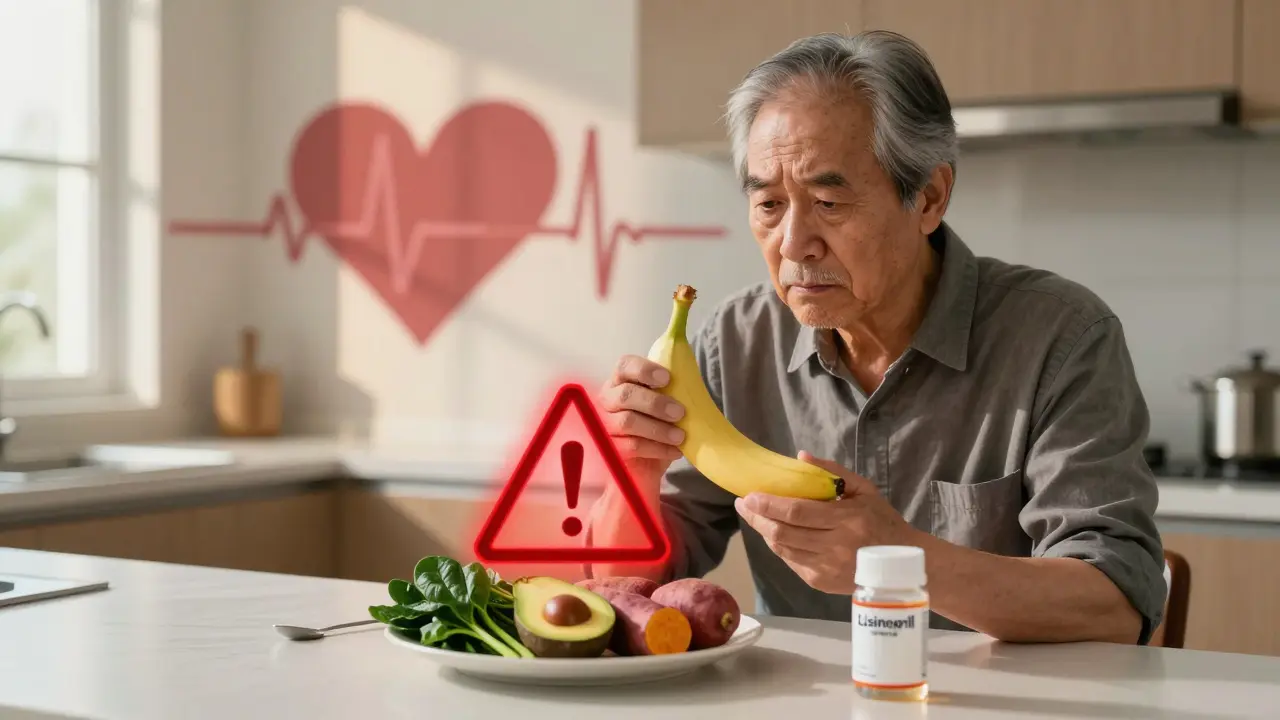
When you're managing high blood pressure, what you eat can be just as important as the pills you take. But here’s the catch: some of the healthiest foods on the planet - the ones your doctor probably told you to eat - can quietly clash with your blood pressure medication. This isn’t a myth. It’s a real, documented risk that affects thousands of people every year. And most of them have no idea.
Take potassium, for example. It’s not just a mineral. It’s a natural blood pressure lifeline. Studies show that getting enough potassium can lower your systolic blood pressure by over 5 mm Hg - that’s like adding a second medication without a prescription. The American Heart Association recommends 3,500 to 5,000 mg per day. Sounds simple, right? But if you’re on certain blood pressure drugs, that same potassium can push your levels too high. And when potassium goes above 5.0 mmol/L, you’re at risk for something called hyperkalemia. That’s when your heart rhythm gets shaky. Muscle weakness. Palpitations. In the worst cases, cardiac arrest.
Which Blood Pressure Medications Raise the Risk?
Not all blood pressure meds play nice with potassium. The real troublemakers are the ones that block your body’s natural way of getting rid of it. These include:
- ACE inhibitors - like lisinopril, enalapril, ramipril
- ARBs - like losartan, valsartan, irbesartan
- Potassium-sparing diuretics - like spironolactone and eplerenone
These drugs work by calming down your renin-angiotensin system - the same system that makes your blood vessels constrict. But here’s the side effect: they also reduce how much potassium your kidneys flush out. So if you’re eating a lot of potassium-rich foods on top of these meds, your body starts holding onto more than it should. According to the 2020 Hypertension journal meta-analysis, patients on ACE inhibitors or ARBs typically see their serum potassium rise by 0.3 to 0.5 mmol/L just from normal dietary intake. That might sound small, but in someone with even mild kidney issues, it’s enough to tip the scale.
What Counts as a High-Potassium Food?
Let’s cut through the noise. You don’t need to memorize a 50-item list. Just know which foods are the big offenders - and which ones are safer.
| Food | Potassium (mg) | Notes |
|---|---|---|
| 1 medium banana | 422 | Popular, but risky if you’re on spironolactone |
| 1 cup cooked spinach | 839 | One of the highest sources - easy to overconsume |
| 1 medium sweet potato | 542 | Often eaten daily - cumulative effect matters |
| 1 avocado | 975 | One avocado = nearly 25% of daily limit |
| 3 oz salmon | 534 | Healthy fat, high potassium |
| 1 cup coconut water | 600 | Marketing says "electrolyte boost" - dangerous on meds |
| 1 cup black beans | 739 | Common in plant-based diets |
| 1 cup blueberries | 114 | Safer alternative to bananas |
| 1 cup apple juice | 150 | Low-potassium beverage option |
Here’s what patients actually do: they eat a banana for breakfast, a spinach salad for lunch, sweet potato at dinner, and a glass of coconut water after the gym. That’s over 2,500 mg from just four items. Add in a handful of almonds or a spoonful of peanut butter, and you’re hitting 3,000 mg before noon. If you’re on lisinopril? That’s a recipe for trouble.
Why Supplements Are Worse Than Food
Some people think, "If potassium is good, then more must be better." So they grab a potassium supplement. Big mistake.
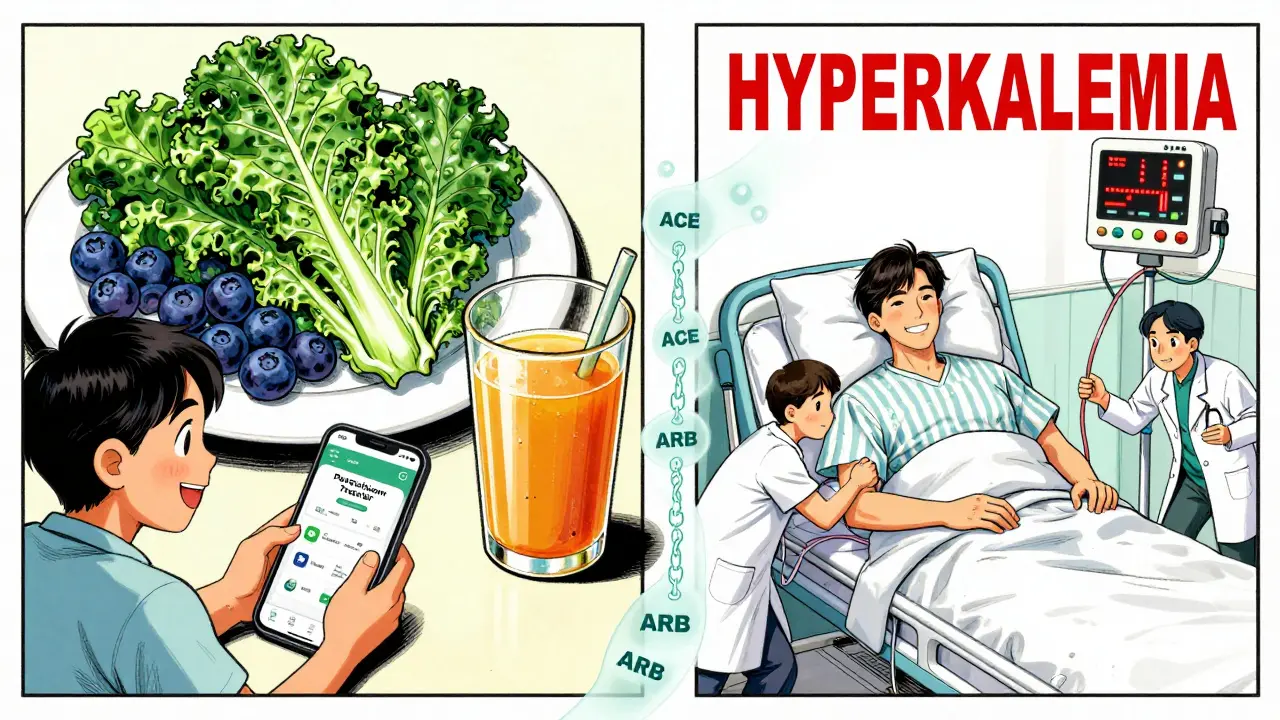
Supplements deliver potassium in concentrated, unbuffered forms - often as potassium chloride. That’s like pouring salt directly into your bloodstream. A 2017 Kidney International study found that just 40 mmol of potassium chloride (about 3,120 mg) over two weeks caused hyperkalemia in 11% of kidney disease patients. The same dose from food? Almost no risk.
Why? Because food comes with fiber, water, and other compounds that slow absorption. Your body regulates it naturally. Supplements? They flood your system. And if your kidneys are already slowing down - which happens with age, diabetes, or early kidney disease - you’re not equipped to handle it.
Who’s Most at Risk?
You might think this only affects older people. But it’s more nuanced than that.
- People over 65 - kidneys naturally decline with age
- Those with CKD (chronic kidney disease) - even stage 2 (eGFR 60-89) raises risk
- Diabetics - high blood sugar damages kidney filtering
- Black Americans - CDC data shows 22% have potassium deficiency, but also higher rates of hypertension and kidney disease, making them more vulnerable to both low and high potassium
- People on multiple meds - NSAIDs, ACE inhibitors, and diuretics together? Triple risk
One Reddit user, u/HypertensionWarrior, shared: "I was eating three bananas a day because my doctor said "eat more potassium." My potassium hit 5.4. I ended up in the ER with muscle cramps and a weird heartbeat. Turns out I was on spironolactone. My doctor never mentioned the interaction."
That story isn’t rare. A 2023 MyHealthTeams survey found 19% of hypertension patients experienced symptoms like weakness or palpitations after increasing potassium intake - and 7% needed emergency care.
What Should You Do?
Don’t panic. Don’t stop eating vegetables. But do this:
- Know your meds. If you’re on an ACE inhibitor, ARB, or potassium-sparing diuretic, assume potassium is a concern.
- Get tested. Ask your doctor for a serum potassium blood test before and 4 weeks after changing your diet. Normal range is 3.5-5.0 mmol/L. Anything above 5.0 needs attention.
- Track your intake. Use apps like Cronometer or the National Kidney Foundation’s "Potassium Counts" app. They’re free and accurate.
- Swap smartly. Replace bananas with blueberries. Swap spinach for kale (lower potassium). Choose apple juice over coconut water.
- Don’t use salt substitutes. Many contain potassium chloride. A quarter-teaspoon can add 250-700 mg. That’s like eating half a banana in one go.
- Time your meds. Take your ACE inhibitor or ARB at least 2 hours before or after a high-potassium meal. This reduces absorption spikes.
And if you’re on one of these drugs? Don’t start a high-potassium diet without talking to your doctor. Even if you feel fine. Even if your kidneys seem fine. The damage can be silent.
Good News: It Can Be Managed
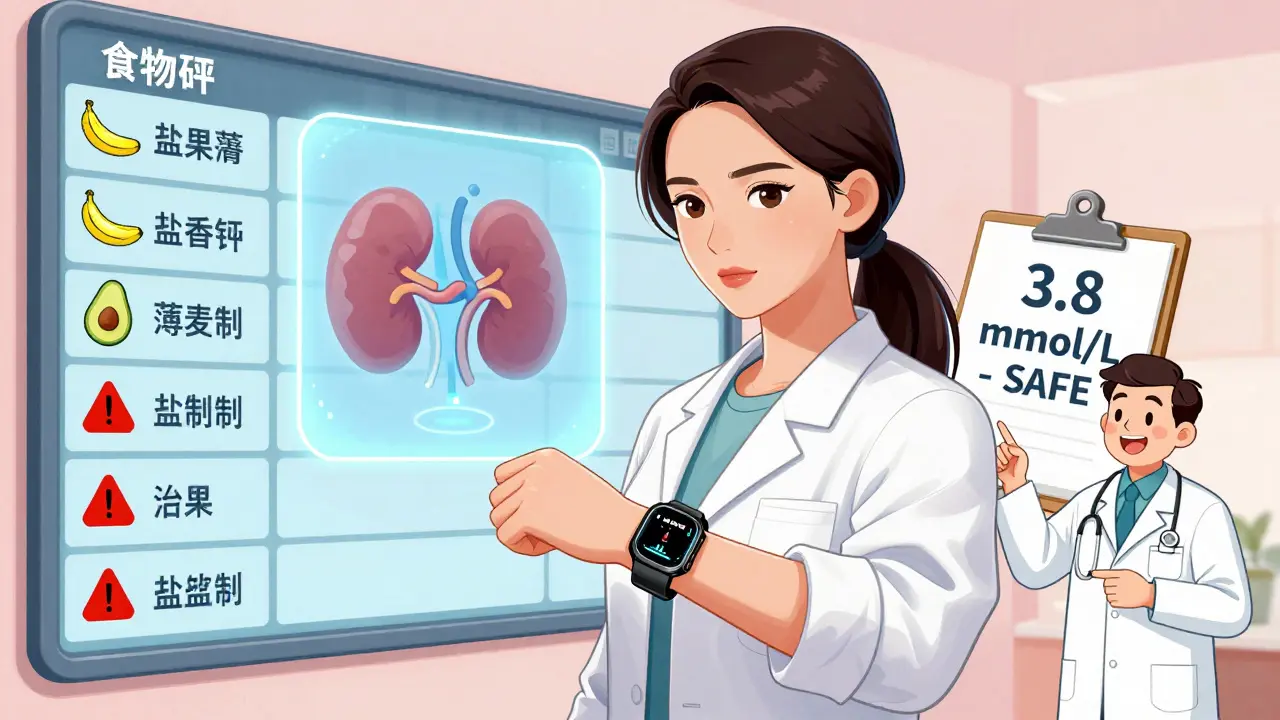
Here’s the flip side: when done right, potassium-rich diets work. A 2022 PatientsLikeMe analysis showed that 63% of hypertensive patients who adjusted their diet under medical supervision dropped their systolic blood pressure by 5 mm Hg or more within 8 weeks. That’s as good as adding a new pill - no side effects, no cost.
One patient, diagnosed in 2021, said: "My doctor added potassium checks to my quarterly labs after my levels hit 5.1. Now I track both sodium and potassium. My BP went from 152/94 to 128/82. I didn’t change my meds - just my food.""
And now there’s new help. In 2023, the FDA approved patiromer (Veltassa), a potassium binder that lets people on RAAS inhibitors eat more potassium without the risk. Clinical trials showed 89% of patients stayed in the safe range with this drug - compared to 67% without it.
Even better, new tech is coming. Omron’s HeartGuide smartwatch - launching in Q2 2024 - will soon track potassium trends through skin sensors. It’s not a replacement for blood tests, but it gives early warnings.
The Bottom Line
Potassium isn’t the enemy. Neither are your blood pressure meds. The problem is the silence between them. Too many people assume "healthy food = always safe." It’s not. And too many doctors assume patients know the risks. They don’t.
If you’re on ACE inhibitors, ARBs, or potassium-sparing diuretics:
- Don’t eliminate potassium-rich foods - just manage them.
- Don’t take supplements without testing.
- Don’t assume your kidneys are fine just because you feel okay.
- Do get a blood test.
- Do talk to your doctor about your diet.
- Do use an app to track what you eat.
Because the goal isn’t to avoid good food. It’s to make sure your body can handle it - safely.
Can I still eat bananas if I’m on blood pressure medication?
You can, but only if you’re not on an ACE inhibitor, ARB, or potassium-sparing diuretic - and even then, limit to one per day. If you’re on one of those meds, switching to blueberries, apples, or grapes reduces risk while still giving you fiber and antioxidants. One banana has 422 mg of potassium - that’s nearly 12% of your daily limit. If you’re eating other high-potassium foods too, it adds up fast.
Is potassium from food safer than supplements?
Yes, by a large margin. Food delivers potassium slowly, along with fiber and water, which helps your body regulate absorption. Supplements - especially potassium chloride pills - dump large doses into your system all at once. That’s why 11% of kidney patients on potassium chloride supplements developed dangerous hyperkalemia in a 2-week study. The same amount from food? Almost no risk. Never take potassium supplements unless your doctor specifically prescribes them.
How often should I get my potassium levels checked?
If you’re on an ACE inhibitor, ARB, or spironolactone, get tested at baseline, then again at 2 weeks and 4 weeks after changing your diet or starting the med. After that, every 3 to 6 months is standard. If you have kidney disease, diabetes, or are over 65, your doctor may want it every 3 months. Don’t wait for symptoms - hyperkalemia often has none until it’s too late.
Do salt substitutes contain potassium?
Most do - and that’s the problem. Many "low-sodium" salt substitutes replace sodium chloride with potassium chloride. A quarter-teaspoon can contain 250-700 mg of potassium. If you’re on an ACE inhibitor, that’s like eating a small banana every time you season your food. Check the label. If it says "potassium chloride," avoid it. Use herbs, lemon juice, or vinegar instead.
What are the early signs of high potassium?
The earliest signs are subtle: tingling in hands or feet, muscle weakness (especially in legs), fatigue, or an irregular heartbeat. These can be mistaken for stress or aging. But if you’re on a high-risk medication and feel this way, get your potassium checked immediately. Severe hyperkalemia (above 6.0 mmol/L) can cause cardiac arrest - and it often happens without warning.
Can I stop my blood pressure medication if I eat more potassium?
Absolutely not. Potassium from food helps lower blood pressure, but it doesn’t replace medication. Stopping your meds can cause dangerous spikes in pressure. The goal is to combine both safely - not swap one for the other. Always work with your doctor to adjust treatment, never on your own.
Alex MC
March 15, 2026 AT 18:22rakesh sabharwal
March 17, 2026 AT 17:08Dylan Patrick
March 18, 2026 AT 12:00Thanks for the wake-up call. I’m on losartan. Going to track my intake now. No more avocado toast at breakfast. Who knew healthy could be dangerous?
Amisha Patel
March 20, 2026 AT 01:02My doctor never mentioned it
Should I get tested?
Buddy Nataatmadja
March 21, 2026 AT 17:12Hugh Breen
March 22, 2026 AT 13:58My mum almost went into cardiac arrest because she took potassium pills + ate 3 bananas a day on ACE inhibitors. She’s fine now, but we almost lost her. Share this. Save lives.
Byron Boror
March 24, 2026 AT 08:29Richard Harris
March 24, 2026 AT 11:39Kandace Bennett
March 26, 2026 AT 11:12Shruti Chaturvedi
March 27, 2026 AT 05:42I’ve been eating them for years
Should I stop?
Katherine Rodriguez
March 28, 2026 AT 16:27