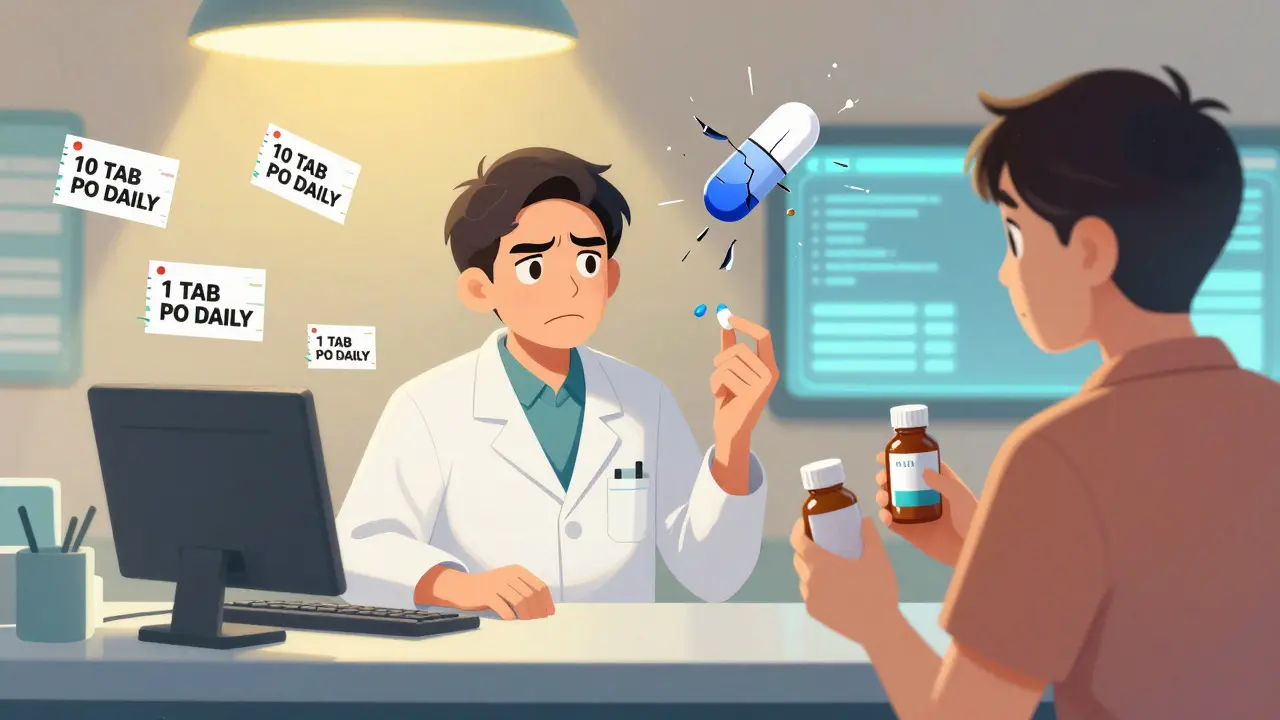
Electronic prescribing was supposed to fix medication errors. It cut down messy handwriting, reduced wrong doses, and made refills easier. But here’s the truth: e-prescribing didn’t eliminate errors-it just moved them. Today, nearly 4 in 10 prescribing errors in U.S. clinics come from transcription issues inside e-prescribing systems, not from doctors’ bad penmanship. Pharmacists are still spending 15 to 30 minutes a day fixing broken prescriptions. Patients are still getting the wrong meds. And the biggest culprit? Systems that don’t talk to each other.
Why E-Prescribing Still Causes Transcription Errors
E-prescribing systems were designed to replace paper. But many still work like old fax machines with digital screens. A doctor writes a prescription in Epic. It gets sent to a pharmacy using QS/1. But the sig-those instructions like “take one tablet daily”-gets translated wrong. Instead of “1 TAB PO DAILY,” the pharmacy system reads it as “10 TAB PO DAILY.” That’s not a typo. That’s a system failure. A 2023 Reddit post from a pharmacy tech with over 800 upvotes described it perfectly: “We fix this every shift.” The problem isn’t the doctor. It’s not the pharmacist. It’s the gap between systems. Even though 89% of U.S. pharmacies receive e-prescriptions, only 32% get them without needing manual fixes. That’s because most systems still use outdated data formats. HL7 FHIR, the modern standard for health data exchange, is slowly replacing older protocols. But if your clinic uses a 2015 version of Cerner and your pharmacy runs on a 2018 version of Pioneer, the data gets scrambled. Think of it like sending a text message from an iPhone to a Nokia 3310-it just won’t land right.Standardizing the Sig: The #1 Fix
The most common transcription error? The prescription instructions. “Take one tablet by mouth every morning” becomes “1 TAB PO QD.” But some systems read “QD” as “10 times daily.” That’s not a misunderstanding-it’s a design flaw. The fix? Standardized sig formatting. A 2018 Health Affairs study showed that when clinics forced providers to pick from a dropdown menu instead of typing free text, transcription errors dropped by 41%. No more “take 1 tab po bid” or “1 tab po 2x daily.” Instead, you pick: “Once daily,” “Twice daily,” “Every 8 hours.” The system auto-translates that into a clean code every pharmacy understands. This isn’t optional anymore. The 2021 AHRQ Technical Report listed it as the top evidence-based strategy. And it works. One clinic in Ohio switched to structured sigs and saw their pharmacy clarification calls drop from 18 per day to 3. That’s not just efficiency-it’s safety.CancelRx: Stop the Confusion Before It Starts
Ever had a patient come in saying, “I got two prescriptions for the same drug?” That’s not a mistake-it’s a system failure. In older e-prescribing systems, if a doctor changes a med, they can’t delete the original. They just send a new one. So the pharmacy gets two prescriptions: one for 5 mg, one for 10 mg. Which one is right? The pharmacist has to call the clinic. That’s a transcription error waiting to happen. Enter CancelRx. Developed by Surescripts in 2012, this protocol lets doctors electronically cancel a prescription before it’s filled. It’s like hitting “undo” on a text message before it’s sent. When implemented, it cuts discontinued medication errors by 63%. That means fewer wrong pills, fewer calls, and less stress for everyone. Yet, only 47% of U.S. clinics use it regularly. Why? Because it’s turned off by default in many EHRs. You have to enable it. And train staff. And test it. Most practices skip it because they don’t know it exists.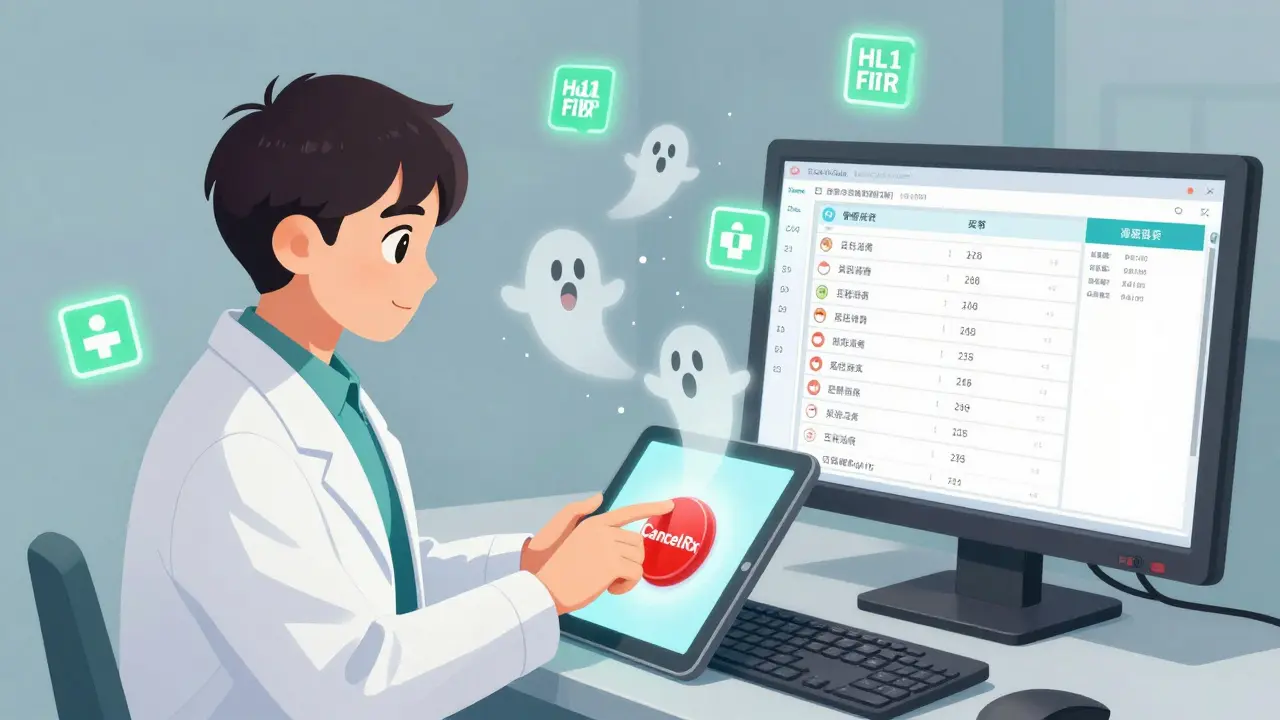
Link the Medication List-One Source of Truth
Imagine a patient takes five medications. The doctor writes a new one. But the EHR doesn’t show the full list. So the doctor prescribes something that interacts with a drug already on file. The pharmacy sees the new script, but not the old one. They fill it. The patient gets sick. That’s a transcription error too-because the system didn’t share the full picture. The solution? A single, shared medication list. Not a list the doctor copies from one screen. Not a list the pharmacist prints out. One real-time, synchronized list that both the clinic and pharmacy can see. When the doctor adds lisinopril, it shows up instantly in the pharmacy’s system. When the pharmacist updates the patient’s allergies, the doctor sees it too. This isn’t science fiction. A 2022 MGMA case study found that clinics using Epic integrated with CVS Pharmacy eliminated 100% of their refill transcription errors. Why? Because both sides saw the same data. No guesswork. No manual entry. No “I thought they were on…”Stop Overriding Alerts-It’s Not a Feature, It’s a Flaw
You’ve seen it: “Alert: This drug interacts with warfarin.” You click “override.” Why? Because you’ve seen it 20 times today. You’re tired. You assume it’s a false alarm. That’s alert fatigue-and it’s responsible for 34% of transcription errors, according to Dr. Joan Ash’s 2019 FDA testimony. E-prescribing systems flood providers with warnings. Some are critical. Most are noise. The system doesn’t learn. It doesn’t adapt. So providers learn to ignore it. That’s dangerous. The fix? Smart alerts. Not more alerts. Better ones. Modern systems now use patient-specific data to filter warnings. Instead of flagging every interaction, they only warn if the patient has kidney disease, is over 70, or is taking another blood thinner. That cuts false alerts by 60%. And when the warning pops up, it tells you exactly what to do: “Switch to apixaban” or “Check INR in 48 hours.” No guessing. No override.
Integrated Systems Beat Standalone-But Only If They’re Set Up Right
There are two types of e-prescribing systems: standalone and integrated. Standalone tools like DrFirst Rcopia are easy to use. They’re cheap. And they’re popular in small clinics-82% of practices under 10 providers use them. But they don’t connect to your EHR. So you copy-paste patient info from one screen to another. That’s where errors creep in. Integrated systems like Epic or Cerner pull everything from one database. No copying. No switching. They reduce overall prescribing errors by 84%, according to a 2021 JAMIA study. But only if they’re fully connected to the pharmacy. If your Epic system sends prescriptions to a pharmacy that uses a different format, you’re back to square one. The real win? When your EHR, your pharmacy system, and your medication list all talk using the same language: HL7 FHIR. That’s the future. And it’s coming fast. The ONC’s 2023 roadmap requires all systems to use FHIR by 2025. Until then, ask your vendor: “Are we FHIR-certified? Can we send prescriptions directly to our pharmacy without manual entry?” If they say no, you’re still at risk.What You Can Do Today
You don’t need to wait for a system upgrade to fix transcription errors. Here’s what works now:- Turn on CancelRx. Check your EHR settings. If it’s off, enable it. Train every provider.
- Use structured sigs. Force dropdowns for dosing frequency, route, and form. No free text.
- Check the medication list. Before prescribing, open the shared list. Verify every drug.
- Ask your pharmacy. Do they get your prescriptions cleanly? If not, ask why. Push for FHIR.
- Don’t override alerts blindly. If you see the same warning twice, report it. Ask for smarter rules.
The Bottom Line
E-prescribing didn’t fail. It was half-built. The technology exists to stop transcription errors. But it’s not automatic. It takes work. It takes training. It takes asking the right questions. The goal isn’t to eliminate every error-it’s to make them rare. And it’s possible. Clinics that use structured data, CancelRx, and FHIR-connected systems cut transcription errors by 90%. Patients get the right meds. Pharmacists get their nights back. And doctors? They stop wasting time fixing what the system broke.The next time you send an e-prescription, ask yourself: Is this going to land right? Or am I just adding another glitch to the machine?
What are the most common transcription errors in e-prescribing?
The most common errors include misread dosage instructions (like “1 TAB PO DAILY” being interpreted as “10 TAB PO DAILY”), duplicate prescriptions when a doctor doesn’t cancel the original, missing medication history leading to dangerous interactions, and incorrect patient identifiers due to poor system integration. These errors often stem from systems using outdated data formats instead of modern standards like HL7 FHIR.
Can e-prescribing systems really reduce medication errors?
Yes-but only when properly implemented. Studies show e-prescribing reduces overall prescribing errors by 13% to 99%, depending on the system. However, transcription errors still make up 37-41.5% of all errors in poorly connected systems. Fully integrated systems using standardized formats and real-time pharmacy connectivity can reduce transcription errors by up to 92% compared to standalone or legacy systems.
What is CancelRx and why does it matter?
CancelRx is a national protocol that lets prescribers electronically cancel a previously sent prescription. It prevents pharmacists from receiving conflicting prescriptions-for example, one for 5 mg and another for 10 mg of the same drug. When used, it reduces discontinued medication errors by 63%. Despite its effectiveness, many clinics still don’t enable it, leaving pharmacists to guess which version is correct.
How do I know if my e-prescribing system is interoperable?
Ask your vendor: “Do we use HL7 FHIR for pharmacy connectivity?” and “Can prescriptions be sent directly to our pharmacy without manual re-entry?” If your pharmacy needs to call your clinic to clarify dosing, route, or patient info, your system isn’t interoperable. True interoperability means the prescription arrives complete, correct, and ready to fill-no human intervention needed.
Is there a financial penalty for not using e-prescribing correctly?
Yes. Medicare Part D requires e-prescribing for all prescriptions. Practices that don’t comply face payment penalties. Additionally, the 21st Century Cures Act imposes fines for “information blocking”-any practice that prevents seamless data exchange between systems. This includes refusing to connect to pharmacy networks or using outdated formats that force manual entry.
What’s the future of e-prescribing?
The future is FHIR-based, AI-powered, and patient-centered. By 2025, all U.S. systems must support FHIR APIs for seamless data exchange. Pilot programs like Epic’s DoseMeRx and Surescripts’ Blue Button 2.0 are already using AI to validate prescriptions and let patients share their own medication lists. These tools could cut transcription errors by another 65% by 2026. But until every clinic, pharmacy, and system uses the same standard, errors will persist.
shivam utkresth
January 27, 2026 AT 08:17Man, this hits home. I work in a clinic in Delhi that uses a hacked-together EHR from 2014, and we still get prescriptions that say '10 TAB PO DAILY' when the doc meant '1 TAB'. The pharmacy here calls us like clockwork-every damn shift. We don't even bother correcting it anymore, we just call the patient and say 'hey, your doc probably meant one, not ten'. It's not a tech problem-it's a laziness problem. Someone needs to force vendors to use dropdowns. Free text is a death sentence.
bella nash
January 27, 2026 AT 18:32It is of considerable import to note that the structural deficiencies inherent in contemporary electronic prescribing architectures represent a systemic failure of interoperability governance rather than a mere technical oversight. The persistence of legacy protocols such as HL7 v2.x, in conjunction with the non-adoption of FHIR standards, constitutes a violation of the principle of semantic consistency in health information exchange. One must therefore conclude that the root cause is not human error but institutional inertia.
SWAPNIL SIDAM
January 28, 2026 AT 22:18This is crazy. My uncle got the wrong pill because the system thought 'QD' meant 10 times a day. He ended up in the hospital. It's not a glitch. It's a crime. Someone needs to get fired. Not just 'fix it'-FIRE THEM.
Geoff Miskinis
January 29, 2026 AT 01:08Let’s be honest: most of these clinics are run by people who think ‘Ctrl+C Ctrl+V’ is a clinical workflow. The fact that 82% of small practices use standalone systems is less a market choice and more a testament to the collective mediocrity of American healthcare administration. If you can’t afford FHIR, you shouldn’t be prescribing. Simple.
Sally Dalton
January 29, 2026 AT 14:05OMG YES. I’m a pharmacy tech and this is my life. We get the same 3 errors over and over. I love the structured sigs idea!! I tried to get my boss to make dropdowns but she said ‘but docs like typing’. Like… they’re typing wrong? 😭 Can we just make it easier for everyone?? Also CancelRx is a GAME CHANGER. We got it working last month and my stress levels dropped like a rock. 🙏
eric fert
January 29, 2026 AT 17:28Look, I get it. Everyone’s tired of hearing about e-prescribing errors. But let’s not pretend this is just about ‘bad systems’. It’s about culture. The culture of ‘just override the alert’. The culture of ‘I don’t have time to check the med list’. The culture of ‘it’s not my job to train the pharmacist’. This isn’t a software issue. It’s a human failure. And no amount of FHIR will fix that. You want to reduce errors? Fire the ones who click ‘override’ without thinking. Make them sit through a 3-hour lecture on warfarin interactions. Make them write ‘I will not override without review’ 100 times. Until then, we’re just rearranging deck chairs on the Titanic.
Curtis Younker
January 29, 2026 AT 19:15Y’all, I work in a small clinic and we turned on CancelRx last month. I was skeptical. But guess what? We haven’t had a single duplicate script since. The pharmacists stopped calling us. Our patients are safer. And honestly? My team feels less burned out. This isn’t rocket science. It’s just doing the damn thing. If your EHR has CancelRx and you’re not using it-you’re not just lazy, you’re putting lives at risk. Go enable it. Right now. I’ll wait.
Shawn Raja
January 31, 2026 AT 17:14So we’re supposed to believe that FHIR is the magic bullet? Cute. The same people who sold us on EHRs in 2009 said they’d ‘revolutionize care’. Now we’re stuck with systems that make doctors spend 40% of their day clicking boxes instead of talking to patients. And you want us to trust another ‘standard’? Nah. This isn’t about tech. It’s about control. The vendors don’t want interoperability-they want lock-in. FHIR? More like Faux-HIR. They’ll make it complicated enough that only big hospitals can afford it. Meanwhile, the rest of us? Still copying and pasting. Like always.
Ryan W
February 1, 2026 AT 08:04Why are we even talking about this? In the U.S., we have the best technology in the world. If your clinic can’t get e-prescribing right, you’re either incompetent or you’re in a third-world country. We don’t need more standards-we need accountability. If you’re still using 2015 Cerner and you’re in a Medicare practice? You should be fined. Period. Stop blaming the software. Blame the people who refused to upgrade. This isn’t a tech problem. It’s a failure of American leadership.
Henry Jenkins
February 2, 2026 AT 13:21I’ve been digging into this for a year now. The data shows that structured sigs reduce errors by 41%, CancelRx by 63%, and FHIR integration by up to 92%. But here’s what nobody talks about: the human cost. Pharmacists are working 15 extra minutes a day fixing these errors. That’s 75 minutes a week. 300 minutes a month. That’s 3600 minutes a year-over 60 hours-just correcting systems that should’ve worked. That’s time they could’ve spent counseling patients, checking for allergies, answering questions. This isn’t just about efficiency. It’s about dignity. These are skilled professionals. They deserve systems that work. And we owe it to them to demand better. It’s not just a tech fix. It’s a moral one.