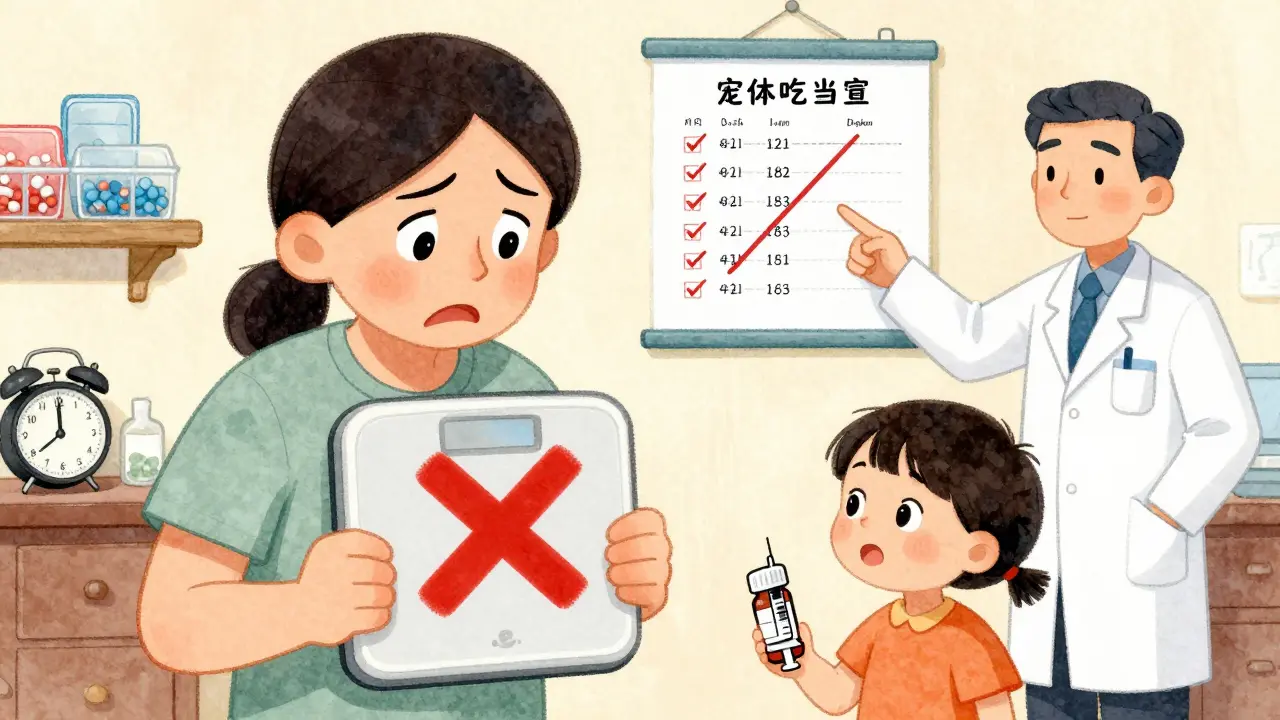
Missing a dose of your child’s medication happens. It’s stressful. It’s common. And if you don’t know what to do next, it can be dangerous. You might panic and give two doses to make up for it. Or you might skip it entirely and hope your child’s condition doesn’t worsen. But here’s the truth: never double a dose. That’s the biggest mistake parents make-and it’s the one that puts kids at the highest risk.
Why Doubling Doses Is Dangerous
Children’s bodies process medicine differently than adults. Their livers and kidneys aren’t fully developed. Their weight changes fast. A dose that’s safe for a 40-pound child could be toxic for a 30-pound child. When you double a dose, you’re not just giving extra medicine-you’re overwhelming their system. According to Dr. Sarah Verbiest’s 2023 review, doubling pediatric doses increases the risk of severe adverse reactions by 278% in children under 12. That’s not a small number. That’s life-threatening. In emergency rooms, overdose cases from doubled doses are more common than you’d think. Morphine, lorazepam, and antibiotics are frequent culprits. One study found that 73.8% of morphine errors in prehospital settings came from weight estimation mistakes. If you guess your child’s weight instead of using a scale, you’re already playing Russian roulette with their safety.When to Give the Missed Dose (It Depends on the Schedule)
There’s no one-size-fits-all answer. What you do depends on how often your child takes the medicine. Here’s what leading children’s hospitals recommend:- Once daily: If you remember within 12 hours of the missed time, give it. If it’s been more than 12 hours, skip it. Don’t give it the next morning unless your doctor says so.
- Twice daily (every 12 hours): If you remember within 6 hours, give it. If it’s been longer, skip it and wait for the next scheduled dose.
- Three times daily (every 8 hours): Give it if you remember within 3 hours. After that, skip it.
- Four times daily (every 6 hours): Give it only if you remember within 2 hours. Otherwise, skip it.
- Every 2-4 hours (as needed): If you miss a dose by more than 2 hours, skip it. Never try to catch up.
What About High-Risk Medications?
Some medications are different. These are called “high-alert” or “red-category” drugs. They include chemotherapy, insulin, seizure meds like phenytoin, and strong painkillers like fentanyl. For these, the rules change. If you miss a dose of any high-risk medication, call your child’s doctor or pharmacist immediately. Don’t guess. Don’t wait. Even one missed dose can reduce treatment effectiveness or trigger a crisis. For example, in oncology, missed chemo doses can allow cancer cells to regrow. In epilepsy, skipping an antiseizure med can lead to status epilepticus-a life-threatening seizure that won’t stop. A 2021 review found that 25% of high-risk pediatric medications had no missed-dose instructions in their patient leaflets. That’s a system failure. You can’t rely on the label. You have to rely on your care team.How to Avoid Missed Doses in the First Place
Prevention is better than correction. Here’s how to set your child up for success:- Use a pill organizer with alarms. Simple ones with compartments for morning, afternoon, evening, and bedtime work best. Set phone alarms too.
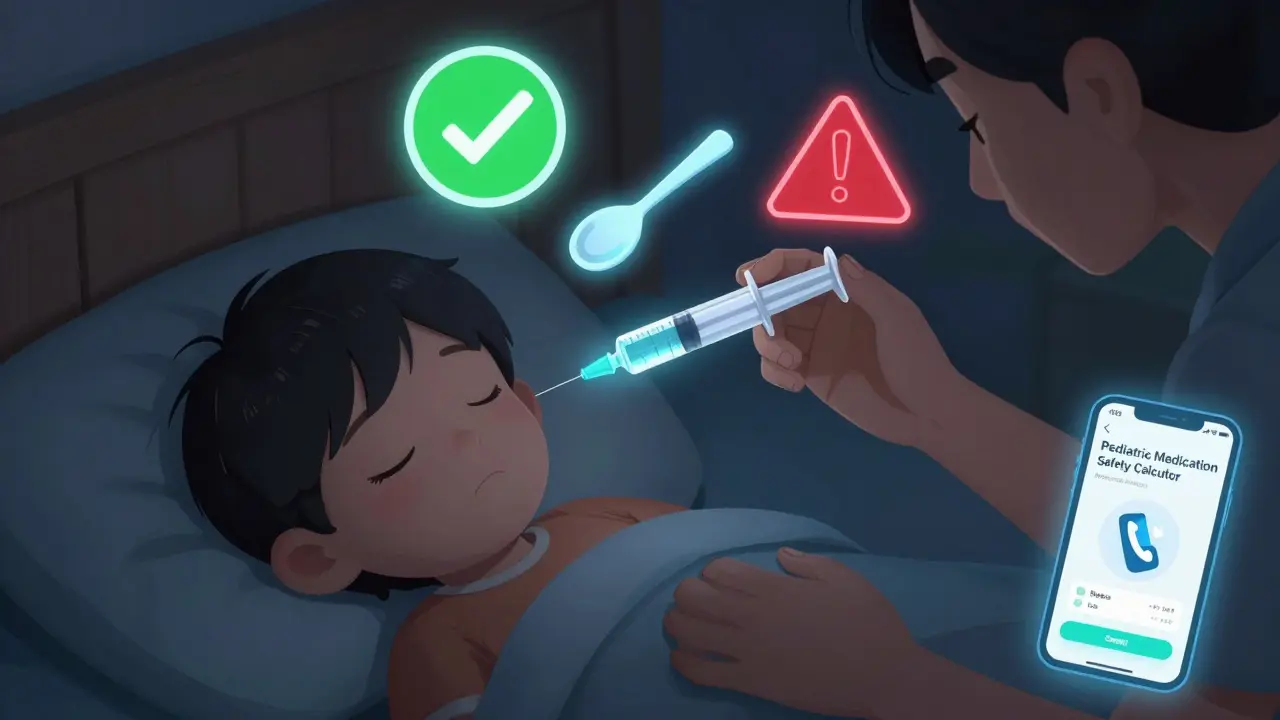
- Use an oral syringe, not a spoon. A teaspoon is not a milliliter. The FDA says household spoons cause 22% of dosing errors. Oral syringes are precise, cheap, and often free from pharmacies.
- Write down the schedule. Include the time, dose, and reason (e.g., “Amoxicillin 5 mL at 8 AM and 8 PM for ear infection”). Tape it to the fridge or bathroom mirror.
- Color-code for complex regimens. If your child takes four or more meds daily, use colored stickers or labels. Red for morning, blue for afternoon, green for night. Boston Children’s Hospital found this cuts missed doses by 44%.
- Teach-back method. After your doctor explains the schedule, ask your child to repeat it back to you. Then ask them to show you how they’d use the syringe. If they can’t, you haven’t understood it yet.
What to Do If You’re Not Sure
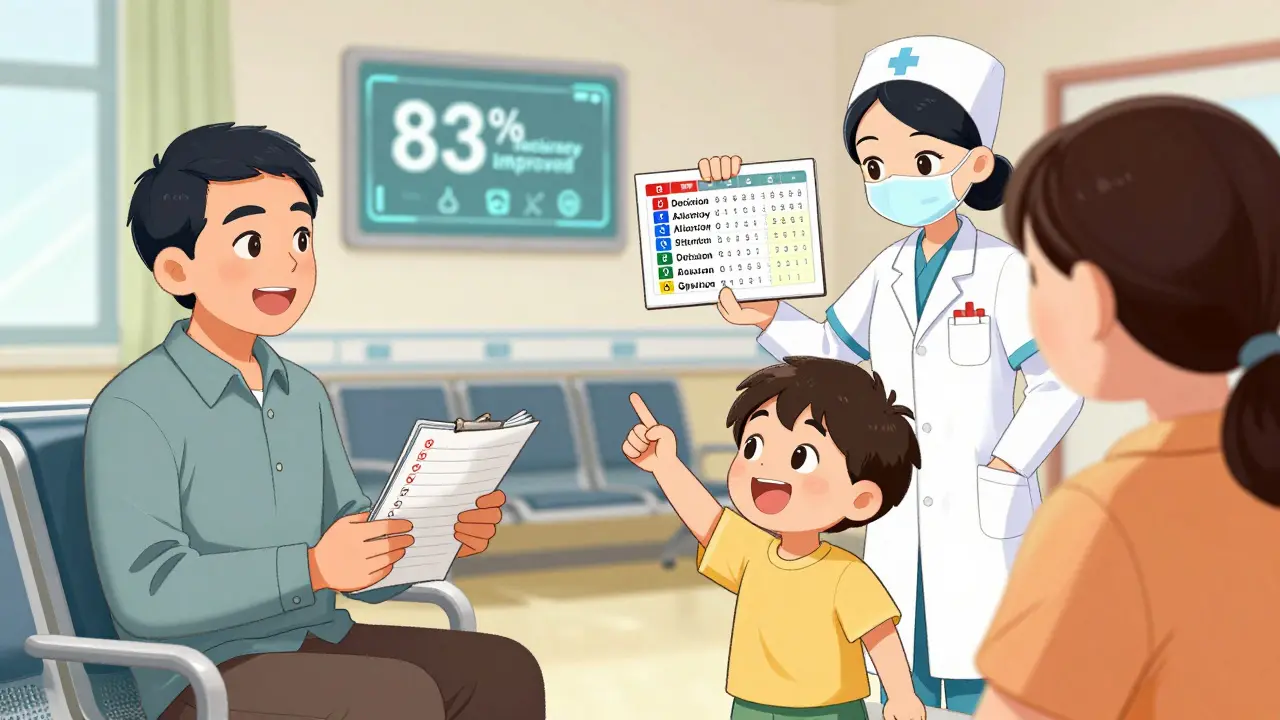
You’re not alone if you’re confused. A 2022 survey from Children’s Hospital of Philadelphia found that 41% of parents couldn’t correctly decide whether to give or skip a missed dose for a twice-daily med. For three-times-daily meds, that number jumped to 68%. If you’re unsure, don’t guess. Call your pediatrician’s office. Most have nurses on call 24/7. If it’s after hours, call the pharmacy. They’re trained to handle these questions. Don’t wait until morning. Don’t search online. Don’t ask strangers on Facebook groups. The advice you get there might be wrong-or worse, well-meaning but dangerous. There’s a new tool that helps: the American Academy of Pediatrics’ Pediatric Medication Safety Calculator app. It’s free. You input the drug name, frequency, and how long it’s been since the missed dose. It tells you exactly what to do. Beta testers saw an 83% improvement in decision accuracy.Special Cases: Liquid Medications and Weight-Based Dosing
Most pediatric meds are liquid. That’s good because dosing can be adjusted. But it’s risky because measuring is hard. Always use the syringe that came with the medicine. Never use a kitchen spoon. A tablespoon holds 15 mL. A teaspoon holds 5 mL. But not all spoons are the same. One study showed parents using household spoons overdosed by 30% on average. Weight matters. Doses are calculated in mg per kg. If your child weighs 15 kg and the dose is 10 mg/kg, they need 150 mg total. If you estimate weight by age (“my child is 4, so about 16 kg”), you’re wrong. A 2021 study found that using length-based resuscitation tapes (which measure from head to heel) reduced weight estimation errors by 42% compared to age-based formulas. Ask your pharmacist for one. They’re free.What If You Accidentally Double the Dose?
If you gave two doses by accident:- Call Poison Control at 1-800-222-1222 immediately.
- Have the medicine bottle ready. Know the name, strength, and how much was given.
- Don’t wait for symptoms. Some reactions take hours to show.
- Do not induce vomiting unless instructed.
Technology Can Help-But It’s Not Perfect
Smart pill dispensers that lock and beep when it’s time are growing in popularity. In clinical trials, they reduce missed doses by 68%. But they’re expensive. And if your child has a complex regimen with multiple meds at different times, they can be overwhelming. AI tools like the NIH’s PediMedAI project are being tested. They send alerts 30 minutes before a dose is due, track adherence, and even notify your doctor if doses are missed repeatedly. But these aren’t widely available yet. Don’t wait for tech to fix your problem. Use the simple tools you have now.Final Rule: When in Doubt, Skip It
This is the golden rule. If you’re not sure whether to give the dose, skip it. Wait for the next scheduled time. Missing one dose is rarely dangerous. Giving too much can be fatal. Your child’s body can handle a gap. Medications are designed to work over time. One missed dose won’t undo weeks of treatment. But one doubled dose could land them in the ER. Keep a log. Write down every dose you give and every one you miss. That way, if you need to call the doctor, you have the facts. No guessing. No memory lapses. Just clear, accurate information.FAQ
What should I do if I miss a dose of my child’s antibiotic?
If you miss a dose of an antibiotic, give it as soon as you remember-if it’s within half the time until the next dose. For example, if it’s given twice daily (every 12 hours), and you remember within 6 hours, give it. If it’s been longer, skip it. Never double up. Skipping one dose won’t stop the antibiotic from working, but doubling it can cause stomach upset, diarrhea, or even allergic reactions. Always finish the full course unless your doctor says otherwise.
Can I give my child a missed dose at bedtime if I forgot earlier in the day?
Only if it’s still within the safe window. For a once-daily medicine, you can give it up to 12 hours late. For a twice-daily, only up to 6 hours late. If it’s past that, don’t give it at bedtime. Giving a dose too close to the next one can cause drug buildup. For example, giving a 6 PM dose at 11 PM when the next dose is scheduled for 6 AM means you’ve only waited 7 hours-not the required 12. That’s too close. Skip it and resume the regular schedule in the morning.
My child vomits right after taking medicine. Should I give another dose?
If your child vomits within 15-20 minutes of taking the medicine, it’s likely they didn’t absorb it. In that case, you can give another full dose. If they vomited more than 20 minutes after taking it, the medicine was probably absorbed. Don’t give another dose. If vomiting continues, call your doctor. Don’t assume every vomit means you need to re-dose.
Are there apps that help track pediatric medication schedules?
Yes. The American Academy of Pediatrics has a free app called the Pediatric Medication Safety Calculator. It tells you exactly what to do when a dose is missed based on the drug and timing. Other apps like Medisafe and MyTherapy also work well. Look for ones that let you set reminders, log doses, and share reports with your doctor. Avoid apps that don’t cite medical sources or require payment for basic features.
How do I know if my child’s medicine is high-risk?
High-risk medications include chemotherapy drugs, insulin, seizure medications (like phenytoin or valproate), strong opioids (like morphine or fentanyl), and blood thinners. If your child is on any of these, the label should say “high-alert” or “take exactly as directed.” If you’re unsure, ask your pharmacist. They’re trained to identify these. Never assume a medicine is safe just because it’s common. Always double-check.
Jake Nunez
January 10, 2026 AT 06:55Just read this whole thing. Honestly, this should be mandatory reading for every new parent. I didn't know doubling doses could be this dangerous. I thought it was just annoying to miss one. Now I know it's a potential ER trip.
Saved the Poison Control number. Right next to my kid's emergency contacts.
Michael Marchio
January 12, 2026 AT 00:27It's frankly irresponsible how little guidance parents receive on this. The fact that 25% of high-risk pediatric meds don't even have missed-dose instructions on the label is a systemic failure that pharmacies and pharmaceutical companies are ignoring. You can't just hand someone a vial of insulin or phenytoin and assume they'll intuitively know how to handle a missed dose. This isn't a parenting blog-it's a public health crisis wrapped in a prescription bottle. And yet, we still rely on Google and Facebook groups for medical advice. Someone needs to mandate clear, standardized, and legally enforceable dosing protocols for every pediatric medication. No more ambiguity. No more "it depends." Kids aren't lab rats.
lisa Bajram
January 13, 2026 AT 16:43OH MY GOSH, I CANNOT BELIEVE I JUST LEARNED THIS!!
I used to eyeball liquid meds with a kitchen spoon-YES, I’M SHAMING MYSELF-until my son threw up after a double dose of amoxicillin. I thought I was being "helpful" by making sure he got his full dose. Turns out I was nearly poisoning him.
Got the oral syringe today. Got the pill organizer. Got the color-coded stickers. Got the AAP app downloaded. And I’m telling EVERY mom in my playgroup. This is life-or-death stuff, people. No more guessing. No more "I think it’s okay." If you’re unsure-SKIP IT. Repeat it like a mantra. SKIP. IT.
Also, the weight tape thing? Game. Changer. I’m ordering one right now. Thank you for writing this. Seriously.
P.S. If you’re using a spoon? STOP. NOW. Go to CVS. Get a syringe. It’s free. I promise. I did.
Ted Conerly
January 14, 2026 AT 23:05Love this. So clear, so practical. I’ve been a nurse for 12 years and even I learned something new about the timing windows for four-times-daily meds.
One thing I’d add: if you’re ever unsure, call the pharmacy. Not the doctor’s office. Not Google. Not your aunt who "used to be a nurse." Pharmacists are the unsung heroes of medication safety. They’re trained for this exact scenario. And most will talk to you for free, even after hours.
Also-yes to the color-coding. My daughter takes seven different meds. We use a rainbow sticker system. She even helps now. She picks the right color. Feels like a game. No more panic. Just routine.
You’ve got this. And if you mess up? It’s okay. Just don’t double. Skip. Call. Learn. Move on.
Faith Edwards
January 15, 2026 AT 05:53One cannot help but observe the alarming degree of medical illiteracy among contemporary parenting demographics. The casual reliance upon anecdotal Facebook advice, household utensils for pharmaceutical administration, and the pervasive myth that "more is better" when it comes to pediatric dosing is not merely irresponsible-it is a dereliction of parental duty. The fact that such a comprehensive, evidence-based guide is even necessary speaks volumes about the erosion of basic medical literacy in the digital age. One would assume that, in the 21st century, the ability to follow a prescribed regimen with precision would be a baseline expectation-not a topic for viral Reddit threads. I urge all parents to treat this as non-negotiable: if you cannot adhere to a simple schedule with accuracy, perhaps reconsider the responsibility of managing a child’s pharmacological regimen. The stakes are not hypothetical. They are clinical. They are lethal.
Jay Amparo
January 15, 2026 AT 20:24Wow. This is the kind of post that makes me proud to be part of this community.
I’m from India, and here, a lot of parents just give "half a tablet" or "a spoonful" without knowing the exact dose. I’ve seen kids get sick because of this. I showed this to my sister-she’s a new mom. She cried because she’d doubled a dose once and didn’t know it was dangerous.
Just shared the AAP app link with her. Also, the weight tape thing? I’m ordering one for her. We don’t have scales everywhere, but we do have measuring tapes. This is brilliant.
Thank you for making this so clear. Not just for Americans. For everyone.
Lisa Cozad
January 15, 2026 AT 20:26My daughter takes four meds. Three of them are liquid. I used to just pour from the bottle into a cup. I thought it was fine.
Not anymore.
Got the syringes. Got the log. Got the alarms. I’m not perfect-I missed one dose last week. But I didn’t double. I skipped. And I called the pharmacist. They said it was fine.
That peace of mind? Worth every minute of setup.
Also-yes, the color-coding works. My toddler now points to the red sticker and says "medicine time." It’s adorable. And safe.
Saumya Roy Chaudhuri
January 17, 2026 AT 11:05Let me just say this: if you’re still using a kitchen spoon to measure your child’s medicine, you’re not just careless-you’re negligent. The FDA says 22% of dosing errors come from household spoons? That’s not a statistic. That’s a headline waiting to happen. And you’re probably the parent who thinks "it’s close enough."
It’s not.
Every single time you do this, you’re gambling with your child’s liver. You think you’re being practical? You’re being dangerous. And don’t even get me started on people who guess weight by age. I’ve seen it. I’ve seen the ER reports. It’s not cute. It’s not okay. Get a syringe. Get a scale. Get educated. Or stop pretending you know what you’re doing.
anthony martinez
January 18, 2026 AT 20:01So let me get this straight. The solution to parents doubling doses is... a free app? A color-coded sticker? A syringe?
Not a national public health campaign? Not mandatory pharmacist counseling? Not standardized labeling laws?
Wow. We really just outsource child safety to a Google Play download now. Next thing you know, we’ll be using TikTok tutorials to administer epinephrine.
Anyway. Thanks for the syringe tip. I’ll go buy one. Just like everyone else.
Mario Bros
January 19, 2026 AT 13:15Big thanks for this. Seriously.
I used to just wing it. Then my son had a seizure after I gave him an extra dose of his seizure med because I thought he "didn’t feel right." Turned out he was just tired.
Now I have the app, the syringe, the log, and the alarm. I even set a backup alarm on my watch.
And I never, ever double. Ever.
One missed dose? Fine. Two doses at once? No thanks. I’ve seen what that looks like.
You got this, parents. We’ve all been there. Just don’t guess. Call. Skip. Repeat.
Jaqueline santos bau
January 20, 2026 AT 03:36I’m so tired of people acting like this is some groundbreaking revelation. This is basic medical knowledge. If you didn’t know that doubling doses is dangerous, you shouldn’t be parenting. And if you’re still using spoons? You’re a liability. I’ve seen kids in the ER because of this. I’ve held their hands while they vomited blood because their parents thought "a little extra won’t hurt."
Stop acting like you’re doing a favor by reading this. This is your job. This isn’t a hobby. This isn’t a blog post. This is your child’s life.
And if you think the AAP app is enough? You’re delusional. You need to be educated. Not just reminded.
chandra tan
January 21, 2026 AT 23:50From India here. We don’t always have access to syringes or scales. But we do have clean, small plastic caps from medicine bottles. I learned to use those as measuring tools. One cap = 5 mL. I mark it with a pen. It’s not perfect, but it’s better than a spoon.
Also, we use the "skip it" rule religiously. No double-dosing. Never.
Thanks for this. It’s good to know we’re not alone in this.
Jake Kelly
January 23, 2026 AT 04:56Just wanted to say thank you. I’ve been a single dad for five years. I’ve missed doses. I’ve panicked. I’ve called Poison Control twice.
This guide is the one I wish I’d had when I started.
Not every parent has a nurse in the family. Not every parent has time to research. This is clear. This is calm. This is helpful.
Thank you for making it.
lisa Bajram
January 23, 2026 AT 19:23Wow, I just saw @6709’s comment and I’m crying a little. That’s exactly why I wrote this.
Single parents, caregivers, grandparents, foster parents-you’re the real MVPs. You don’t have a medical degree. You don’t have a spouse to double-check. You’re doing this alone, often exhausted, often scared.
So please: if you’re unsure, SKIP IT. Call the pharmacy. Use the app. Write it down. Breathe.
You’re doing better than you think. And you’re not alone.
Love you all. Seriously.