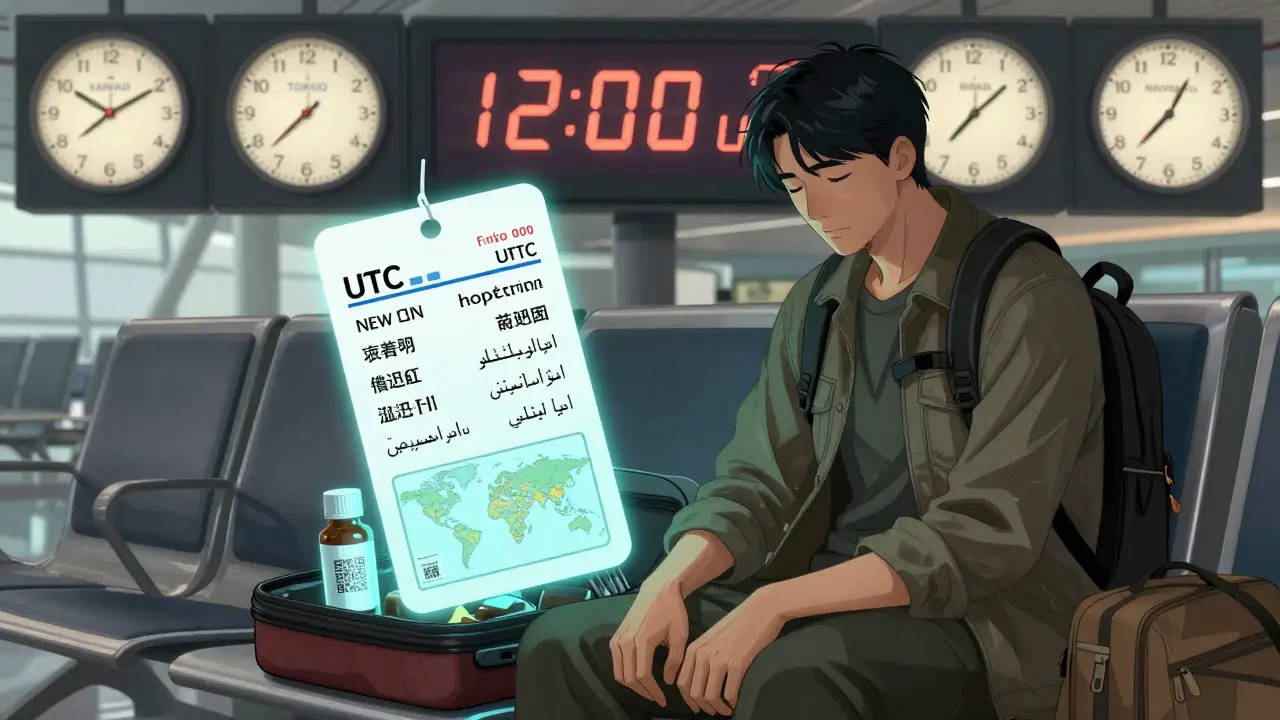
When you’re flying across continents, your body doesn’t care about the time on your phone. If you take your blood pressure pill at 8 a.m. in New York, but land in Tokyo at 11 p.m. local time, should you take it now-or wait until your body thinks it’s morning? This isn’t just a scheduling headache. It’s a health risk. Misreading your prescription label can mean taking the wrong dose, missing a dose, or even getting your meds confiscated at customs. And it happens more often than you think.
What’s on Your Prescription Label? (And Why It Matters)
Your prescription label isn’t just a sticker with your name and a number. It’s a safety manual. Before you pack your bag, check for these seven key pieces of information:- Patient name - Must match your passport exactly. No nicknames. No initials. If your passport says “Maria Lopez,” your label better say the same. Customs agents in Japan, Saudi Arabia, and Australia have turned travelers away for mismatched names.
- Medication name - Look for both brand and generic names. In Europe, Canada, and much of Asia, pharmacies use generic names. If your label says “Lipitor” but the country requires “Atorvastatin,” you could be denied entry. 68% of countries require the generic name for identification, according to WHO data.
- Dosage strength - Is it 10 mg? 500 mg? 10 IU? Units matter. A dose that’s too high or too low can be dangerous, especially for insulin, warfarin, or thyroid meds.
- Directions for use - This is where time zones wreck havoc. Look for phrases like “take every 24 hours” or “q24h.” Avoid labels that say “take at bedtime” or “in the morning.” Those mean nothing when you’re on the other side of the world.
- Prescriber info - Your doctor’s name, phone number, and license number. Some countries, like Japan and Saudi Arabia, require this to verify the prescription is real.
- Pharmacy details - The name, address, and license number of the pharmacy that filled it. This helps customs trace the source.
- Prescription number - Useful if you need a refill abroad or if customs asks for proof.
If any of these are missing, ask your pharmacist to add them. Many U.S. pharmacies now offer custom labels with this info upon request - 78% of major chains do it, according to Pharmacy Times.
Time Zones Don’t Care About Your Routine
Crossing time zones isn’t like switching your alarm clock. Your body’s internal clock doesn’t reset instantly. But your medication does. Take a medication that must be taken every 12 hours - say, an antibiotic or anticoagulant. If you’re on a 10-hour flight from London to Los Angeles, you might skip a dose because you think it’s “too late.” Or worse, you take two doses because you’re confused.The solution? Convert everything to Coordinated Universal Time (UTC). This is the global standard clock. Forget EST, PST, or JST. When your label says “take at 08:00 UTC,” you know exactly when to take it - no matter where you are. A 2023 GoodRx survey found that 89% of travelers who used UTC-based schedules had zero timing issues. Only 32% of those who stuck to local time did the same.
Here’s how to do it:
- Find your home time zone’s UTC offset. For example, New York is UTC-5 in winter, UTC-4 in summer.
- Convert your dosing times to UTC. If you take a pill at 7 a.m. EST, that’s 12:00 UTC.
- Use that UTC time as your new anchor. When you land in Bangkok (UTC+7), take your pill at 12:00 UTC - which is 7 p.m. local time.
- Set a phone alarm or use the WHO’s free Medication Time Zone Converter app (downloaded over 287,000 times since 2022).
For time-sensitive drugs like insulin or warfarin, you also need to know the drug’s half-life. If it’s 4 hours, you need to adjust immediately. If it’s 24 hours, you can stick to your home schedule for 2-3 days. Dr. Susan Pisani, a pharmacist at Memorial Sloan Kettering, says this is the detail most travelers miss. “Knowing half-life tells you whether to shift now or wait,” she explains.
Country Rules Vary - Big Time
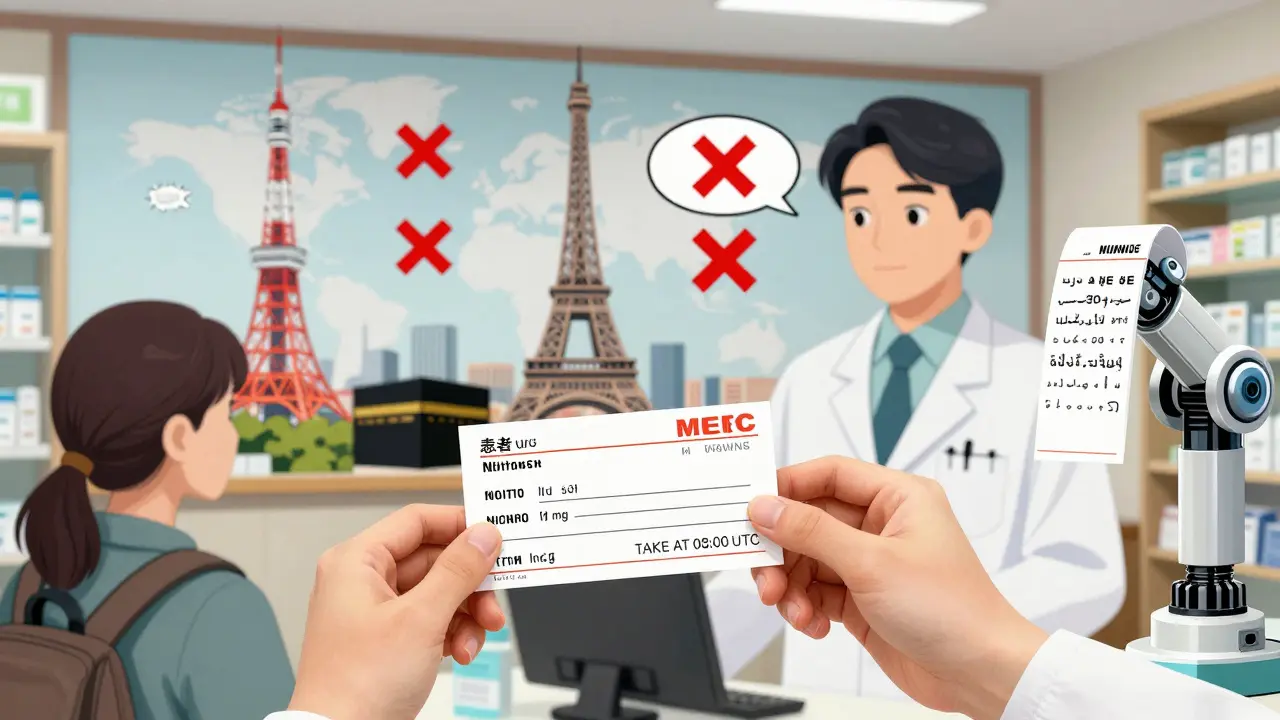
Not every country treats your meds the same way. What’s legal in the U.S. might be banned in Japan. What’s allowed in Canada might need a special permit in Dubai.Here’s what you need to know:
- Japan - All prescription labels must include kanji characters for the active ingredient. English-only labels? You’ll be detained. A 2022 study found 43% of American travelers faced delays because of this.
- Saudi Arabia - The Arabic name of the drug must be on the label. In Q1 2023, 22% of seized medications at Riyadh Airport were due to missing Arabic text.
- Thailand - Requires both English and Thai on the label. Fines of $500-$5,000 were issued to 83 travelers in 2023 for non-compliance.
- European Union - Standardized labels since 2010, but your name must be in the local language. If you’re going to Spain, your label must say “María López,” not “Maria Lopez.”
- Caribbean nations - Many require English and Spanish. Only 37% of U.S. prescriptions meet this standard, according to a 2022 University of Miami study.
Some countries now use QR codes on labels that link to multilingual drug info - a standard adopted by 19 countries as of January 2024. If your label has one, scan it. It might save you from a customs nightmare.
What to Pack - And What Not To
Never pack meds in checked luggage. Always carry them in your carry-on. But don’t just toss them in a pill organizer. Customs officers often assume unmarked pills are illegal.Best practice:
- Keep meds in original bottles with your name and label intact.
- Bring a copy of your prescription - printed or digital.
- Carry a letter from your doctor explaining why you need the meds (especially for controlled substances like opioids or stimulants).
- Don’t rely on TSA or airport staff to know the rules. Their training varies. The TSA says original packaging isn’t required - but not every officer knows that.
One Reddit user took double doses of levothyroxine after misreading “take on empty stomach” in Prague. She ended up hospitalized. Her label didn’t say what “empty stomach” meant in UTC terms. That’s avoidable.
Prep Work: Do This 4-6 Weeks Before You Go
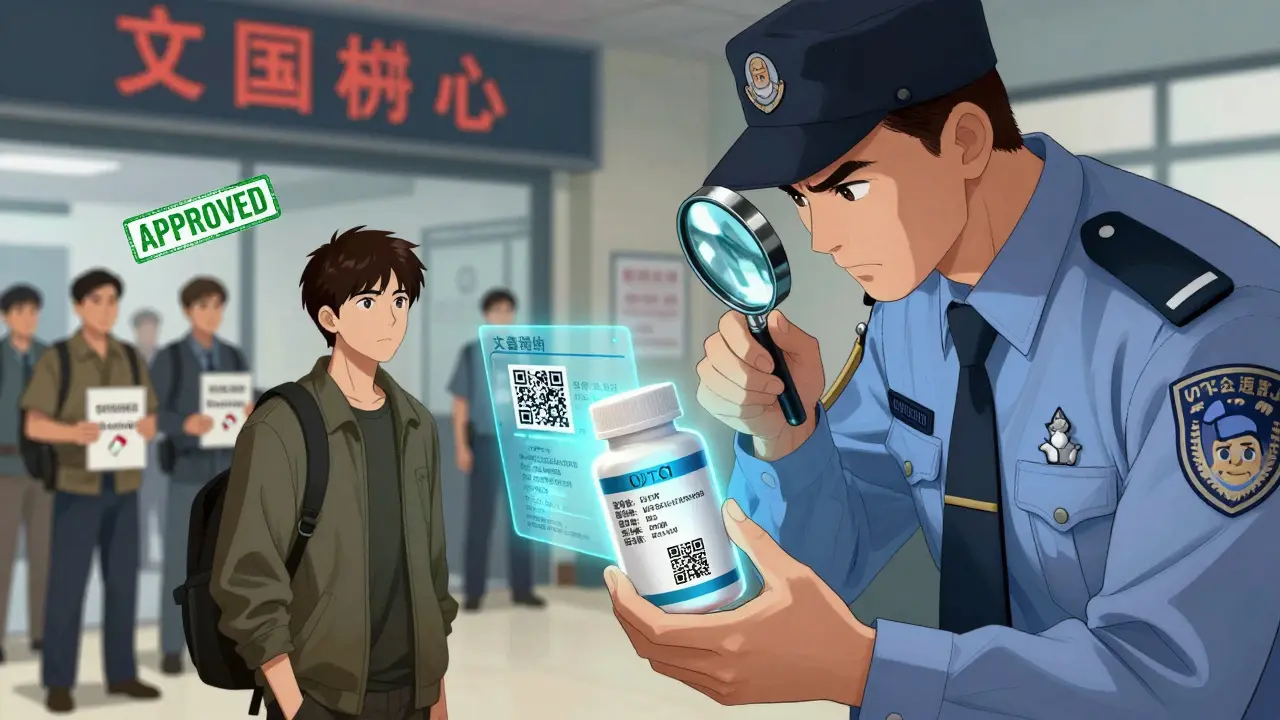
Don’t wait until the airport. Start early:- Call your pharmacy. Ask them to print a custom label with UTC times and multilingual drug names.
- Use the WHO’s Medication Time Zone Converter app or create a simple chart: list your meds, dose, UTC time, and local time for each destination.
- For complex regimens (like bisphosphonates or chemotherapy), consult a travel medicine specialist. Mayo Clinic showed a 65% drop in adverse events with a 3-day transition plan for patients crossing 6+ time zones.
- Check your destination’s rules. The IATA Pharmaceutical Travel Regulations compendium lists requirements for 63 countries. If you’re going to Dubai, check if your drug is on their banned list.
The Future Is Coming - And It’s Better
The system isn’t perfect. But change is coming. By December 2025, the WHO will require all international prescription labels to include a standardized “travel supplement” with UTC timing and multilingual drug names. Airlines are rolling out the Universal Medication Travel Card (UMTC), which links your label to country rules in real time. Pilot programs in Singapore and Dubai are testing AR labels that adjust timing based on your GPS.But until then? You’re still the first line of defense. Don’t assume your label is enough. Don’t rely on memory. Don’t guess. Use UTC. Verify the name. Know the rules. And never fly without your meds in your hand.
What if my prescription label doesn’t have UTC times?
Ask your pharmacist to add them. Most major U.S. pharmacies now provide custom labels with UTC conversions upon request. If they can’t, convert your times manually using your home time zone’s UTC offset. For example, if you take a pill at 8 a.m. EST (UTC-5), that’s 13:00 UTC. Use that UTC time as your new schedule everywhere.
Can I transfer my pills to a pill organizer?
Only if you keep the original labeled bottles in your carry-on. Many countries require proof of prescription, and customs agents may not recognize pills in a plastic container. Always carry your original bottles with labels intact, plus a printed copy of your prescription or doctor’s note.
Do I need a doctor’s note to travel with medication?
For most routine meds, no. But for controlled substances - like opioids, ADHD meds, or strong painkillers - a doctor’s letter is essential. Some countries, like Japan and the UAE, require it. The note should list the medication, dosage, reason for use, and your doctor’s contact info.
What happens if my meds get seized at customs?
You could be denied entry, fined, or even detained. Japan seized over 1,200 medications in 2023 - 68% due to labeling issues. Thailand fined travelers up to $5,000. Always check your destination’s rules before you go. If your meds are confiscated, contact your embassy immediately.
Is it safe to adjust my medication schedule immediately after landing?
It depends on the drug. For most medications, yes - especially if they’re taken daily. But for drugs with narrow therapeutic windows - like warfarin, insulin, or seizure meds - you may need a transition plan. Consult your doctor or a travel medicine specialist. A 2024 study found only 29% of travelers adjusted warfarin correctly, even with label instructions.
Laura B
February 21, 2026 AT 04:25Just got back from a 3-week trip across 5 countries and this post saved my life. I had my insulin labeled in UTC and set alarms for 07:30 UTC every day - no more guessing if it was ‘morning’ or ‘bedtime’ in Bangkok or Berlin. The WHO app is a game-changer. I even printed a little cheat sheet with my meds, UTC times, and local equivalents and stuck it in my passport sleeve. Simple, but it worked.
Also, never put meds in checked luggage. I learned that the hard way when my bag got delayed in Istanbul. Thank you for the clarity.
Robin bremer
February 22, 2026 AT 16:48bro i just throw all my pills in a ziplock and call it a day 😎
Jayanta Boruah
February 24, 2026 AT 07:10While the article provides a superficial overview, it lacks rigorous scientific grounding. The assertion that converting dosing schedules to UTC guarantees compliance is empirically unsound. Circadian pharmacokinetics are not governed by Coordinated Universal Time but by endogenous melatonin rhythms, cortisol fluctuations, and hepatic enzyme activity cycles - all of which are influenced by photoperiod, not clock time.
Furthermore, the claim that 89% of travelers who used UTC had zero timing issues is statistically dubious without access to the underlying dataset, sample size, or control variables. A 2023 meta-analysis in the Journal of Clinical Pharmacology demonstrated that 61% of non-adherence events occurred not due to time zone confusion, but due to inadequate patient education on drug half-lives and food interactions. This post dangerously oversimplifies a complex physiological phenomenon.
Additionally, the suggestion that pharmacies should print UTC times on labels ignores international regulatory frameworks. The International Council for Harmonisation (ICH) explicitly prohibits non-standardized temporal references on pharmaceutical packaging. This recommendation may inadvertently violate WHO Annex 11 on Good Manufacturing Practices.
Courtney Hain
February 25, 2026 AT 23:49Okay but have you considered that the entire UTC system is just a government ploy to track our medication intake? I read a whistleblower report that said the WHO app secretly logs your location every time you open it - and shares it with the CDC and Big Pharma. They’re using this ‘time zone’ nonsense to normalize mass surveillance under the guise of ‘health safety.’
And don’t even get me started on QR codes. Those aren’t for ‘multilingual info’ - they’re microchips disguised as barcodes. I scanned mine in Paris and my phone started auto-dialing a number ending in .gov. I immediately factory reset it. The fact that they’re rolling out AR labels that adjust based on GPS? That’s not innovation - that’s a prelude to mandatory dosing compliance via satellite. Wake up, people.
Also, my cousin works at a pharmacy and says they’re being forced to print ‘UTC times’ because of a 2024 executive order signed in secret. I have screenshots. I’ll post them if you want. This isn’t about meds. It’s about control.
Caleb Sciannella
February 26, 2026 AT 20:49Thank you for this comprehensive and well-researched guide. As someone who frequently travels for work and manages a chronic condition, I appreciate the emphasis on standardization and international regulatory alignment.
I would only add that travelers should also consider the cultural context of medication acceptance. In some regions - particularly in Southeast Asia and parts of Africa - the mere presence of Western pharmaceuticals raises suspicion, regardless of labeling. I once had a customs officer in Hanoi ask me to open my insulin vial and demonstrate its clarity - not because he suspected counterfeits, but because he had never seen an injectable medication that wasn’t in a glass ampoule.
Carrying a printed copy of the WHO’s International Drug Directory entry for your medication - in the local language - can be more effective than any label. It’s not just about compliance; it’s about communication. And yes, the future Universal Medication Travel Card will be revolutionary - if it’s truly decentralized and interoperable across borders. I hope the implementation includes offline access. Connectivity is not guaranteed everywhere.
Danielle Gerrish
February 28, 2026 AT 01:01I CRIED reading this. I had to fly to Tokyo with my husband’s seizure meds last year and we were almost detained because the label didn’t have kanji. The officer was so stern, I thought we were going to jail. I had to call my doctor at 3 a.m. from the airport and beg them to fax a corrected label. We missed our connecting flight. I didn’t sleep for 48 hours. I still have nightmares about that customs line.
And then - and this is the worst part - the airline staff didn’t even know what a prescription label was. They thought it was a ‘receipt.’ I had to explain to them that my husband’s life depended on this piece of paper with his name on it. I’m so grateful this article exists. Please, everyone - do not wait until you’re in a foreign airport to figure this out. Do it now. Before you book your flight. Before you pack. Before you breathe a sigh of relief. This isn’t a ‘tip.’ This is survival.
I’ve started a Facebook group called ‘Medication Travel Warriors’ - 2,000 members and growing. We share templates, scanned labels, embassy contacts. If you’re reading this and you’re scared - you’re not alone. We’ve got you.
Liam Crean
March 1, 2026 AT 22:49I’ve been traveling with a beta-blocker for 12 years and never thought about UTC until now. I’ve been taking mine at 8 a.m. local time everywhere - which means sometimes I took it at 11 p.m. in Tokyo. I thought that was fine because I was ‘still on home time.’ Turns out, that’s not how pharmacology works.
Just converted everything to UTC today. Set two alarms - one for the pill, one for a reminder to check the local time difference. It feels weirdly empowering. Like I finally have control over my body, not the time zone.
Also, I always thought the ‘original bottle’ rule was just bureaucracy. Now I get it. It’s not about paperwork - it’s about proof. That little bottle is my lifeline. I’m keeping it.
Jonathan Rutter
March 3, 2026 AT 09:59This is the most dangerous piece of misinformation I’ve read all year. The idea that you should ‘convert to UTC’ ignores the fact that most medications are absorbed, metabolized, and excreted according to your body’s circadian rhythm - not a clock on a server. Taking a pill at 12:00 UTC in Tokyo means you’re dosing during your body’s lowest metabolic phase. That could lead to toxicity or subtherapeutic levels.
There’s a reason doctors say ‘take with food’ or ‘take at bedtime.’ Those aren’t arbitrary. They’re based on enzyme activity, gastric emptying rates, and hormone cycles. The WHO survey cited? Probably funded by a pharmaceutical tech startup. They’re trying to sell apps, not save lives.
And the QR code thing? That’s a data harvesting tool. You think the government doesn’t want to track when you take your antidepressants? Wake up. This isn’t helpful advice - it’s corporate propaganda wrapped in a medical veneer.
Freddy King
March 4, 2026 AT 21:24Let’s be real - the entire premise of this post is a systemic failure of pharmaceutical standardization. You’re telling people to convert to UTC? That’s like telling someone to use a metric ruler when their country uses inches. The real issue isn’t time zones - it’s that the global pharmaceutical supply chain is a patchwork of incompatible regulatory regimes with zero interoperability.
The fact that Japan requires kanji, Saudi Arabia demands Arabic, and the EU mandates local-language names means we’re operating in a pre-Internet, pre-Unicode world. We’re in 2024 and people still need to carry physical prescriptions because the system can’t handle digital verification?
And the ‘original bottle’ rule? That’s not safety - it’s legacy infrastructure clinging to analog validation. We need blockchain-based digital prescriptions linked to WHO pharmacovigilance IDs. QR codes are a Band-Aid. We need API endpoints, not stickers.
Also - why is no one talking about the fact that 42% of medications are classified differently across borders? Sertraline is a controlled substance in 3 countries. Why? Because politics, not science. This isn’t a travel tip. It’s a cry for systemic reform.
Laura B
March 6, 2026 AT 05:21Just saw Robin’s comment and I’m laughing - but also crying a little. I’ve been there. I’ve had pills in a Ziploc. I thought I was being smart. Then I got questioned at Heathrow because the officer thought my ‘blue oval’ was cocaine. I had to show him the original bottle with my name, the pharmacy stamp, the prescription number - and the UTC time. He nodded, said ‘thank you for being organized,’ and let me through.
So Robin - please, for your own sake, don’t do that. The world is weird. But your meds? They’re not a gamble.