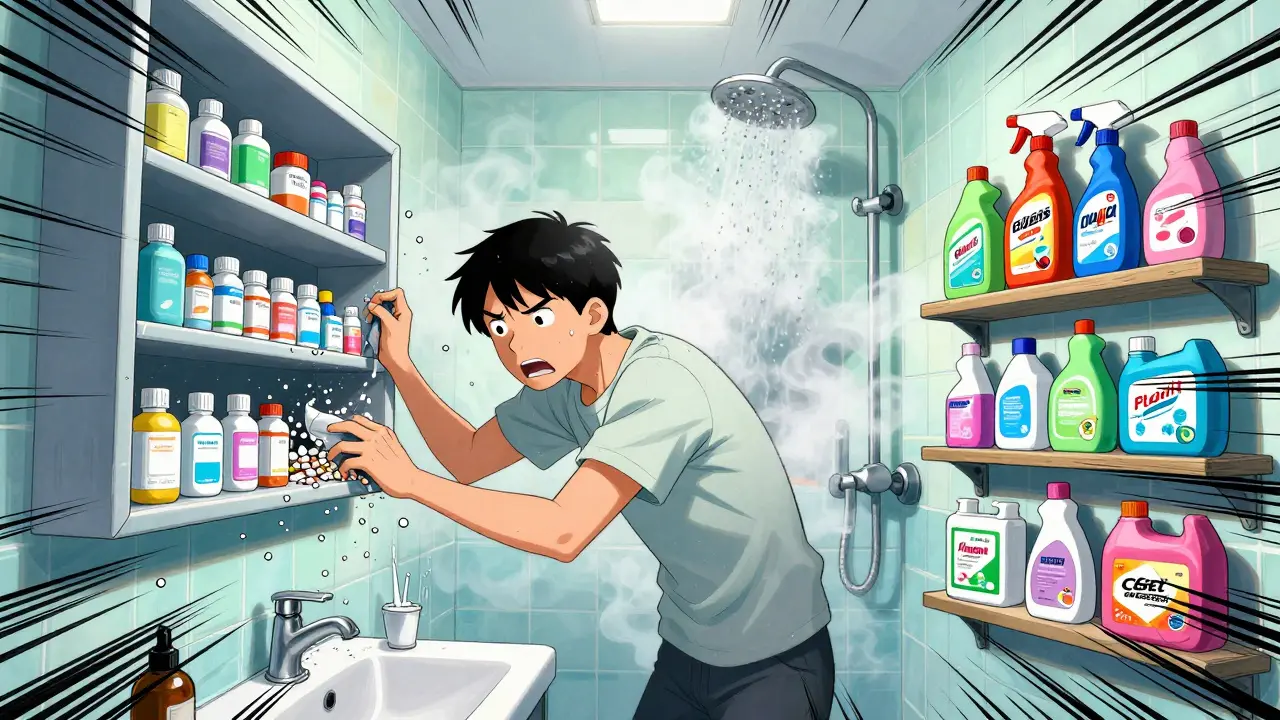
Most of us keep our cleaning supplies and medicines in the same place-the bathroom. It seems convenient until you realize that mixing these two categories creates a serious safety hazard. According to the Centers for Disease Control and Prevention (CDC), 60,000 children are treated in emergency departments annually for accidental medication poisoning. Worse still, the American Association of Poison Control Centers documented 45,000 cases of unintentional exposure where household chemicals mixed with medications in 2022. The problem isn't just about keeping kids away; it's about preventing dangerous chemical reactions that can ruin your meds or create toxic fumes.
You don't need a chemistry degree to fix this. You just need to understand that medicines and cleaners have opposite storage needs. By separating them physically and logically, you protect your health, your wallet, and your family. Here is how to do it right, based on current safety standards from the EPA and NIOSH.
Why Mixing Them Is Dangerous
The first step is understanding why they shouldn't share space. Medications are delicate biological compounds. They degrade when exposed to heat, humidity, and volatile chemicals. Dr. Lewis Nelson from New York University Langone Health found that medications stored within 2 feet of household chemicals degrade 37% faster due to off-gassing. That means your expensive prescription might stop working before its expiration date.
On the flip side, household chemicals like bleach or ammonia are volatile. When they sit near open medicine bottles, their vapors can seep into porous packaging. This cross-contamination doesn't just spoil the drug; it can create new, harmful substances if someone accidentally ingests both. The National Institute for Occupational Safety and Health (NIOSH) emphasizes physical separation as the primary defense against this kind of contamination.
| Feature | Medications | Household Chemicals |
|---|---|---|
| Temperature | Cool, dry (58°F-86°F) | Away from heat sources; some require cool temps |
| Humidity | Low humidity preferred | Ventilated areas to prevent fume buildup |
| Access Level | Locked, out of sight (above 48 inches) | Below eye level (max 54 inches) for spills |
| Container Type | Original labeled containers | Secondary containment for corrosives |
The Golden Rule: Distance and Height
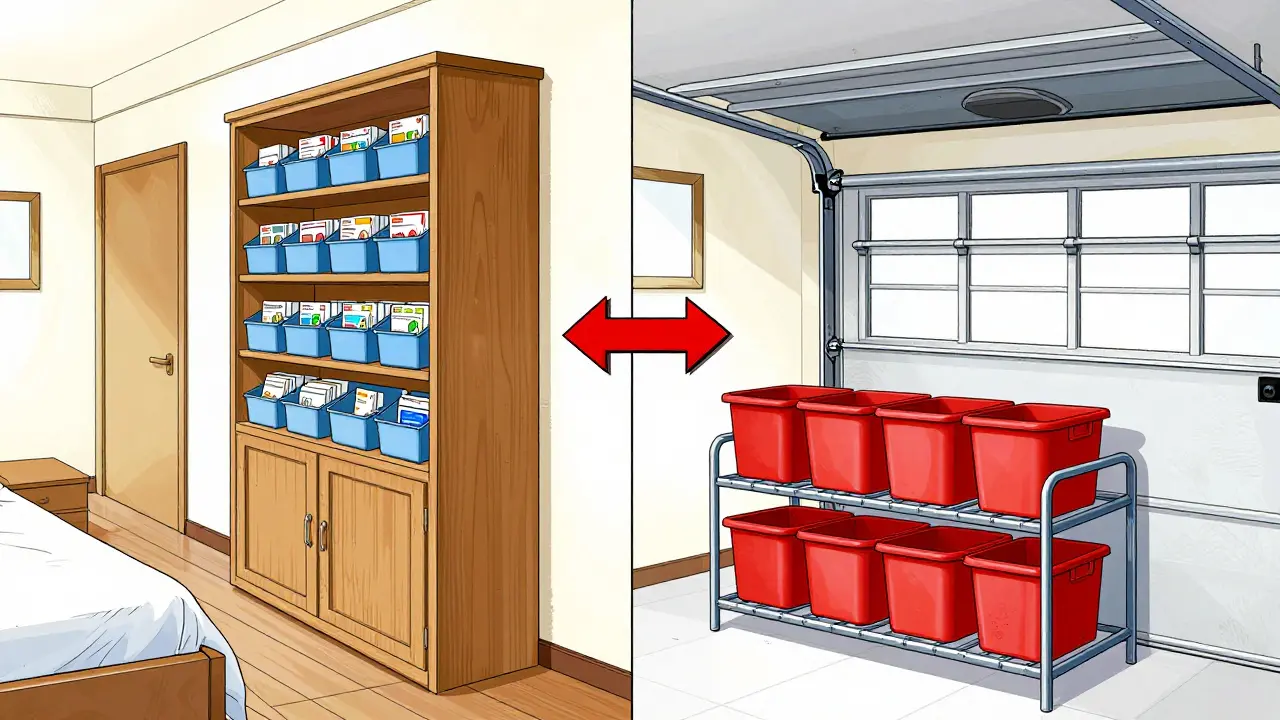
If you take nothing else from this guide, remember the distance rule. Expert consensus establishes a minimum physical separation of 6 feet between where you store medicines and where you store chemicals. The EPA’s Safe Storage guidelines note that 83% of accidental poisoning cases involve items stored within 3 feet of each other. Simply moving your cleaner to the garage and your pills to the bedroom closet solves most problems instantly.
Height matters too, but here is the tricky part: the rules contradict each other. The CDC recommends storing all medications at or above 48 inches to keep them out of children's reach. However, the University of Wisconsin EHS guidelines state that hazardous chemicals should be stored below eye level (maximum 54 inches) so that if a bottle breaks, the spill stays low and doesn't splash onto your face. This narrow 6-inch gap makes sharing a shelf impossible. You must choose different locations entirely.
- Medications: Store in a locked cabinet or high shelf, ideally above 60 inches.
- Chemicals: Store in a well-ventilated area, below eye level, preferably in a utility room or garage.
Handling Refrigerated Medications Correctly
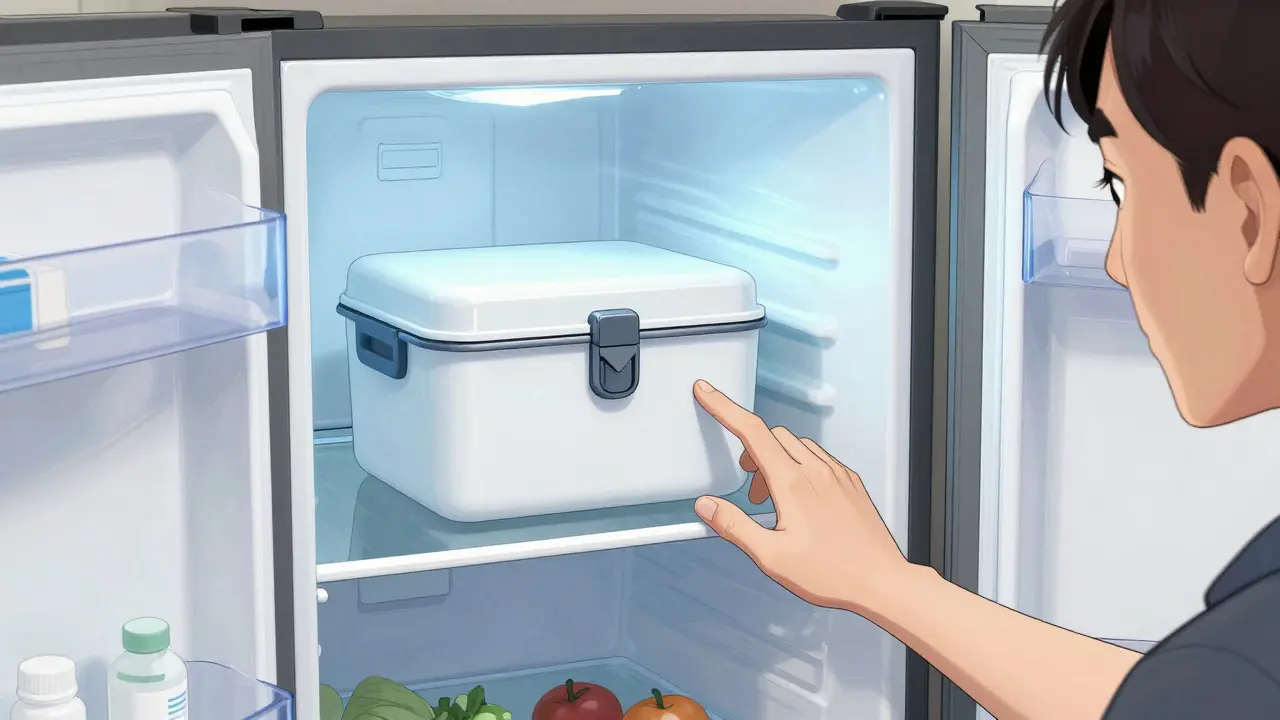
Some medicines, like certain insulins or liquid antibiotics, need refrigeration. This is where many people make a fatal error by putting them next to food or, worse, near cleaning supplies kept in kitchen cabinets. Liquid medications should go in the center of the refrigerator, where temperatures stay stable between 36°F and 46°F. Never put them in the door, where temperature swings exceed 10°F-far beyond the 2°F variation limit recommended by pharmaceutical manufacturers.
Crucially, flammable household chemicals must never be stored in a standard refrigerator. The risk of explosion from sparks inside the fridge is real. If you have insulin and bleach, they cannot share the same appliance or even the same room. Use a lockable box specifically designed for medical use, such as the MedLock Pro 3000, which studies show reduces accidental poisoning incidents by 89%. Keep this box away from any area where you clean or store sprays.
Organizing Your Space: Practical Steps
Now that you know the rules, let’s look at how to set up your home. You don’t need to buy expensive smart systems immediately, though devices like the SafeMed Home System can monitor humidity and reduce degradation risks by 53%. Start with these low-cost, high-impact changes:
- Create Three Zones: Designate one zone for meds (locked, high), one for non-hazardous cleaners (mid-level), and one for hazardous chemicals (low, ventilated).
- Use Color-Coding: The InfantRisk Center found that color-coded storage reduced confusion by 62%. Use blue bins for meds and red for chemicals. Visual cues help everyone in the house avoid mistakes.
- Keep Original Containers: Don't transfer pills to unmarked jars. The CDC reports that keeping meds in original, clearly labeled containers reduces confusion incidents by 67%.
- Install Separate Cabinets: If possible, install a dedicated locked cabinet for meds in a bedroom or hallway, far from the laundry room or garage where chemicals live.
Common Mistakes to Avoid
Even well-meaning families slip up. Consumer Reports found that 38% of households store medications in kitchen drawers. This is risky because kitchens are hubs for cooking oils, detergents, and degreasers. Another common error is using the bathroom medicine cabinet. Bathrooms are humid, hot, and often hold toothpaste, mouthwash, and cleaning wipes-all potential contaminants.
Avoid storing hydrogen peroxide or acetone near medicines. These degrade quickly above 77°F and release vapors that can compromise nearby drugs. Also, never assume that "child-proof" caps are enough. Locked boxes are significantly safer. Dr. Kelly Johnson-Arbor notes that while high shelves are good, locked storage reduces child access by 92%, regardless of height. If you forget the key, you’ve created a new hazard, so keep keys accessible to adults but hidden from kids.
Future-Proofing Your Home Safety
Safety technology is evolving. The National Institute of Standards and Technology is testing RFID-tagged containers that alert you if incompatible substances are placed within 3 feet of each other. While these aren't widely available yet, you can mimic this logic manually. Label your storage areas clearly. Check expiration dates regularly. And always consult your pharmacist if you're unsure about specific storage requirements for your prescriptions.
Separating household chemicals from medication storage isn't just about tidiness. It's a critical health practice that preserves drug efficacy and prevents life-threatening accidents. By creating distinct zones, respecting temperature limits, and using locks, you build a safer home for everyone.
How far apart should I store medicines and cleaning chemicals?
Experts recommend a minimum distance of 6 feet between medication storage and household chemical storage. This separation prevents volatile fumes from degrading medications and reduces the risk of accidental ingestion or mixing.
Can I store medications in the bathroom medicine cabinet?
It is not recommended. Bathrooms are typically humid and experience temperature fluctuations, which can degrade medications. Additionally, bathrooms often store cleaning products, increasing the risk of cross-contamination. A cool, dry, locked cabinet in a bedroom or hallway is safer.
Where should I store flammable household chemicals?
Flammable chemicals should be stored in a well-ventilated area, away from heat sources, and below eye level (maximum 54 inches from the floor) to minimize injury from spills. Never store them in a refrigerator or near medications.
Do I need a lockbox for my medications?
Yes, especially if you have children or pets. Studies show that locked storage reduces child access by 92%. Even without children, locks prevent accidental misuse and keep medications secure from theft or unauthorized access.
How does humidity affect medication storage?
High humidity can cause tablets to crumble, capsules to stick together, and liquids to grow bacteria. Medications should be stored in cool, dry places with temperatures between 58°F and 86°F. Avoid bathrooms and kitchens unless properly ventilated and climate-controlled.
What should I do if a chemical spills near my medications?
If a chemical spills near medications, discard the affected medications immediately. Do not use them, as they may be contaminated. Clean the area thoroughly according to the chemical's safety data sheet (SDS) before restocking.
Brian Irwin
June 1, 2026 AT 04:53honestly this is such a relief to read because i always felt weird about keeping my insulin in the fridge next to the bleach bottle but never had the words to explain why it felt wrong. seeing the actual science behind the off-gassing makes me want to go home and rearrange my entire kitchen right now. thanks for breaking down the height rules too since nobody ever tells you that chemicals need to be low while meds need to be high. its one of those things where common sense should dictate it but we all just lazily throw everything in the bathroom cabinet. i’m definitely getting one of those lockboxes mentioned because peace of mind is worth every penny.
Daniel Tremblay
June 2, 2026 AT 02:55Oh, please. Spare us the lecture on how we’re all walking time bombs waiting to explode because we put our ibuprofen near the Windex. I’ve been storing my meds in the bathroom for twenty years without dying, so clearly the CDC can take their statistics and shove them. It’s not like I’m mixing bleach and ammonia in a bucket under the sink either. This article reads like it was written by someone who has never actually cleaned a house or taken a pill in their life. Just keep your shit organized and stop acting like everyone else is an idiot.
Henri-Paul Soulodre
June 3, 2026 AT 07:01The moral decay of society is evident when we allow such dangerous negligence to persist in our homes! To think that parents are casually exposing their children to toxic fumes while simultaneously degrading their life-saving medications is absolutely horrifying. We have a duty, a sacred obligation, to protect the vulnerable from these invisible killers. The fact that you might be reading this and thinking 'it's fine' is what keeps emergency rooms full. Wake up! Your apathy is killing people!
Aswin Ashokan
June 5, 2026 AT 04:37too much fluff for such simple advice. just separate them. dumb.
William Storm
June 5, 2026 AT 17:48One must consider the epistemological implications of storage logistics; indeed, the dichotomy between pharmaceutical preservation and chemical volatility presents a fascinating case study in domestic entropy. While the author cites NIOSH with apparent reverence, one wonders if such rigid adherence to bureaucratic guidelines stifles the organic chaos necessary for true household equilibrium. Nevertheless, the suggestion regarding the 6-foot rule possesses a certain aesthetic symmetry that cannot be entirely dismissed, even if it borders on the absurdly pedantic.
Wendy Engelmann
June 6, 2026 AT 14:01i used to keep everything in the bathroom because it was convenient but after reading this i realized how much humidity was probably ruining my pills. moving them to a locked box in the bedroom closet seems like such a small change but it feels like a huge step forward for safety. it is interesting how something so simple can make such a big difference in the long run. i appreciate the calm explanation without any panic mongering.
Lisa Thomas
June 7, 2026 AT 14:33OMG thank you for this!! 😱 i literally almost bought a new medicine cabinet today and didn't realize the humidity issue. i'm so glad i stopped to read this first. i'm going to move all my cleaners to the garage immediately. it's scary how many people do this wrong 💔
Nicholas Bowling
June 8, 2026 AT 00:59you guys are all overreacting. i mix bleach and vinegar all the time and nothing happens. this whole guide is just fear-mongering to sell more lockboxes. who needs six feet of separation? my bathroom is tiny and i still live. typical clickbait nonsense designed to make you feel stupid for doing things normally. i refuse to change my habits based on some random internet article. let the chips fall where they may.
Adelaide Motata
June 8, 2026 AT 20:34actually u guys dont know wat ur talking about. i work in a pharmacy and we store everything together fine. the cdc stats are old news. just use common sense. also spelling matters but whatever. most ppl here are clueless.
Mike Crump
June 9, 2026 AT 17:13G'day folks! 🌟 What a fantastic discussion this is turning into. I reckon Daniel Tremblay raises a valid point about convenience, but Henri-Paul Soulodre isn't entirely wrong about the stakes either. As an Aussie who's seen our fair share of summer heatwaves, I can tell you that temperature control is no joke. If you're in a region with high humidity like Brisbane, that bathroom cabinet is basically a sauna for your pills. Try using a desiccant pack in your med box if you can't get AC everywhere. Let's look out for each other's health, eh? 🤝
Samantha Arbuckle
June 10, 2026 AT 03:04this is such a great reminder to check our habits 🙌 i love the color-coding idea especially for families with kids. blue for meds red for chemicals is so easy to remember. lets make our homes safer together! ✨💪
Stephanie Francis
June 10, 2026 AT 09:33I must respectfully disagree with the notion that this is merely a matter of tidiness. The scientific evidence presented regarding degradation rates is irrefutable. Furthermore, the emotional toll of knowing one's family is at risk due to improper storage is significant. One should not dismiss these guidelines as trivial. It is imperative that we adhere to established safety protocols to ensure the well-being of all household members. Thank you for bringing this critical information to light.