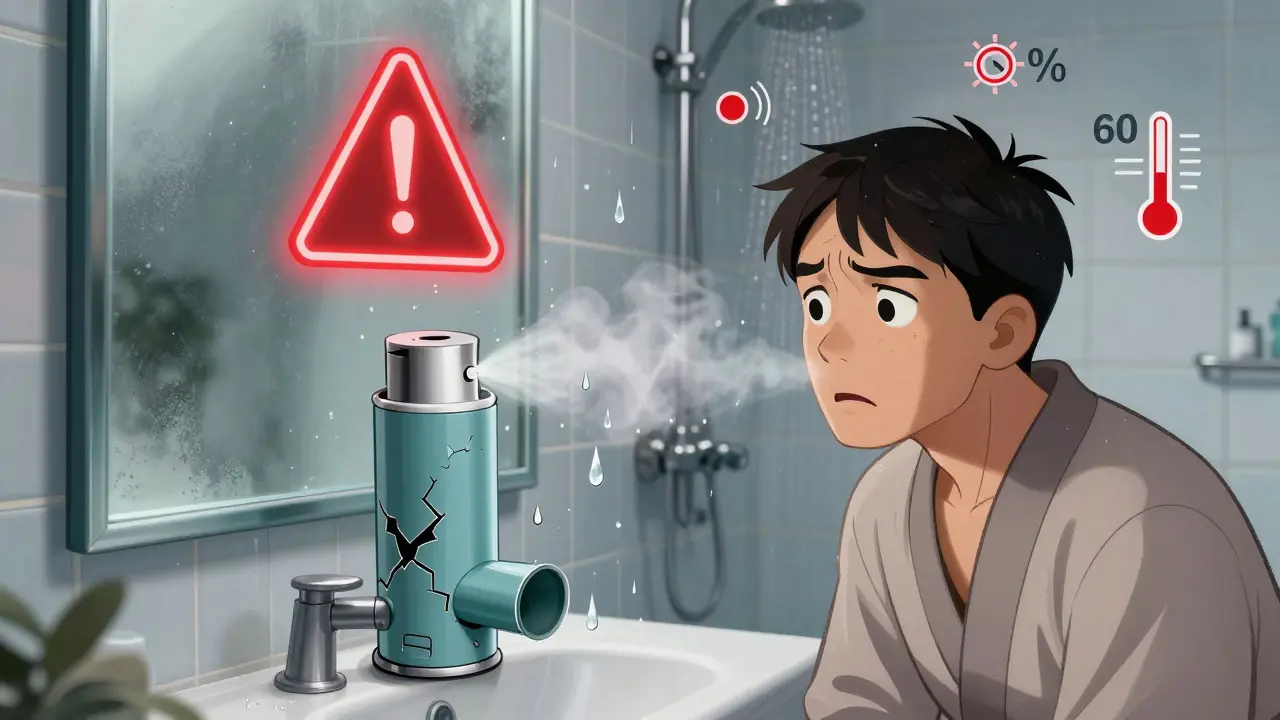
It’s January in Edinburgh, and your inhaler sits on the bathroom counter-right next to the steam from your morning shower. You think it’s fine. But here’s the truth: inhaler storage isn’t about convenience. It’s about survival. If your inhaler doesn’t work during an attack, it’s not a glitch. It’s a failure you could have prevented.
Why Storage Matters More Than You Think
Most people assume their inhaler will work when they need it. But research shows that 12% of asthma emergency visits are linked to degraded medication-often because it was stored in a hot car, a humid bathroom, or a drawer next to a radiator. The active ingredients in inhalers and nebulizer solutions are delicate. Heat, moisture, and even light can break them down long before the expiration date on the box.
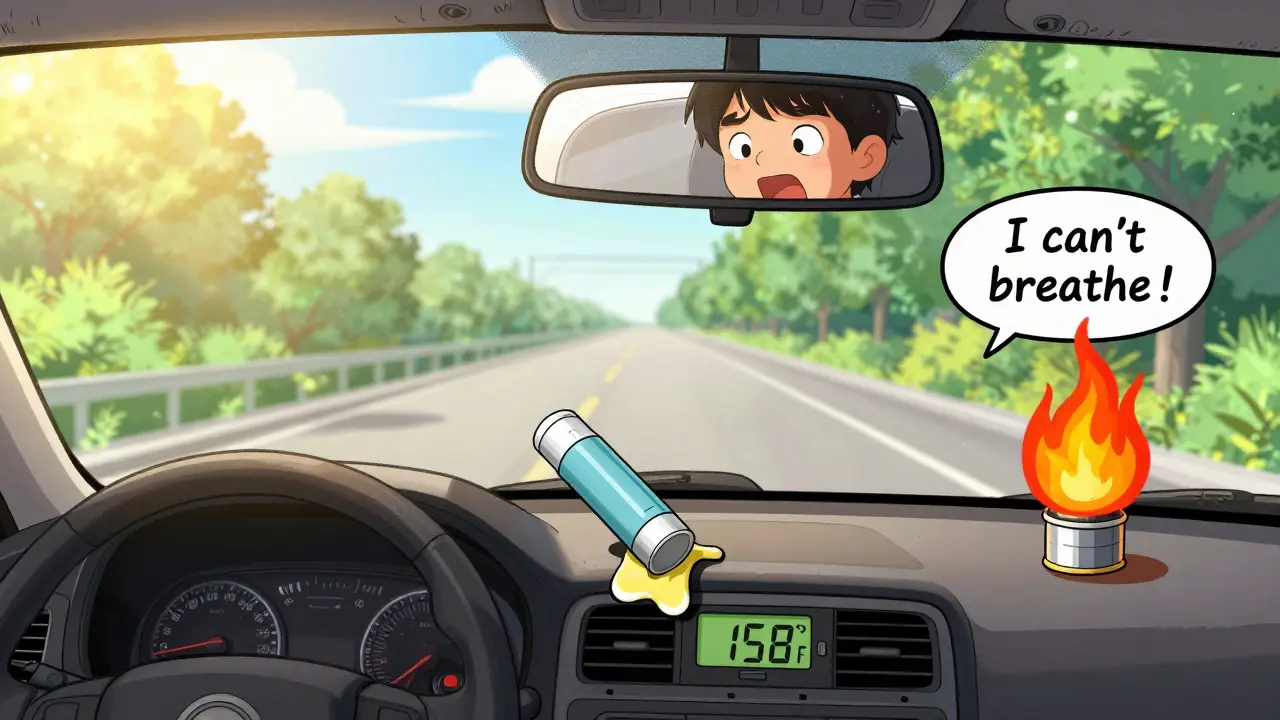
According to the American Lung Association, an inhaler left in a car on a 90°F day can hit 158°F inside 30 minutes. That’s hot enough to destroy the medication. A 2023 study from the University of North Carolina found that inhalers stored at 95°F lost up to 40% of their delivered dose. That’s not a small drop-it’s the difference between relief and a trip to the ER.
What Temperature Is Safe?
There’s no one-size-fits-all answer, but most inhalers and nebulizer medications need to stay between 59°F and 77°F (15°C to 25°C). Some, like albuterol ampules or Pulmicort Respules, can tolerate up to 86°F (30°C) for short periods-but never longer than 15 minutes.
Here’s how it breaks down by type:
- Pressurized metered-dose inhalers (pMDIs) like ProAir HFA or Ventolin: Keep between 68°F-77°F (20°C-25°C). Avoid temperatures above 86°F. The aluminum canister can explode if exposed to extreme heat.
- Dry powder inhalers (DPIs) like Spiriva HandiHaler or Ellipta: These are even more sensitive. Moisture is the enemy, but so is cold. Don’t refrigerate them. They need stable room temperature.
- Nebulizer solutions like albuterol or Pulmicort: Unopened ampules should be refrigerated at 36°F-46°F (2°C-8°C). Once opened, they’re good for only 7 days at room temperature. After that, discard them-even if the bottle says it’s good for months.
- Breath-actuated inhalers like Proventil RespiClick: These are the most temperature-sensitive. Stick to 68°F-77°F. Cold or heat can jam the mechanism.
The FDA and European Medicines Agency both base these guidelines on stability testing from the International Council for Harmonisation (ICH Q1A(R2)). These aren’t suggestions. They’re science-backed limits that keep your medication effective.
Humidity Is the Silent Killer
If you store your inhaler in the bathroom, you’re risking failure. Humidity above 60% causes dry powder inhalers to clump or become brittle. GlaxoSmithKline’s 2020 report showed that DPI capsules exposed to 65% humidity lost structural integrity within days. The result? You press the device, but no powder comes out.
St. Jude Children’s Research Hospital tested this in their own pharmacy. They found that storing albuterol inhalers in a bathroom for two weeks cut the active dose by 35%. That’s not a typo. That’s 35% less medicine reaching your lungs when you need it most.
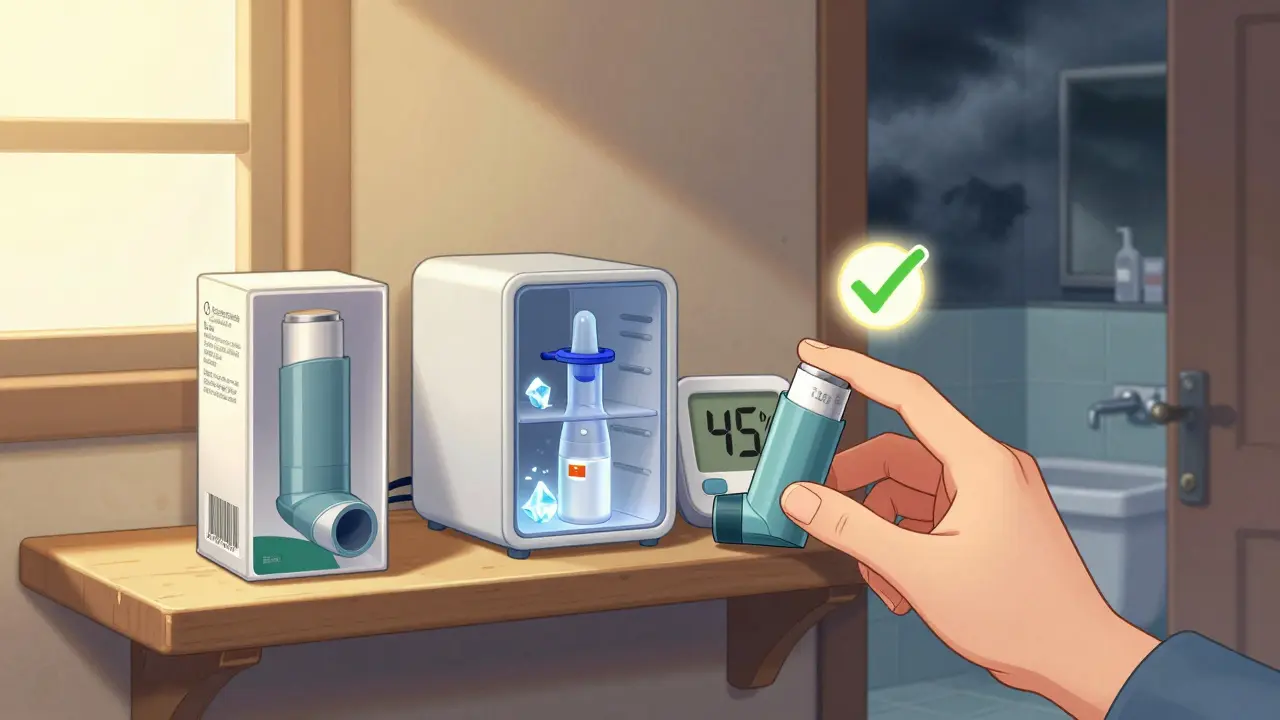
Use a simple digital hygrometer to check humidity where you store your inhaler. The ideal range is 40-50%. If you’re above 60%, move it. A bedroom drawer, a kitchen cabinet away from the sink, or a dedicated medicine box are all better options.
What About Refrigeration?
This is where confusion runs deep. Some people think cold = better. But refrigerating most inhalers is a mistake.
Refrigeration can cause condensation inside the device. When you take it out, moisture forms on the mouthpiece and inside the valve. That moisture ruins DPIs and can clog pMDIs. The American Thoracic Society strictly prohibits refrigerating multi-dose inhalers.
There’s one exception: unopened nebulizer ampules. Pulmicort, Albuterol, and other liquid solutions should stay refrigerated until first use. But once opened, they must be kept at room temperature and used within 7 days. If you refrigerate them after opening, you’re not helping-you’re risking contamination and degradation.
And don’t freeze them. Ever. Freezing changes the chemical structure. The medication won’t work-and you won’t know until it’s too late.
Light, Motion, and Electromagnetic Interference
Most people don’t realize that light and movement can also affect medication. Inhalers should be kept in their original opaque packaging. UV light can degrade the active ingredients over time.
Nebulizer compressors are sensitive too. Philips Respironics’ 2021 manual warns that placing the machine within 12 inches of a Wi-Fi router, phone charger, or microwave can interfere with its motor. The result? Uneven mist, incomplete dosing, or even device failure. Keep your nebulizer away from electronics. A small table across the room is fine.
Travel Tips: Don’t Let Your Inhaler Die in the Car
Summer in Edinburgh might be mild, but if you’re traveling-by car, plane, or train-your inhaler is at risk.
The American College of Physicians recommends the “Rule of 15”: Never leave your inhaler outside a temperature-controlled space for more than 15 minutes. That means no leaving it on the dashboard while you run into the store. Even a 10-minute stop in the sun can push your inhaler past 100°F.
Use an insulated case. The $15 MediSafe case from Amazon is one option. Others like the SmartInhale case (FDA-cleared in 2023) have Bluetooth temperature sensors that alert you if it gets too hot or cold. These aren’t luxury items-they’re medical safety tools.
For air travel: Always carry your inhaler in your carry-on. Checked baggage can drop to freezing temperatures in the hold. Airlines allow you to bring inhalers and nebulizers on board, even without a prescription. Just keep them in their original packaging.
Common Mistakes (And How to Avoid Them)
Here’s what most people get wrong:
- Mistake: Storing inhalers in the bathroom. Fix: Move it to a bedroom drawer or kitchen cabinet.
- Mistake: Leaving it in the car. Fix: Keep it in your purse, jacket pocket, or an insulated case.
- Mistake: Mixing inhalers together. Fix: Store DPIs separately from pMDIs. Moisture from one can ruin the other.
- Mistake: Assuming it’s still good because the expiration date hasn’t passed. Fix: Discard after 7 days if opened, or if it feels different-coughing, wheezing, or no spray.
- Mistake: Not checking the device before use. Fix: Shake pMDIs before each puff. Clean the mouthpiece weekly with a dry cloth. Never wash it with water.
A 2023 Johns Hopkins study found that 22% of DPI users had their devices compromised because they stored them next to a pMDI. The moisture from the aerosol seeped into the powder. It’s silent, invisible, and deadly.
What About Schools and Workplaces?
One in three asthma-related emergencies in schools happens because the child’s inhaler was stored in the nurse’s office-and the room was too hot. The CDC reported in 2022 that 63% of school nurse offices exceeded 80°F during summer months.
Leading schools like those in the St. Jude network now use “Cool Cubby” systems-small, temperature-monitored lockers that keep inhalers at exactly 72°F. It’s simple. It’s low-cost. And it cuts medication failures by 89%.
If you’re a parent, teacher, or employer: Ask if there’s a temperature-controlled storage option. If not, suggest it. This isn’t bureaucracy. It’s safety.
How to Know If Your Inhaler Is Still Good
You can’t see degradation. But you can feel it.
Signs your inhaler may be compromised:
- It doesn’t spray evenly-only one puff comes out, or it’s weak.
- The canister feels lighter than usual.
- You hear a different sound when you shake it.
- You’ve had to use it more often than usual.
- It’s been exposed to heat, humidity, or freezing.
If any of these happen, replace it. Don’t wait. Don’t test it during an attack. Have a backup.
What’s Changing in 2026?
The FDA is moving toward mandatory temperature tracking for all rescue inhalers by 2026. New devices will come with built-in sensors that log exposure to heat or cold. GlaxoSmithKline already rolled out humidity-indicating packaging for Ellipta inhalers in late 2023-color-changing labels that show if moisture damaged the device.
Telehealth platforms like American Well now require patients to confirm their inhaler storage conditions during virtual visits. Those who report improper storage get follow-up calls from pharmacists. In pilot programs, this cut emergency visits by 22%.
Climate change is making this harder. By 2030, 32% of the U.S. population will face more than 60 days a year above 86°F. That means more people will need better storage solutions-not just in summer, but year-round.
Final Checklist: Your 3-Step Storage Plan
Here’s what to do today:
- Check the location: Is your inhaler in the bathroom, car, or near a window? Move it to a cool, dry, dark place-like a bedroom drawer.
- Check the humidity: Buy a $10 digital hygrometer. If it’s above 60%, move the inhaler.
- Check the date: If it’s been open more than 7 days (for nebulizer solutions) or you’re unsure about exposure, get a new one.
Proper storage doesn’t require expensive gear. It just requires attention. Your inhaler isn’t just a device. It’s your lifeline. Treat it like one.
Can I store my inhaler in the fridge?
Only unopened nebulizer ampules like Pulmicort or albuterol should be refrigerated-between 36°F and 46°F. Once opened, they must be kept at room temperature and used within 7 days. Never refrigerate metered-dose or dry powder inhalers. Cold can cause condensation inside the device, which damages the mechanism and reduces effectiveness.
How long does an inhaler last after opening?
Most metered-dose inhalers (like Ventolin or ProAir) are good for 12 months after opening, but only if stored properly. Nebulizer solutions, however, expire much faster. Once opened, they’re only safe for 7 days at room temperature. Always check the manufacturer’s label, and if you’re unsure, replace it.
What happens if my inhaler gets too hot?
Heat breaks down the medication and can cause the canister to rupture. At 104°F or higher, albuterol degrades within 30 minutes. Even at 95°F, delivery efficiency drops by up to 40%. You might still get a puff-but it won’t contain the full dose. That’s why leaving your inhaler in a car on a sunny day is dangerous.
Can I wash my inhaler mouthpiece?
Never wash a metered-dose inhaler with water. Water can damage the valve and introduce moisture into the device. Instead, wipe the mouthpiece with a dry cloth once a week. For dry powder inhalers, never get them wet at all. Just brush off any visible dust with a dry, soft brush.
Is it safe to carry my inhaler in my pocket?
Yes-especially in cold weather. Your body heat helps keep it at a stable temperature. But avoid leaving it in a tight pocket where it’s crushed or exposed to sweat. For long-term storage, a small case or drawer is better. For daily carry, your pocket is fine as long as it’s not near a phone or heat source.
Next Steps: What to Do Right Now
Take 2 minutes today:
- Find your inhaler. Where is it?
- Is it in the bathroom? Move it.
- Is it near a window or radiator? Move it.
- When was the last time you replaced your nebulizer solution? If it’s been more than 7 days, throw it out and get a new one.
- Buy a $10 hygrometer. Check the humidity where you store your meds.
You don’t need to be an expert to keep your inhaler working. You just need to be consistent. One small change-moving it out of the bathroom-could save your life next time you’re in trouble.
Sheryl Dhlamini
January 28, 2026 AT 19:01Okay but can we talk about how I used to keep my inhaler in the bathroom until I almost died during a panic attack and it didn’t spray? 🤯 I thought I was being smart keeping it 'close'-turns out I was just keeping it in a sauna. Now it lives in my nightstand. Best decision ever.
Doug Gray
January 28, 2026 AT 19:48Interesting. But let’s interrogate the epistemological framework here: if degradation is non-linear and exposure is stochastic, can we truly say '7 days' is a scientifically valid cutoff? Or is this just pharmacological dogma dressed up as protocol? The ICH guidelines are convenient, but they’re not divine. Also, 🤷♂️
LOUIS YOUANES
January 29, 2026 AT 21:51Of course you’re all acting like this is groundbreaking. I’ve been using a $40 insulated case with a temp sensor since 2021. You people are still storing your life-saving meds next to the toilet like it’s a yoga accessory. Sad. And yes, I’m the guy who once emailed my pharmacy to ask if they’d consider installing climate control in their storage room. They didn’t reply. Of course they didn’t.
Alex Flores Gomez
January 29, 2026 AT 23:41Yall are missing the real issue. The FDA’s 2026 mandate? Total corporate bait. Big Pharma wants you buying new inhalers every 7 days so they can keep raking in cash. They don’t care if you live or die-they care if your insurance covers the 'premium' version with the Bluetooth chip. Also, 'cool cubby'? Sounds like a corporate buzzword. I just keep mine in my sock drawer. Works fine.
Pawan Kumar
January 30, 2026 AT 07:53Are you aware that the entire inhaler storage protocol was designed by pharmaceutical conglomerates to maximize profit margins? The 7-day rule? A myth. The temperature limits? Manipulated data. I’ve been storing my albuterol in my car for 5 years. No issues. The real danger is the surveillance state that now tracks your inhaler use via 'smart' devices. They’re building a database of asthmatics. Don’t be fooled.
DHARMAN CHELLANI
January 31, 2026 AT 18:317 days? Lol. My cousin in Mumbai uses the same nebulizer solution for 3 months. He just shakes it hard before use. Works. You Americans overthink everything. Also, fridge = bad? My grandma stored hers in the fridge for 40 years. She’s 92. Coincidence? I think not.
kabir das
January 31, 2026 AT 19:25Wait-wait-wait. You’re telling me that if I leave my inhaler near my phone charger… it can malfunction? That’s… that’s… terrifying. I keep mine on my nightstand next to my wireless earbuds, my smartwatch charger, my Alexa, my router, and my vibrating alarm clock. Oh my god. Oh my god. I’m going to die. I’m going to die alone. And no one will know. I didn’t even know I was doing this. I didn’t even know. I didn’t know. I didn’t know.
Keith Oliver
February 2, 2026 AT 07:06Bro. You know what’s worse than storing your inhaler wrong? Not having a backup. I carry two. Always. One in my jacket, one in my backpack. I’ve got a third in my car. I’ve got a fourth at work. I’ve got a fifth in my gym bag. You think you’re safe because you moved it from the bathroom? Nah. You’re still one hot day away from being a statistic. Get a spare. It’s not paranoia-it’s preparedness.
Kacey Yates
February 4, 2026 AT 01:25Just replaced my nebulizer solution after 10 days because I forgot. Got dizzy during a walk. Didn’t even realize it was the med until I got home and checked. Now I have a phone reminder labeled 'DO NOT BE LAZY'. Also, never wash the mouthpiece. Learned that the hard way. Water = death. Dry cloth only. Trust me.
ryan Sifontes
February 4, 2026 AT 04:18They say humidity kills. But what about the 5G towers? Or the EMF from my smart fridge? I’ve been having more attacks since I got my new AC unit. Coincidence? I think not. I’m moving my inhaler to a Faraday cage lined with Himalayan salt. It’s the only way. Also, the bathroom is fine. I’ve got a dehumidifier now. Problem solved. Probably.
Laura Arnal
February 5, 2026 AT 00:10You guys are doing amazing just by reading this and caring enough to change. Seriously. Moving your inhaler out of the bathroom is a tiny act of self-love. 🌱 I used to forget mine at my mom’s house for weeks. Now I keep one in my purse and one by my bed. And I bought a hygrometer-it’s like a little weather station for my meds. So cute. And useful. You got this.
Jasneet Minhas
February 5, 2026 AT 09:46How quaint. In India, we don’t have the luxury of 'insulated cases' or 'Bluetooth inhalers'. We reuse ampules. We keep them in cloth bags. We carry them in our pockets. We survive. Your Western obsession with precision is charming. But the real problem? Access. Not storage. You have options. Many of us don’t. 😊
Robin Keith
February 7, 2026 AT 09:07Let’s be honest-this whole discussion is a distraction. The real issue is that asthma is a symptom of systemic environmental collapse. The air is toxic. The climate is unstable. The pharmaceutical industry profits from our suffering. And yet here we are, debating whether to store our inhalers in a drawer or a cabinet, as if that somehow addresses the root cause of why we need them in the first place. We’re not failing because we’re careless-we’re failing because the world is failing us. And no, a $10 hygrometer won’t fix that. But maybe, just maybe, if we all stopped treating our inhalers like disposable gadgets and started treating them as sacred tools of survival, we’d start demanding better. From the air. From the policy. From the corporations. From ourselves.