
If you’ve been told you need hyaluronic acid injections for your knee pain, you’re not alone. More than 4.6 million Americans got them in 2018 alone - even though doctors still can’t agree if they actually work. For many, it feels like a last resort after painkillers failed and physical therapy didn’t stick. But here’s the truth: these shots aren’t magic. They’re not a cure. And for some people, they barely do more than a placebo.
What Are Hyaluronic Acid Injections Really Doing?
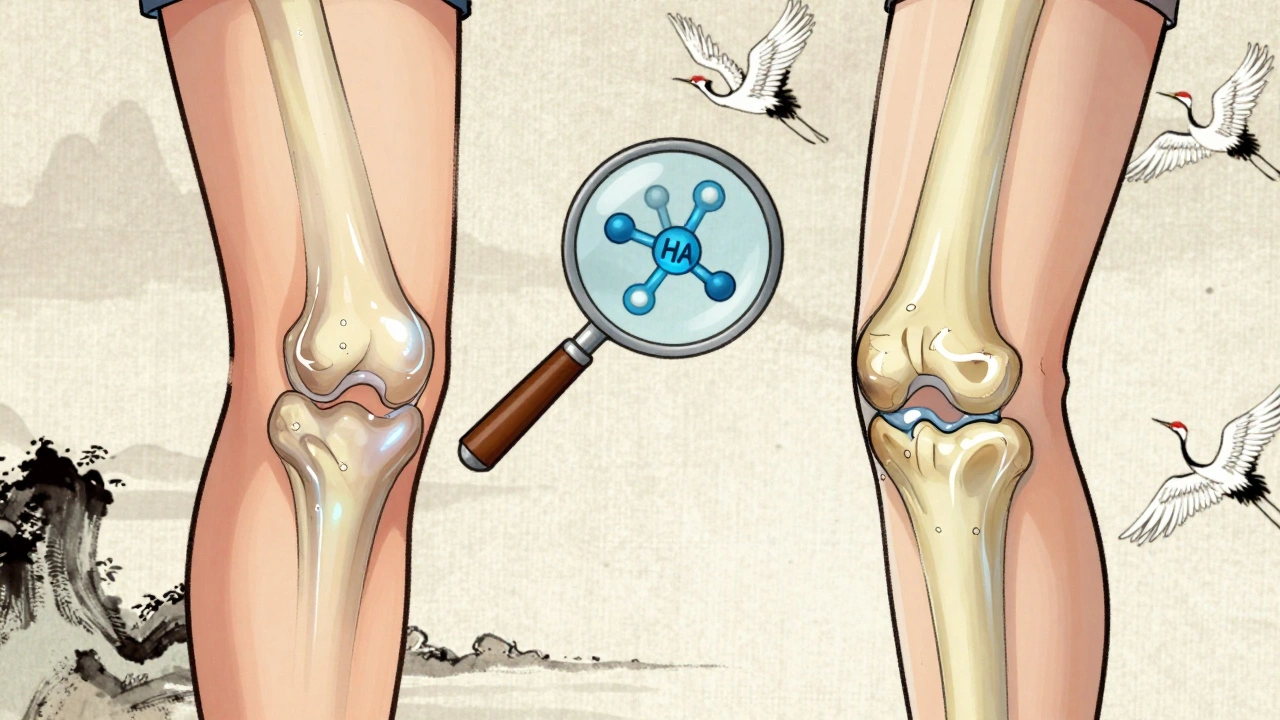
Your joints have a natural lubricant called synovial fluid. It’s thick, slippery, and acts like shock absorber between your bones. In a healthy knee, hyaluronic acid (HA) makes up a big part of that fluid - about 3 to 4 milligrams per milliliter. But when osteoarthritis sets in, that number drops by 30% to 50%. The fluid gets thin, watery, and loses its cushioning power. That’s when your knee starts to grind, ache, and swell.
Hyaluronic acid injections - also called viscosupplementation - try to fix that. Doctors inject a gel-like form of HA directly into the joint. The idea is simple: replace what’s missing. Some products are made from rooster combs (yes, really), others are made in labs using bacteria. Molecular weight matters too. Low-weight versions like Hyalgan (500 kDa) break down fast. High-weight ones like Synvisc (6,000 kDa) last longer but cost more.
It sounds logical. But logic doesn’t always mean effectiveness.
Do They Actually Work?
This is where things get messy.
Some studies say yes. A 2022 meta-analysis found that patients who got two to four injections had slightly less pain than those who got saline shots. The difference? About 9% on a pain scale - barely enough to notice. Other research, including a 2015 NIH review, concluded the effect is “modest” and fades after six months. Then there’s STAT News’ 2022 deep dive into 50 years of data: they found these injections are “barely more effective than a placebo.”
Compare that to corticosteroid shots. Steroids give faster relief - often within days - but it lasts only 4 to 6 weeks. HA injections take 2 to 4 weeks to kick in, but if they work, the relief can stretch out to 26 weeks. That’s a trade-off: slow start, longer ride.
And then there’s the single-injection vs. multi-injection debate. Some brands like Gel-One promise results with just one shot. Others, like Euflexxa or Orthovisc, require three or four weekly shots. The Arthritis Foundation says three doses are more effective than one or two. But a 2022 study by Vincent et al. found no real difference between single and multiple injections. So which protocol should you follow? It depends on who you ask.
Who Benefits Most - And Who Should Skip It?
Not everyone is a candidate. These injections are only meant for mild to moderate osteoarthritis - usually Kellgren-Lawrence grades 1 to 3. That means there’s still some joint space left. If you have “bone-on-bone” arthritis (grade 4), don’t expect anything from HA. Henry Ford Health says it clearly: no benefit.
Good candidates are adults who’ve tried the basics and still hurt: weight loss, exercise, physical therapy, acetaminophen, or NSAIDs like ibuprofen. If those didn’t help enough, HA might be next.
But here’s the catch: not everyone responds. Studies show about 15% get mild pain or swelling after the shot. Less than 0.1% have serious allergic reactions. Most people feel fine. But if you’re one of the 40% to 60% who don’t feel better? You’ve spent time, money, and discomfort for nothing.
There’s no reliable way to predict who will respond. No blood test. No scan. No biomarker. It’s still guesswork.
How It’s Done - And What to Expect
The procedure is quick. You sit in a doctor’s office. The skin around your knee is cleaned. Sometimes they numb it. Then, using ultrasound or X-ray for accuracy, the doctor inserts a needle into the joint space and injects the gel. It takes 5 to 10 minutes. You can walk out right after.
But don’t go for a run the next day. Most clinics advise avoiding heavy activity for 48 hours. You might feel a bit stiff or sore - that’s normal. If your knee swells up badly or turns red, call your doctor. That’s not normal.
Some people feel relief within a week. Others wait 6 to 8 weeks. That’s when pain levels usually peak - if the treatment is going to work at all. After that, it slowly fades. Many patients get repeat injections after 6 to 12 months. But there’s no evidence that repeated use is safer or more effective long-term.
Cost, Coverage, and the $300 Million Question
One shot can cost between $300 and $1,000. A full course of three? That’s $900 to $3,000. Medicare paid over $300 million for these injections in 2022. That’s not because they’re proven. It’s because they’re still covered.
Insurance doesn’t always pay. Some plans require you to try physical therapy or weight loss first. Others won’t cover them unless your arthritis is confirmed on X-ray and you’re past age 50. Always check with your provider.
And here’s the uncomfortable truth: the market keeps growing. New versions are being developed - longer-lasting, cross-linked, combination formulas. Companies are betting on hope. Patients are betting on relief. But the science? It’s still stuck in the middle.

What Experts Really Think
Some doctors swear by them. They’ve seen patients walk again after years of pain. Others refuse to give them. They point to the Cochrane reviews, the NIH reports, the BMJ analyses - all showing weak or no benefit.
The Cleveland Clinic says HA “might” protect cartilage. But there’s no solid proof. The Arthritis Foundation says it’s “an option” - not a recommendation. The American Academy of Orthopaedic Surgeons doesn’t endorse it at all.
One thing everyone agrees on: HA injections aren’t a substitute for exercise. Strength training, low-impact cardio, and weight control are still the most proven ways to slow osteoarthritis. If you’re skipping those to chase a shot, you’re missing the real game-changer.
Alternatives Worth Considering
If you’re thinking about HA injections, ask yourself: what else could help?
- Corticosteroid shots: Faster pain relief (days), but short-lived (weeks). Good for flare-ups.
- Physical therapy: Builds muscle around the knee. Reduces load on the joint. Proven to work long-term.
- Weight loss: Losing just 10 pounds cuts knee pressure by 40 pounds with every step.
- Braces or shoe inserts: Can shift pressure away from the damaged part of the joint.
- PRP or stem cell injections: Still experimental. Much more expensive. No strong evidence yet.
Some people combine treatments. A steroid shot to calm a flare, then HA to try for longer relief, while doing PT and losing weight. That’s smart. Relying only on HA? That’s risky.
The Bottom Line
Hyaluronic acid injections are not a scam. But they’re not a miracle either. They’re a gray area - a treatment with weak evidence, moderate risk, and variable results. If you’re in mild to moderate pain, have tried everything else, and are okay with a 50-50 chance of feeling better for a few months, they might be worth a try.
If you’re hoping for a permanent fix, you’ll be disappointed. If you’re avoiding surgery because you think this will delay it - maybe, but not guaranteed. And if you’re doing it because your doctor suggested it without explaining the odds? You deserve better.
Ask for the data. Ask how many patients benefit. Ask what happens if it doesn’t work. And never let anyone make you feel like you’re giving up if you say no.
John Webber
December 2, 2025 AT 01:52i got these shots last year and honestly? my knee felt fine for like 3 months then back to normal. wasted $800 and a whole afternoon sitting in a clinic. why do they even still offer this?!
Elizabeth Farrell
December 4, 2025 AT 00:27I understand how frustrating it is to hear ‘this might help’ when you’re already in so much pain. But for some people, even a small improvement-like being able to walk to the mailbox without wincing-is worth trying. I’ve seen friends who didn’t respond, and others who finally slept through the night after years of discomfort. It’s not magic, but it’s not nothing either. Be kind to yourself as you decide what’s right for your body.
And if you do try it, please don’t skip the PT afterward. That’s where the real magic happens.
Michael Campbell
December 5, 2025 AT 06:13Big Pharma loves this. Rooster combs? Really? They’re selling snake oil and calling it science. And don’t get me started on Medicare paying $300M for this crap. They’re milking the elderly while real treatments get ignored.
Victoria Graci
December 5, 2025 AT 21:29It’s funny how medicine keeps chasing the illusion of a quick fix while ignoring the slow, messy truth: our bodies heal through movement, not injection.
Hyaluronic acid isn’t a cure-it’s a Band-Aid with a price tag. We treat joints like broken machines that need a lubricant refill, but they’re living tissue, shaped by use, weight, stress, and time. The real question isn’t ‘does it work?’-it’s ‘why are we so desperate to avoid the harder work?’
Maybe we’re afraid of what it means to truly care for ourselves: to lose weight, to move daily, to sit with discomfort instead of numbing it. The shot is easier. So we keep buying it.
Anthony Breakspear
December 7, 2025 AT 17:39Look, I’m not here to sell you on HA shots. I’ve had ‘em twice. First time? Felt like a miracle for 5 months. Second time? Barely noticed a difference. So I stopped chasing the needle and started chasing the squat rack.
Turns out, strengthening my quads and hamstrings did more than any gel from a rooster ever could. If you’re gonna drop cash on this, make sure you’re also doing PT, walking daily, and watching your weight. Otherwise you’re just throwing money at a symptom.
Also-don’t be afraid to say no. Your knee isn’t a vending machine.
william tao
December 8, 2025 AT 16:06It is regrettable that the medical establishment continues to endorse a therapeutic modality that lacks robust, reproducible efficacy data, as evidenced by multiple systematic reviews and meta-analyses published in peer-reviewed journals. The persistence of viscosupplementation in clinical practice, despite its marginal benefit-to-risk ratio, represents a failure of evidence-based medicine and an indictment of pharmaceutical influence.
Sandi Allen
December 9, 2025 AT 11:37They’re lying to you. They’re all lying. Rooster combs? Lab-made? Who’s really behind this? Big Pharma + the AMA + the insurance companies-they want you hooked on injections so you never question the system. And don’t forget: they’re testing this on elderly people who can’t fight back. You think this is medicine? It’s exploitation. Wake up.
Shubham Pandey
December 10, 2025 AT 15:42Waste of money. I tried it in India. Same thing. No difference. Just pay for PT.
Sheryl Lynn
December 11, 2025 AT 18:59How quaint. We’ve replaced ancient wisdom-movement, breath, alignment-with a viscous gel harvested from poultry genitalia. Truly, the pinnacle of modern pharmacological artistry. One wonders if the next innovation will be a serum derived from unicorn tears… priced at $1,200 per vial, naturally.
Paul Santos
December 13, 2025 AT 00:47It’s fascinating how we anthropomorphize joints as ‘worn-out machines’ needing ‘lubrication’-a reductionist narrative that conveniently ignores neuroplasticity, proprioceptive retraining, and the biopsychosocial model of pain. HA injections? A temporal palliative with negligible effect size (Cohen’s d < 0.2). Meanwhile, exercise therapy has an effect size of 0.6+. The real tragedy? We’re still debating this in 2025. 🤦♂️
Eddy Kimani
December 13, 2025 AT 07:50From a biomechanics perspective, the molecular weight of HA is critical-high MW HA (like Synvisc) may better restore viscoelasticity in degenerated synovial fluid. But the real issue isn’t the injection-it’s the lack of personalized treatment protocols. We need biomarkers to predict responders. Until then, it’s a gamble. Still, for patients with contraindications to NSAIDs or steroids, it’s a viable option. Just manage expectations.
Chelsea Moore
December 14, 2025 AT 04:35They told me this would ‘save my knee’… and now I’m sitting here with a $2,400 bill and a knee that still screams at 3 a.m. I cried in the parking lot. I trusted my doctor. I trusted the system. And now I feel like a fool. Why didn’t anyone just say ‘it might not work’? Why did they make it sound like hope?!
John Biesecker
December 14, 2025 AT 07:25my knee’s been better since i started walking 40 mins a day… and no, i didn’t need a shot. but hey, if you wanna spend $1k to feel like you’re doing something? go for it. just don’t forget to move your legs after. 🤘🦵