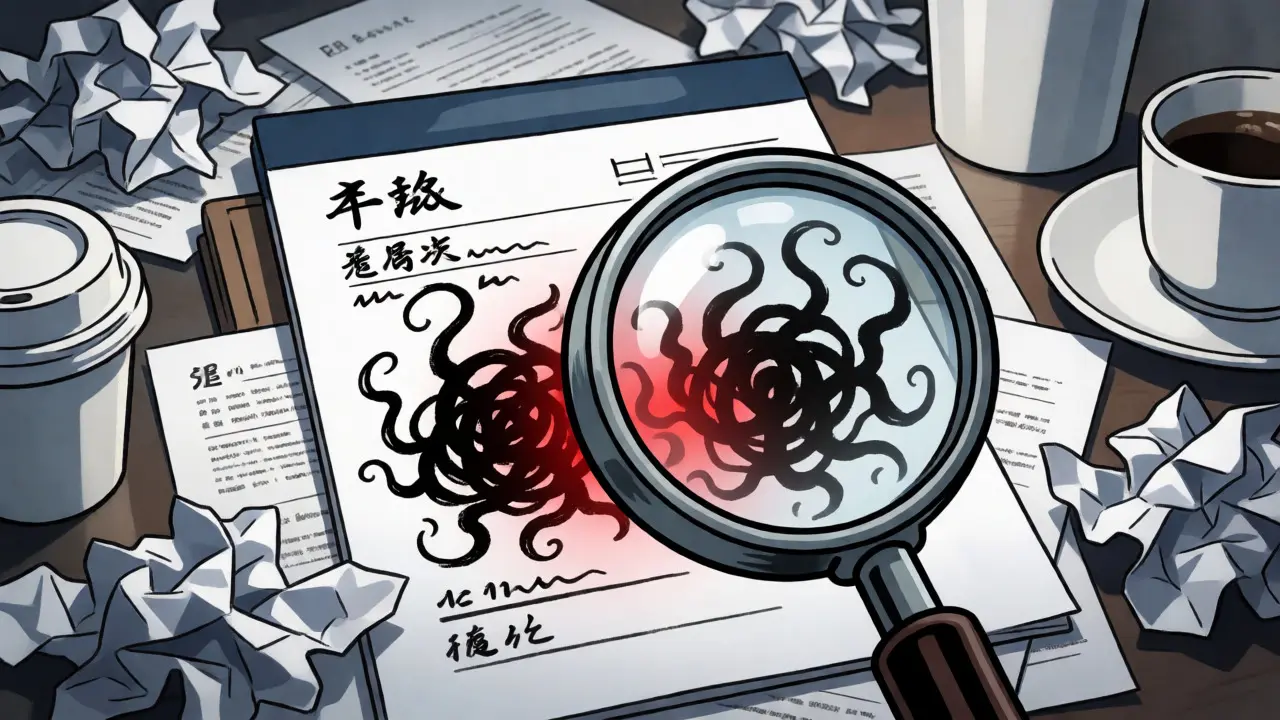
You hand over a slip of paper to the pharmacist. They squint. You squint back. Is that a '5' or an 'S'? Is it 'mg' or 'mcg'? This isn't just awkward; it's dangerous. Illegible handwriting is a persistent source of preventable medical errors that leads to incorrect dosages, wrong medications, and treatment delays. Despite living in an era of AI and instant data, this "dinosaur" still roams hospitals and clinics, causing thousands of adverse events every year.
The stakes are higher than you might think. The Institute of Medicine estimates that illegible prescriptions contribute to approximately 7,000 preventable deaths annually in the United States alone. That’s more than many common diseases kill. If you’ve ever felt frustrated waiting while a pharmacist calls your doctor to clarify a scribble, you’re part of a massive operational burden. Pharmacists make 150 million clarification calls per year in the U.S. just because they can’t read what’s written. So, how do we fix this? And if we can’t all switch to digital overnight, what are the interim solutions?
Why Handwritten Prescriptions Still Cause Chaos
It’s easy to blame doctors for having bad penmanship. But the problem isn’t just about neatness; it’s about cognitive load and systemic design. Physicians are multitasking machines. They manage complex patient histories, interact with electronic health records (EHRs), and communicate with nurses-all while trying to write legibly. A study by Jadhav et al. found that 68% of medical trainees believed improving handwriting would take too much time during busy patient encounters. When speed conflicts with clarity, safety suffers.
The consequences aren’t abstract. Look-alike, sound-alike drug names become nightmares when handwritten. A sloppy 'u' can turn into a 'v', changing one drug into another. Missing decimal points can multiply a dose by ten. In a 2005 audit of operative notes in a British hospital, only 24% were rated as excellent or good for legibility. The rest? Poor enough to confuse nurses, physiotherapists, and other medical officers. This ambiguity forces healthcare professionals to guess, and guessing in medicine is a gamble with patient lives.
The Digital Shift: How E-Prescribing Solves Legibility
Electronic prescribing is the systematic replacement of handwritten orders with digital entries transmitted directly from provider to pharmacy. It emerged around 2003 and has since transformed the landscape. By 2019, adoption among office-based providers in the U.S. hit 80%. Why? Because it works.
Research published in JMIR in 2025 confirmed what many suspected: electronic prescriptions achieve an 80.8% accuracy rate in compliance with safety criteria, compared to a dismal 8.5% for handwritten ones. Even when doctors manually type out prescriptions without templates, accuracy jumps to 56%, far surpassing the handwritten baseline. Veradigm reports that e-prescribing reduces illegibility-related errors by 97%. That’s not a marginal improvement; it’s a near-elimination of the problem.
| Metric | Handwritten Prescriptions | Electronic Prescriptions |
|---|---|---|
| Safety Compliance Rate | 8.5% | 80.8% |
| Error Reduction Potential | Baseline (High Risk) | 97% reduction in illegibility errors |
| Clarification Calls Needed | High (150M+ annually in US) | Negligible |
| Adoption Status (US, 2019) | Declining | 80% of office-based providers |
Barriers to Going Fully Digital
If e-prescribing is so great, why do we still see handwritten scripts? Money and workflow friction. Implementing comprehensive e-prescribing systems costs between $15,000 and $25,000 per provider. For small practices or resource-limited settings, that’s a huge hurdle. Plus, there’s the learning curve. Staff need 8-12 hours of training per clinician. For already overworked doctors, adding screen time feels like another task on an endless list.
There’s also the risk of new types of errors. Researchers Osmani et al. warn about "alert fatigue." When software bombards clinicians with pop-ups for minor interactions, doctors start ignoring them. If they override a critical warning because they’re annoyed by the system, the safety benefit vanishes. We solve one problem (bad handwriting) but risk creating another (complacency toward digital alerts).

Interim Solutions for Non-Digital Settings
Not everyone can go digital tomorrow. In rural areas or developing nations, infrastructure gaps mean handwritten prescriptions will persist for years. So, what’s the best way to keep patients safe while we wait for full digitization? We need strict protocols.
- Print, Don’t Cursive: Block letters are universally easier to read than cursive. There’s no ambiguity between an 'l', 'i', or 'j'.
- Avoid Dangerous Abbreviations: Stick to The Joint Commission’s "Do Not Use" list. Never use 'U' for units (it looks like a zero or four). Write out "units" completely.
- Use Leading Zeros: Write "0.5 mg," not ".5 mg." The leading zero prevents misreading half a milligram as five milligrams.
- Eliminate Trailing Zeros: Write "5 mg," not "5.0 mg." A trailing zero can be mistaken for a comma or decimal point, turning 5 into 50.
- Standardize Measurements: Always include units (mg, mL, mcg). Never assume the pharmacist knows whether you mean milligrams or micrograms.
Self-assessment tools can help too. A 15-item checklist, as suggested by Sendlhofer et al., allows prescribers to review their own scripts for completeness and legibility before handing them over. It’s a low-tech quality control step that catches omissions-like missing prescriber initials or frequency instructions-before they leave the clinic.
The Role of Technology Beyond Simple Typing
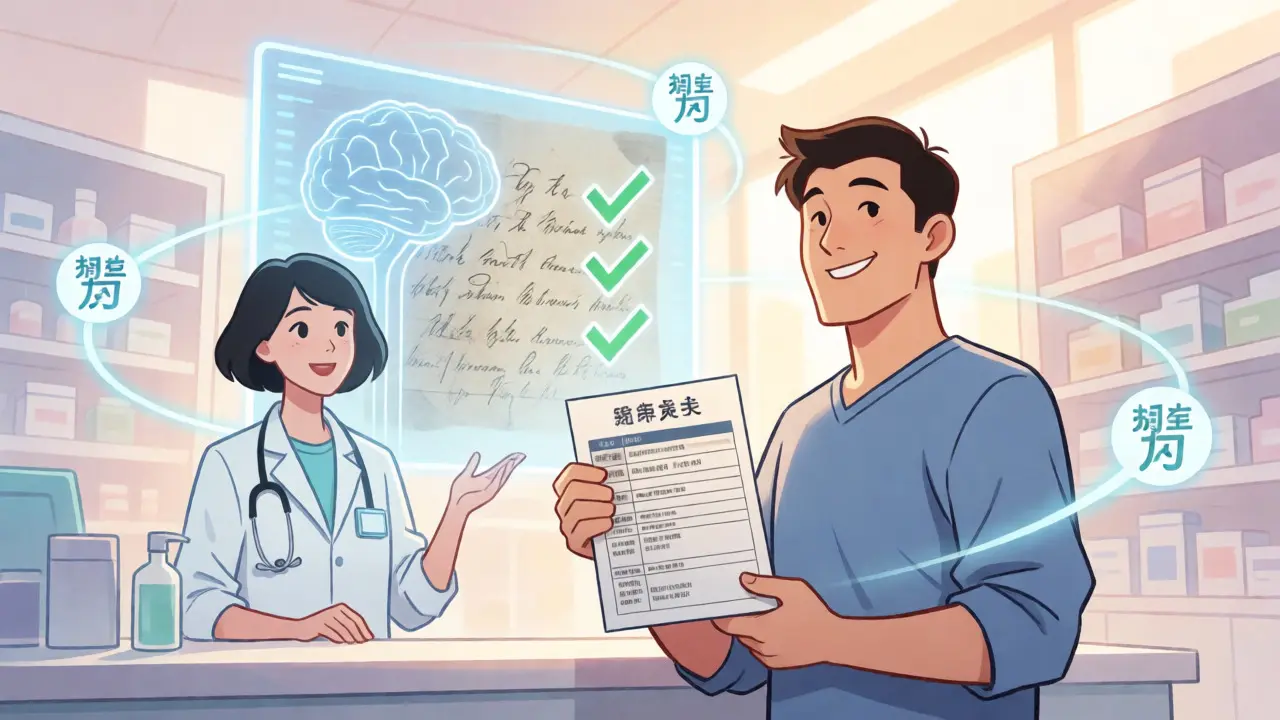
We’re moving beyond simple typing. Artificial Intelligence (AI) is stepping in to bridge the gap. Early studies show AI-assisted handwriting recognition achieves 85-92% accuracy in interpreting common medication names. This technology could serve as a safety net for hybrid systems where doctors still write, but software scans and flags ambiguous terms immediately.
However, tech isn’t a magic wand. It requires robust maintenance and integration. If the EHR crashes, does the prescription system fail too? Reliability is key. Furthermore, interoperability standards mandated by laws like the 21st Century Cures Act ensure that different systems can talk to each other. Without this, you get fragmented care where the pharmacy can’t access the doctor’s context, leading to new kinds of confusion.
What Patients Can Do Right Now
You don’t have to be a passive victim of bad handwriting. You can advocate for your safety. Here’s how:
- Ask for Clarity: If you can’t read your label or the script, ask the pharmacist to explain it. Say, "Can you confirm this is 5 milligrams, not 50?"
- Request Printed Copies: Many pharmacies provide printed summaries of your medications. Ask for one. It removes the handwriting variable entirely.
- Use Patient Portals: Most modern clinics offer online portals where you can view your active prescriptions digitally. Check these instead of relying solely on paper slips.
- Verify Dosage Instructions: Read the directions aloud to yourself. If it says "take two tablets twice daily," repeat it back to the pharmacist. Confirming verbally creates a second layer of verification.
Remember, 22% of healthcare participants admit to ignoring illegible writing rather than seeking clarification. Don’t let your provider or pharmacist be part of that statistic. Speak up. Your health depends on clear communication.
The Future: Extinction of the Scribble?
Leape and Berwick called handwritten notes a "dinosaur long overdue for extinction" back in 2000. Twenty-six years later, the sentiment holds true. With regulatory pushes like CMS meaningful use criteria and the economic pressure of reducing $20 billion in annual error costs, the trajectory is clear. Handwritten prescriptions are becoming rare in developed healthcare systems.
By 2030, experts predict they’ll be nearly extinct globally, except perhaps in the most remote areas. The transition isn’t just about convenience; it’s about moral imperative. Every illegible script is a potential adverse event waiting to happen. As technology becomes cheaper and more intuitive, the excuse for scribbling fades. We owe it to patients to make sure the last thing they hear is a clear, unambiguous instruction-not a squinted guess.
How many deaths are caused by illegible prescriptions?
The Institute of Medicine estimates that approximately 7,000 preventable deaths occur annually in the United States specifically due to errors stemming from illegible handwriting and prescription filling mistakes. This represents a significant portion of the 44,000-98,000 total preventable medical error deaths reported yearly.
Is e-prescribing safer than handwritten prescriptions?
Yes, significantly. Studies show electronic prescriptions have an 80.8% safety compliance rate compared to only 8.5% for handwritten ones. E-prescribing reduces illegibility-related errors by up to 97%, minimizing the risk of dosage mistakes and wrong-drug dispensing.
What are dangerous abbreviations in prescriptions?
Dangerous abbreviations include 'U' for units (can look like 0 or 4), 'IU' for International Units (can look like IV), and trailing zeros (e.g., 5.0 mg, which can be misread as 50 mg). The Joint Commission maintains a "Do Not Use" list to standardize these and prevent misinterpretation.
Why do doctors still write prescriptions by hand?
Reasons include lack of access to electronic systems in resource-limited settings, high implementation costs ($15k-$25k per provider), workflow disruptions, and habit. Some physicians find typing slower than writing during brief consultations, though this is decreasing as interfaces improve.
Can AI fix bad handwriting?
AI-assisted handwriting recognition shows promise, with early studies indicating 85-92% accuracy in interpreting medication names. However, it is currently used as a supplementary tool rather than a complete replacement for digital entry, as human verification is still required for critical safety checks.