
Imagine living with a heavy fog that won’t lift, no matter how many antidepressants you’ve tried. For millions of people with treatment-resistant depression (TRD), this is daily reality. Standard therapies often fail to provide relief, leaving patients feeling stuck and hopeless. But there is a new frontier in mental health care: rapid-acting treatments derived from ketamine, originally an anesthetic drug.
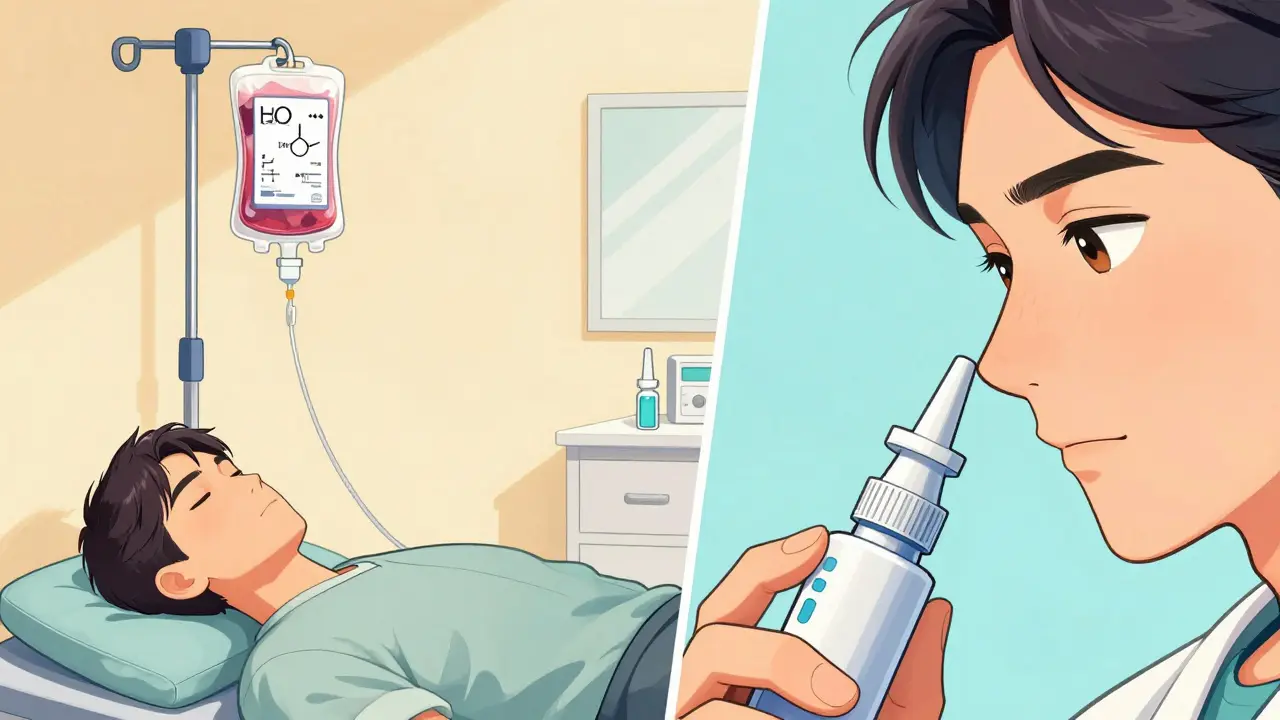
Today, two main options dominate the conversation: intravenous (IV) ketamine and nasal spray esketamine (sold under the brand name Spravato). Both work differently than traditional antidepressants, offering relief in hours or days rather than weeks. But which one is right for you? The answer isn't simple. It depends on your symptoms, your budget, your tolerance for side effects, and even where you live.
What Are Ketamine and Esketamine?
To understand the difference, we first need to look at the chemistry. Ketamine was approved by the FDA in 1970 as a dissociative anesthetic. It is a "racemic" mixture, meaning it contains two mirror-image molecules called enantiomers: the (R)-enantiomer and the (S)-enantiomer.
Esketamine is just the (S)-enantiomer part of that mix. Janssen Pharmaceuticals isolated this specific molecule and developed it into a nasal spray, receiving FDA approval for depression in March 2019. Because esketamine is only half the chemical structure, some researchers believed it would be more potent and have fewer side effects. However, real-world data suggests the full mixture (IV ketamine) might actually be more effective for severe depression, though it comes with stronger dissociative effects.
The key distinction lies in administration and regulation. IV ketamine is used "off-label" for depression, meaning doctors prescribe it based on clinical evidence but not an FDA-specific indication for this use. Esketamine (Spravato) is FDA-approved specifically for TRD and for adults with acute suicidal thoughts when combined with an oral antidepressant.
Efficacy: Which One Works Better?
If speed and depth of relief are your top priorities, recent large-scale studies point toward IV ketamine. A landmark retrospective study published in the Journal of Clinical Psychiatry in September 2025 compared 153 adult patients at McLean Hospital (part of Mass General Brigham). The results were striking:
- IV ketamine reduced depression scores by 49.22% by the final dose.
- Intranasal esketamine reduced scores by 39.55%.
More importantly, IV ketamine showed faster onset. Patients reported symptom improvement immediately after their first infusion. In contrast, those using esketamine typically needed two treatments before seeing significant changes. This aligns with a 2020 meta-analysis in PubMed Central, which concluded that intravenous ketamine appears more efficacious across multiple time points.
However, "better" is subjective. While IV ketamine offers deeper relief, esketamine’s consistency and ease of use make it a strong contender for maintenance therapy. Dr. Christine Denny of Columbia University noted in a 2024 commentary that esketamine’s favorable safety profile makes it better suited for long-term outpatient management.
Safety and Side Effects: What to Expect
Both treatments cause dissociation-that floating, detached feeling where you might feel separated from your body or surroundings. This is actually part of how they work, but it can be unsettling.
In the Mass General Brigham study, 42.3% of IV ketamine patients experienced dissociation, compared to 28.7% of esketamine users. Hallucinations are also more common with IV ketamine. If you have a history of psychosis or bipolar disorder, these risks require careful evaluation by a psychiatrist.
Esketamine has a lower incidence of severe dissociative symptoms because the dose is controlled via nasal spray. However, it still requires strict monitoring. Both treatments mandate a 2-hour observation period after administration due to risks like sedation, dizziness, and blood pressure spikes.
Another critical safety factor is abuse potential. Ketamine is a Schedule III controlled substance. While therapeutic doses are carefully managed, the street drug "Special K" poses addiction risks. Esketamine carries the same classification but is harder to misuse due to its medical-only distribution model.
Cost and Insurance Coverage
Money is often the biggest barrier to access. Here’s how the costs break down in 2026:
| Treatment Type | Average Cost (8 Sessions) | Insurance Coverage Rate | Administration Setting |
|---|---|---|---|
| IV Ketamine | $4,200 - $5,600 | ~38.2% | Clinic/Hospital (Requires IV access) |
| Esketamine (Spravato) | $5,800 - $6,900 | ~67.4% | Certified Clinic (Nasal Spray) |
While esketamine costs more out-of-pocket, it is covered by nearly double the number of commercial insurance plans. According to the National Alliance on Mental Illness (June 2025 report), 67.4% of plans cover Spravato, versus only 38.2% for IV ketamine. If you have good insurance, esketamine may end up being cheaper for you personally. If you’re paying cash, IV ketamine is generally more affordable per session.
Accessibility and Logistics
Where you live matters. As of 2025, there are over 1,000 certified ketamine clinics in the U.S., but Spravato-certified centers are far less common. Only 12.4% of U.S. counties have a center authorized to dispense Spravato, according to the Mental Health Access Project.
IV ketamine requires venous access and providers trained in advanced airway management (per American Society of Anesthesiologists guidelines). This means you’ll likely go to a hospital or specialized infusion center. Esketamine can be administered in psychiatric offices with basic life support certification, making it slightly more convenient if you have a local provider.
Consider your schedule too. Both treatments usually start with twice-weekly sessions for four weeks (induction phase), followed by weekly or bi-weekly maintenance. That’s eight visits in a month. Can you commit to driving yourself home afterward? (You cannot.) Do you have someone who can take you to and from appointments?

Long-Term Outlook and Future Options
Neither treatment is a permanent cure. They are tools to break the cycle of severe depression so other therapies (like talk therapy or lifestyle changes) can take hold. A 2024 multicenter trial found that 56.3% of IV ketamine responders maintained remission at six months with maintenance dosing, compared to 48.7% for esketamine.
Research is evolving rapidly. In November 2025, Nature Mental Health published findings on EEG biomarkers-specifically, increases in gamma power in frontoparietal brain regions-that could predict who will respond best to ketamine. This could soon allow doctors to personalize treatment choices based on brain scans rather than trial and error.
Janssen Pharmaceuticals also received FDA acceptance in September 2025 for a higher-dose Spravato formulation (112 mg), aiming to boost efficacy for non-responders. Meanwhile, phase 3 trials for intramuscular ketamine injections are underway, potentially offering a middle ground between IV infusions and nasal sprays.
How to Choose: A Decision Guide
So, what should you do? Ask your psychiatrist these questions:
- How severe is my depression? If you are in immediate crisis or have suicidal ideation, esketamine’s FDA approval for this specific indication might be safer and faster to access through insurance.
- Have I failed multiple antidepressants? If yes, both options are valid second-line treatments per APA guidelines. If previous treatments caused bad side effects, discuss whether the dissociative effects of IV ketamine or the nasal irritation of esketamine concerns you more.
- What does my insurance cover? Call them. Get pre-authorization info. Don’t assume.
- Can I handle the dissociation? If the idea of feeling “out of body” terrifies you, esketamine’s milder effects might be preferable. If you want the strongest possible relief and can manage the intensity, IV ketamine may be worth it.
- Is there a clinic nearby? Map out your commute. Consistency is key to success.
Remember, this isn’t a decision you make alone. Work with a trusted mental health professional who understands both modalities. Your brain deserves every chance at healing, and sometimes, that means trying something radically different.
How quickly do ketamine and esketamine work?
Both treatments act much faster than traditional antidepressants. IV ketamine often shows symptom improvement immediately after the first infusion, while esketamine typically requires two treatments before significant effects are noticed. Most patients feel some relief within 24 to 48 hours.
Is ketamine addictive?
Ketamine is a Schedule III controlled substance, meaning it has some potential for abuse. However, when administered in a clinical setting under medical supervision, the risk of addiction is low. The doses used for depression are subanesthetic and carefully monitored.
Do I need to stay at the clinic after treatment?
Yes. Both IV ketamine and esketamine require a mandatory 2-hour monitoring period after administration. This is to ensure your vital signs stabilize and to monitor for side effects like dizziness, high blood pressure, or excessive sedation. You cannot drive yourself home.
Which treatment is covered by insurance?
Esketamine (Spravato) is covered by approximately 67.4% of commercial insurance plans because it is FDA-approved for depression. IV ketamine is used off-label, so coverage is less common (around 38.2%), though some plans may reimburse it with prior authorization and documentation of treatment resistance.
Can I combine these treatments with therapy?
Absolutely. In fact, combining ketamine or esketamine with psychotherapy (like CBT or DBT) is considered best practice. The medication helps reduce depressive symptoms rapidly, creating a window of opportunity where you are more receptive to learning coping skills in therapy.