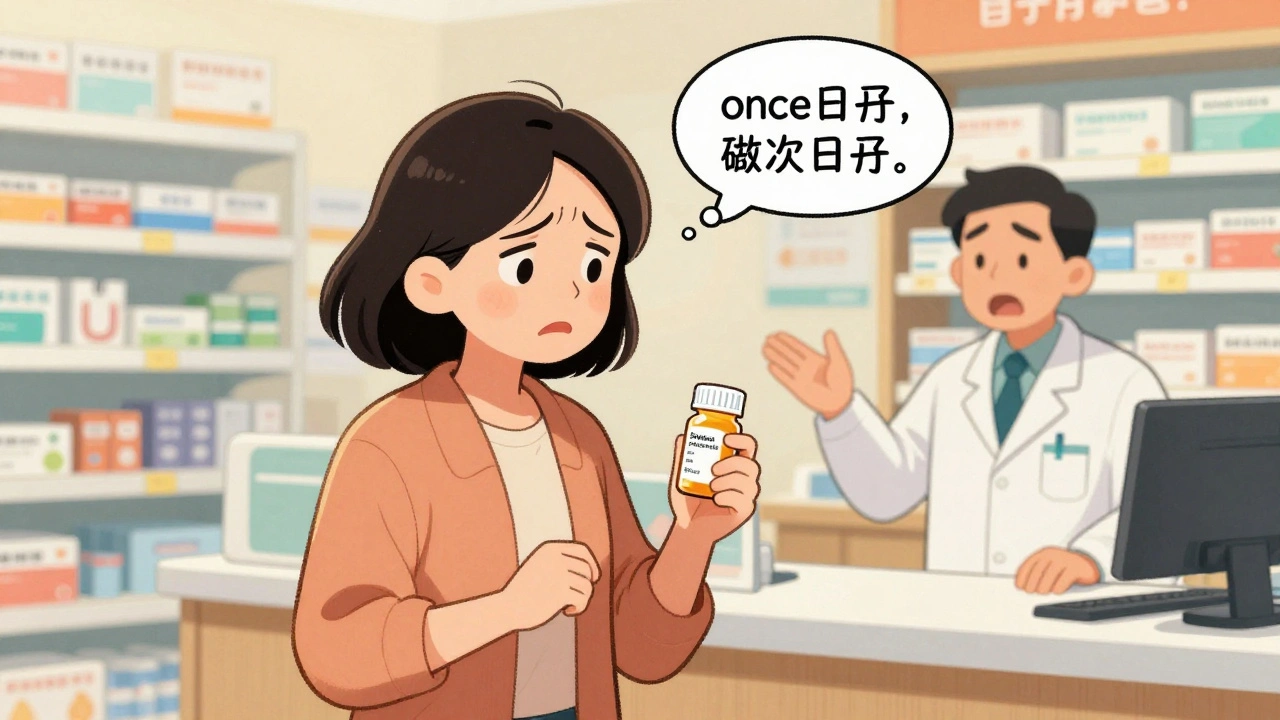
When you’re taking medication, even a small misunderstanding can be dangerous. A wrong dose. A missed schedule. A confused instruction. For people who don’t speak English well, these mistakes aren’t rare-they’re common. And they’re not just inconvenient. They can land someone in the hospital-or worse.
Studies show that families with limited English proficiency (LEP) experience medication errors at nearly twice the rate of English-speaking families. One 2022 study from the Children’s Hospital of Philadelphia found that 17.7% of children in LEP households had a medication error, compared to just 9.6% in English-speaking homes. That’s not a glitch. That’s a system failure.
Why Language Barriers Lead to Dangerous Mistakes
It’s not just about not understanding the words. It’s about not understanding the context. A pharmacist says, “Take one dropperful at bedtime.” But what does “dropperful” mean? Is it one drop? A full dropper? Half? Without clear visuals or a translator, patients guess. And guessing with medication is risky.
One Reddit user shared how their Spanish-speaking mother was given insulin instructions translated by Google Translate. The app misread “twice daily” as “once daily.” She took half the dose for weeks. Her blood sugar crashed. She ended up in the ER. That’s not an outlier. It’s a pattern.
Even simple things like prescription labels become traps. A 2021 report found that 31% of pharmacies in the Bronx couldn’t print prescription labels in Spanish-even though over half the neighborhood speaks it. Some systems can’t translate common terms like “for thirty days” or “take with food.” They freeze. They default to English. And the patient walks out confused.
What Works: Professional Interpreters Save Lives
Using family members or friends to interpret medication instructions is one of the biggest risks. Studies show up to 25% of translations by untrained people are wrong. Why? They don’t know medical terms. They skip details. They soften bad news. They think they’re helping-but they’re making things worse.
Professional interpreters? They’re different. Trained in medical terminology. Bound by ethics. Accurate. A 2017 analysis of over 7,000 cases found that using professional interpreters cut medication errors by nearly half. That’s not a small win. That’s life-saving.
Video or phone interpreters work just as well as in-person ones. A hospital in Chicago reduced LEP medication errors by 40% in one year by switching to video interpretation. No more relying on teenagers or bilingual receptionists who aren’t trained. Just clear, accurate communication.
Directly Observed Dosing: A Simple Fix for High-Risk Meds
For drugs like insulin, blood thinners, or seizure medications, a simple trick can prevent disasters: directly observed dosing. That means the nurse or pharmacist watches the patient take the pill or inject the dose-and confirms they understand how and why.
This isn’t about distrust. It’s about safety. In a 2017 study published in the Journal of General Internal Medicine, this method improved accuracy even when language barriers were strong. The patient holds the pill. The provider says, “This is your insulin. You take it before breakfast.” The patient repeats it back. Then they take it-right there, in front of them.
It takes two extra minutes. But those two minutes stop a hospital stay.

What Hospitals and Pharmacies Should Do
It’s not enough to say, “We have interpreters.” You have to make sure they’re used-every time.
Here’s what actually works:
- Ask every patient their language preference at intake. Don’t assume. Don’t wait for them to ask. Make it part of the check-in form.
- Use professional interpreters for all medication discussions. No exceptions. Not for “quick questions.” Not for “they seem to understand.”
- Translate key medication instructions into the top 5-10 languages in your area. Not just the label. The full directions. What to avoid. When to call the doctor.
- Train staff to recognize when someone needs help. Many providers don’t know how to spot LEP patients. They assume silence means understanding. It doesn’t.
- Use the teach-back method. Ask the patient: “Can you show me how you’ll take this?” or “What will you do if you feel dizzy after this pill?” If they can’t explain it, they don’t understand it.
The Joint Commission and the Office for Civil Rights require this. Title VI of the Civil Rights Act says healthcare providers receiving federal funds must offer language help. Fines can reach $100,000 per violation. But compliance isn’t about avoiding penalties-it’s about saving lives.
What You Can Do as a Patient or Family Member
If you or someone you care for struggles with English, here’s what to do:
- Ask for an interpreter before the appointment. Call ahead. Say: “I need a professional interpreter for my medication discussion.”
- Don’t let staff use a family member. Politely insist: “I’d prefer a trained interpreter.”
- Ask for written instructions in your language. If they say no, ask why-and write it down. You have a right to this.
- Use the teach-back method yourself. After they explain, say: “So, to make sure I got it right-you’re saying I take this at night, not in the morning, right?”
- Bring a list of all your meds. Even if you don’t speak English well, showing the pills helps. Pictures of pills are universal.
One mother in Milwaukee told researchers she didn’t know how to use her child’s inhaler because the label was in English. She didn’t want to admit she didn’t understand. So she guessed. Her child ended up in the ER three times in six months. She didn’t ask for help because she thought it was her fault.
It’s not your fault. It’s the system’s.

The Bigger Picture: Why This Matters Now
By 2030, one in four people in the U.S. will speak a language other than English at home. That’s not a future problem. It’s happening now. And the cost of ignoring it is rising.
Medical errors from language barriers cost the U.S. healthcare system $1.7 billion a year. That’s not just money. It’s lost time. Lost trust. Lost lives.
Companies like LanguageLine Solutions and Certified Languages International are growing fast. EHR systems like Epic and Cerner are adding better language tools. The FDA is planning new rules for multilingual prescription labels in 2024. The NIH is testing AI tools that translate medication instructions in real time.
But technology alone won’t fix this. You can’t just slap a Google Translate widget on a prescription label. You need people-trained, skilled, respected people-on the other end.
Final Thought: Safety Isn’t Optional
Medication safety isn’t a luxury. It’s a basic right. No one should be afraid to take their medicine because they don’t understand the instructions. No child should be hospitalized because a parent didn’t know what “twice daily” meant.
If you’re a provider: don’t wait for someone to ask for help. Offer it. Make it part of your routine.
If you’re a patient or caregiver: speak up. Ask for an interpreter. Demand written instructions. Don’t be afraid to say, “I don’t understand.”
Because when it comes to your health-or your child’s-there’s no room for guesswork.
What should I do if my pharmacy won’t give me my prescription in my language?
You have a legal right to language assistance under Title VI of the Civil Rights Act. Ask to speak with the pharmacist in charge. Request a professional interpreter over the phone. If they refuse, ask for a complaint form. You can also contact your state’s health department or the Office for Civil Rights at HHS. Document the date, time, and what was said. Many pharmacies will fix the issue once they know you’re aware of your rights.
Can I use Google Translate or apps to understand my meds?
Avoid using consumer translation apps for medication instructions. They often get medical terms wrong-like confusing “drops” with “tablets” or misreading “every 6 hours” as “every day.” A 2022 study found that 63% of medication instructions translated by free apps contained dangerous errors. Use them only to get a rough idea. Always confirm with a professional interpreter or pharmacist.
Do I need to pay for interpreter services?
No. By law, hospitals and pharmacies that receive federal funding must provide interpreters at no cost to you. This includes phone, video, or in-person services. If someone asks you to pay, ask for a supervisor. You’re not responsible for the cost. The provider is.
What if I speak a rare language? Will I still get help?
Most major interpretation services offer over 200 languages, including less common ones like Hmong, Karen, or Somali. If your language isn’t available immediately, they can often connect you within 15 minutes via phone or video. If you’re in a rural area or small clinic, ask if they can use a national service like LanguageLine. Many clinics can dial in a translator on the spot.
How can I tell if a provider is truly qualified to interpret?
Ask: “Are you certified as a medical interpreter?” Certified interpreters have passed a national exam and follow strict ethics rules. They won’t add opinions, skip details, or try to “help” by changing what’s said. If someone says they’re “bilingual,” that’s not enough. Look for credentials like CCHI or NBCMI. If they can’t show certification, insist on a professional.
Ali Bradshaw
December 5, 2025 AT 03:13Been there. My abuela took her blood pressure med wrong for months because the label said 'once a day' but she thought it meant 'once a week.' No one asked if she understood. Just handed her the bottle and walked away. Simple fix: show, don't tell. Hold the pill. Say it back. Done.
Marvin Gordon
December 6, 2025 AT 23:33Professional interpreters aren't a luxury-they're the baseline. If your hospital still uses the cousin who took Spanish in high school to explain insulin dosing, you're not just negligent, you're playing Russian roulette with human lives. And yes, it's illegal. Title VI isn't a suggestion. It's the law. Stop pretending it's too hard.
Deborah Jacobs
December 8, 2025 AT 13:25I work in a clinic in Phoenix. We started using video interpreters for every med consult. Guess what? ER visits from LEP patients dropped 52% in 8 months. Not because people got smarter. Because they finally understood what they were taking. The tech is cheap. The training? Free. The will to change? That’s the only thing missing.
One woman told me, 'I thought 'twice daily' meant breakfast and dinner. I didn’t know it meant every 12 hours.' She cried. So did I. We fixed it. No big deal. Just… human.
Stop treating language as a 'nice-to-have.' It’s the difference between a patient walking out alive or in a body bag. And if you don’t see that, you’re not a healer. You’re just a bureaucrat with a stethoscope.
Bring the interpreter. Use the teach-back. Write it down in their language. Do it every time. No exceptions. Not even for 'quick questions.' Because there’s no such thing as a quick question when someone’s life is on the line.
Philip Kristy Wijaya
December 10, 2025 AT 04:03Rupa DasGupta
December 11, 2025 AT 12:12Lucy Kavanagh
December 11, 2025 AT 21:34Let’s be real-this isn’t about language. It’s about the U.S. letting in too many people who refuse to assimilate. We spend billions on interpreters while our own kids can’t read. The NHS in the UK doesn’t do this. Canada doesn’t do this. Why are we the only ones drowning in translation costs? It’s not compassion. It’s cultural surrender.
And don’t even get me started on Google Translate. I saw a guy try to use it to translate his wife’s heart meds. The app said ‘take one tablet after sex.’ He did. Twice. He’s lucky he’s alive.
Jimmy Jude
December 12, 2025 AT 01:33There’s a metaphysical truth here, buried beneath the charts and regulations: language is power. And when you strip someone of their ability to understand the words that control their body, you don’t just confuse them-you dehumanize them.
The pill doesn’t care if you speak English. The bloodstream doesn’t negotiate. But the system? Oh, it negotiates. It negotiates by handing out English-only labels like a religious text. And then it gasps in horror when the faithful stumble.
We are not failing patients because of language. We are failing them because we refuse to see them as equals. The interpreter isn’t a service. It’s a sacrament.
And if you still think this is ‘too expensive’ or ‘too inconvenient’-then you’re not a healer. You’re a priest of indifference. And the altar you serve? It’s made of corpses.
Lynette Myles
December 13, 2025 AT 05:46ashlie perry
December 14, 2025 AT 04:25