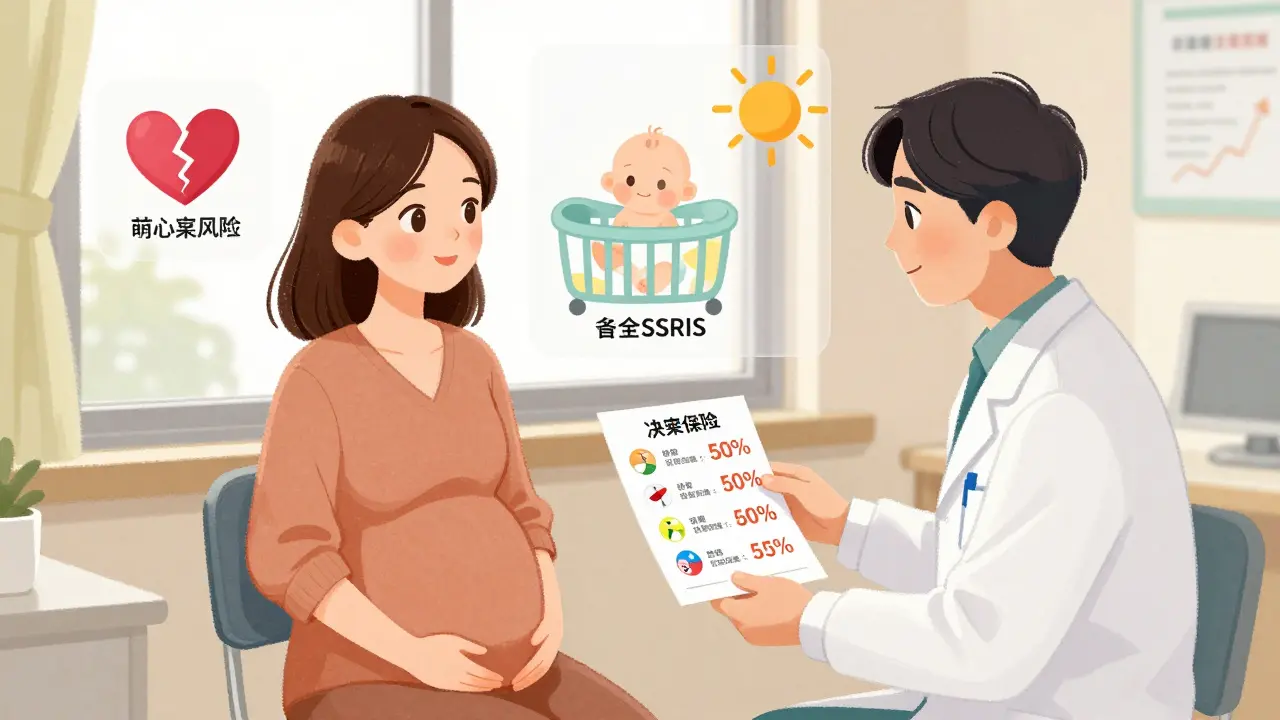
When you’re pregnant and managing a mental health condition, the question isn’t just whether to take medication-it’s how to decide, with full information and without fear. Too many people are told to stop their meds the moment they get a positive pregnancy test. But stopping cold can be just as dangerous as staying on them. The truth? There’s no risk-free option. The goal isn’t to eliminate all risk-it’s to understand it, weigh it, and choose together with your care team.
Why Shared Decision-Making Matters More Than Ever
In 2023, the American College of Obstetricians and Gynecologists updated its guidelines to make one thing crystal clear: mental health treatment during pregnancy isn’t a choice between two bad options. It’s a balancing act. Untreated depression or anxiety raises your risk of preterm birth by 30-50%. The chance of maternal suicide rises by 20%. These aren’t hypotheticals. They’re real, documented outcomes. Meanwhile, some medications carry small but measurable risks. For example, paroxetine (Paxil) is linked to a slightly higher chance of heart defects-rising from about 8 in every 1,000 births to 10 in 1,000. That’s a 25% increase, but it’s still a low absolute risk. Compare that to the 80% relapse rate for severe depression if someone stops SSRIs during pregnancy. That’s not a minor setback. That’s a life-altering crisis. Shared decision-making means you’re not just handed a prescription or told to quit. It means you and your provider sit down with real numbers, your history, your fears, and your values-and build a plan that fits you.Which Medications Are Safer? The Evidence Behind the Choices
Not all psychiatric medications are the same in pregnancy. Some have decades of data. Others are still being studied. Here’s what the latest research says about the most common options:- SSRIs like sertraline (Zoloft), citalopram (Celexa), and escitalopram (Lexapro) are the first-line recommendation from ACOG, the British Association for Psychopharmacology, and the Mayo Clinic. They’re the most studied and generally considered safest. No strong link to birth defects, except for paroxetine.
- Paroxetine (Paxil) is the outlier. Avoid it if you can. The risk of heart defects is higher than with other SSRIs. It’s not banned, but it’s not recommended unless nothing else works.
- Lamotrigine is the go-to for bipolar disorder. It doesn’t cause major birth defects and crosses the placenta less than other mood stabilizers. Lithium is still used but requires close blood level checks because your body processes it differently when pregnant.
- Valproic acid (Depakote) is off-limits. It raises the risk of neural tube defects from 0.1% to 1-2%. That’s a 10- to 20-fold increase. The American Psychiatric Association says it shouldn’t be used in women who could become pregnant.
- Bupropion (Wellbutrin) has a small increased risk of miscarriage and heart defects. It’s sometimes used for depression with fatigue or low motivation, but not as a first choice.
- Tricyclics like nortriptyline are older but still an option if SSRIs fail. They’re less studied but have a long safety record.
- Typical antipsychotics like haloperidol and chlorpromazine have good safety data. Atypical antipsychotics like risperidone or olanzapine? Less clear. Long-term child development data is still limited, so they’re used only when necessary.
The Hidden Risk: Stopping Medication Without Support
Many people stop their meds because they’re scared. A 2023 study from the National Pregnancy Registry found that 68% of pregnant women felt they weren’t given enough information before making a decision. Forty-two percent quit their meds on their own-no doctor involved. The result? Reddit threads from r/PostpartumDepression show a painful pattern. Of 1,243 posts analyzed, 78% said they were pressured to stop medication. Sixty-three percent of those who did reported worsening symptoms-some ended up hospitalized. One woman wrote: “I stopped my antidepressant because my OB said ‘it’s better for the baby.’ Two weeks later, I couldn’t get out of bed. I didn’t know I could ask for help.” The real danger isn’t the pill. It’s the silence around it. When you’re told to stop without a plan, you’re trading one risk for a much bigger one.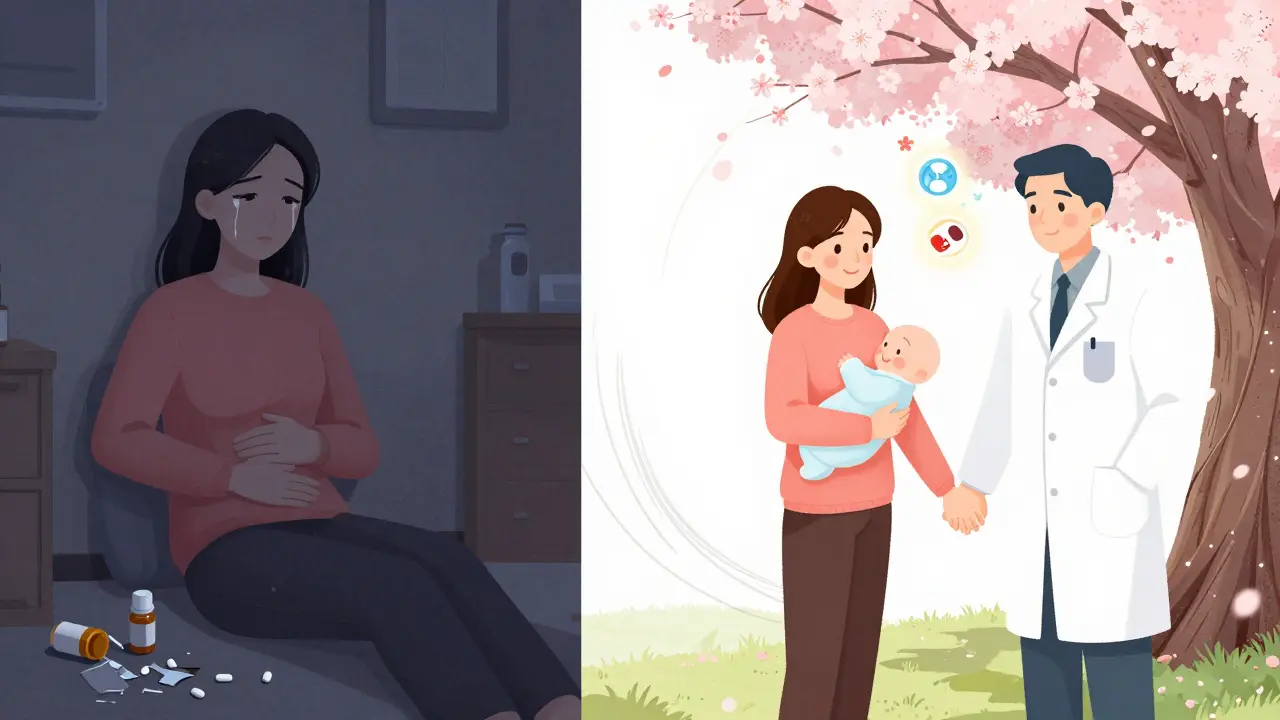
What Shared Decision-Making Actually Looks Like
This isn’t a one-time chat. It’s a process. Here’s how it works in practice:- Assess your relapse risk. Have you had multiple episodes of depression or bipolar disorder? Have you been hospitalized? Have you tried to stop before and crashed? The more history you have, the higher your risk of relapse during pregnancy. Tools like the Edinburgh Postnatal Depression Scale help measure this.
- Know the numbers. Your provider should show you absolute risks, not percentages. Instead of saying “paroxetine increases risk,” they say: “Out of 1,000 babies born to mothers taking paroxetine, about 10 may have a heart defect. Without it, it’s about 8.” That’s not scary-it’s clear.
- Plan for setbacks. What happens if your anxiety spikes at week 20? Who do you call? Is there a backup medication? Are you connected to a therapist who understands perinatal mental health? Having a plan reduces panic.
Preconception Planning: The Best Time to Decide
The best time to talk about medication isn’t when you’re already pregnant. It’s before. Studies show that if you’re stable on your medication for at least three months before conception, your risk of relapse during pregnancy drops by 40%. That’s huge. It means fewer hospital visits, less stress, and a better chance of a healthy pregnancy. Yet, most women don’t talk to their psychiatrist or OB-GYN until after they find out they’re pregnant. If you’re thinking about getting pregnant-even if it’s months away-schedule a meeting. Bring your current meds list. Ask: “What’s the safest plan for me?”What About Breastfeeding?
Many people worry about breastfeeding while on meds. The good news? Most SSRIs pass into breast milk in tiny amounts. Sertraline is often the top choice because it’s least detectable in infants. Lamotrigine is also considered safe. Lithium requires more caution and monitoring. The American Academy of Pediatrics says the benefits of breastfeeding usually outweigh the risks of medication exposure. If your mental health is stable, you’re better able to care for your baby. That’s the real win.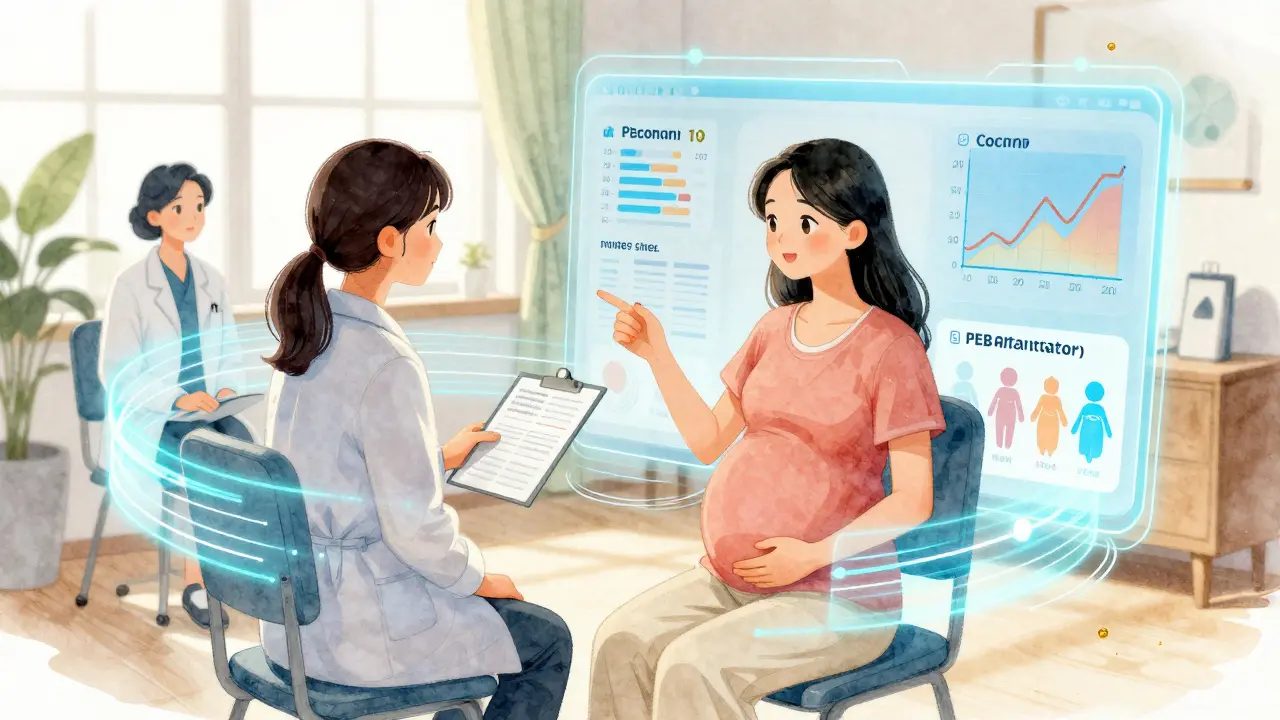
Why This Approach Works-And How It Saves Money
A 2022 cost-benefit analysis found that every $1 spent on structured shared decision-making for perinatal mental health saves $4.70 in avoided healthcare costs. Why? Fewer preterm births. Fewer NICU stays. Fewer emergency psychiatric visits. Fewer cases of postpartum depression that spiral into long-term disability. And it’s not just money. It’s peace of mind. Women who used decision aids reported 37% lower depression scores at six weeks postpartum. They felt heard. They felt in control. That’s not a small thing.Where Things Are Heading
By 2026, shared decision-making tools may use machine learning to give you personalized risk estimates-not just population averages. Imagine a tool that says: “Based on your age, history, and medication, your chance of relapse if you stop is 78%. Your risk of birth defects with sertraline is 2.1%.” That’s not science fiction. It’s already being tested in pilot studies at Massachusetts General Hospital. The National Pregnancy Registry is adding 12 new medications in 2024, including newer antipsychotics like brexpiprazole. More data means better decisions.What You Can Do Right Now
If you’re pregnant or planning to be:- Don’t stop your meds without talking to your provider.
- Ask for the Mental Health Medication Decision Aid. If your provider doesn’t know what it is, ask them to look it up-it’s from ACOG.
- Request a consultation with a perinatal psychiatrist. Over 87% of OB-GYNs now do this routinely.
- Write down your fears, your goals, and your questions before your appointment.
- Remember: Your mental health is part of your baby’s health.
Are SSRIs safe during pregnancy?
Yes, most SSRIs like sertraline, citalopram, and escitalopram are considered safe and are the first-line treatment for depression in pregnancy. Paroxetine is the exception-it has a small increased risk of heart defects and is generally avoided. SSRIs don’t cause major birth defects in most cases, and the risks of untreated depression often outweigh the medication risks.
Can I breastfeed while taking mental health medication?
Yes, many women safely breastfeed while taking SSRIs like sertraline or mood stabilizers like lamotrigine. These medications pass into breast milk in very low amounts. The American Academy of Pediatrics supports breastfeeding in these cases because the benefits to both mother and baby usually outweigh the minimal medication exposure. Always discuss your specific medication with your provider.
What if I stopped my medication before I knew I was pregnant?
Don’t panic. Contact your provider right away. Many medications can be restarted safely during pregnancy, especially if your symptoms are returning. The key is to act quickly-untreated depression or anxiety carries higher risks than restarting a well-studied medication. Your care team can help you assess your current mental state and choose the safest next step.
Is lamotrigine safer than lithium for bipolar disorder during pregnancy?
Yes, lamotrigine is generally preferred over lithium for bipolar disorder in pregnancy because it doesn’t cause major birth defects and has a better safety profile. Lithium can be used but requires frequent blood tests because pregnancy changes how your body processes it. Valproic acid is avoided entirely due to high risks of neural tube defects and developmental issues.
Why do some doctors still tell pregnant people to stop all meds?
Some providers still rely on outdated guidelines or fear liability. But major organizations like ACOG and the British Association for Psychopharmacology now clearly state that untreated mental illness poses greater risks than most medications. The shift is happening-87% of OB-GYNs now consult perinatal psychiatrists-but not all have caught up. If you’re told to stop, ask for evidence. Request a referral to a specialist.
How can I find a provider who supports shared decision-making?
Look for clinics that offer perinatal psychiatry services or ask your OB-GYN for a referral. You can also contact Postpartum Support International-they connect families with providers trained in perinatal mental health. Ask potential providers: “Do you use decision aids to discuss medication risks?” If they say yes, they’re likely aligned with current guidelines.
jeremy carroll
December 16, 2025 AT 04:26thank you.
Edward Stevens
December 16, 2025 AT 21:39we used to just trust our bodies. now we need a 12-page risk matrix just to breathe.
Alexis Wright
December 17, 2025 AT 13:23The real risk isn't paroxetine - it’s the institutional erasure of maternal intuition. The data doesn't care about your trauma, your dreams, or the fact that your grandma took lithium in the 60s and you’re still alive.
This isn’t medicine. It’s algorithmic paternalism with a pretty infographic.
Rich Robertson
December 18, 2025 AT 14:44In my family, you didn’t talk about meds. You prayed. You drank herbal tea. You 'got stronger.'
But seeing data like '80% relapse rate if you stop SSRIs' - that’s not cold stats. That’s a mother losing herself. That’s a baby losing their anchor.
We need more of this - not just in the US, but everywhere. Knowledge is the first act of love.
Natalie Koeber
December 19, 2025 AT 00:03And now they want you to believe that taking pills is safer than 'letting nature take its course.'
Have you heard of the 2018 whistleblower report on SSRIs and fetal serotonin disruption? No? That’s because they buried it.
Don’t trust the 'evidence.' Trust your gut. And if your gut says no - then no.
Rulich Pretorius
December 20, 2025 AT 07:00We don’t have ACOG guidelines. We have one OB in a rural clinic who doesn’t know what an SSRI is.
So when a woman asks if she should stop her meds, I say: 'What happens if you stop? Can you feed your child? Can you hold them?'
If the answer is 'I won’t be able to,' then the pill is the lifeline. Not the poison.
Dwayne hiers
December 21, 2025 AT 08:32That’s why dose titration is critical - not discontinuation.
Additionally, placental CYP2D6 and CYP2C19 expression modulates fetal exposure. Sertraline’s low placental transfer coefficient (0.12) makes it preferable over fluoxetine (0.48).
Contextualizing absolute risk (e.g., 10/1000 vs. 8/1000) is statistically sound but clinically insufficient without pharmacogenomic profiling.
Jonny Moran
December 23, 2025 AT 02:49She didn’t need to be a hero. She needed to be supported.
And honestly? Our kids are thriving. One’s in kindergarten, the other’s a toddler. No developmental delays. No weird quirks. Just two happy, loud, messy humans who love their mom - who was there, because she got the help she needed.
That’s the win.
Tim Bartik
December 23, 2025 AT 07:36WE’RE TURNING PREGNANCY INTO A LAB EXPERIMENT.
My cousin took Zoloft. Her kid had tics for 2 years. No one told her that. No one even asked.
Stop pushing pills. Start pushing honesty.
Sinéad Griffin
December 25, 2025 AT 03:06my OB said 'just stop' like it was a light switch.
i cried in the parking lot.
then i found this post.
thank u. 🙏❤️
Daniel Wevik
December 26, 2025 AT 18:07Women have been gaslit for generations about their mental health - told they’re 'too emotional,' 'hormonal,' 'not strong enough.'
Now we’re being told to 'choose wisely' - but the choice was never real if the information was buried under fear and outdated dogma.
When you give someone data, tools, and space to decide - you’re not prescribing medication. You’re restoring dignity.
Thomas Anderson
December 26, 2025 AT 23:14my kid is 4 now. smart, funny, hugs me every night.
if i’d stopped because someone said 'it’s better for the baby,' i’d be dead.
and then who’d take care of him?
Wade Mercer
December 28, 2025 AT 02:58Modern medicine treats symptoms, not souls.
What if your depression isn’t a chemical imbalance - but a sign your life needs to change?
Maybe you need to leave your job. Maybe you need to stop pretending you’re okay.
Medication is a bandage. Not a cure.
Sarthak Jain
December 29, 2025 AT 04:40but when you’re alone, scared, and no one listens? medicine becomes the only voice that says: 'you’re not broken.'
thank you for saying this. i’m sharing this with my sister. she’s 8 months pregnant and crying every night.
Daniel Thompson
December 29, 2025 AT 21:08Are we prioritizing maternal stability over long-term neurodevelopmental outcomes? The data is still emerging.
Let’s not confuse 'evidence-based' with 'unquestionably safe.'
Prudence, not protocol, should guide these decisions.