
Symptom Tracker Calculator
Track Your Symptoms
What Your Scores Mean
0-3: Good control - Symptoms are well managed with minimal side effects.
4-6: Moderate control - Treatment may need adjustment. Monitor closely.
7-10: Poor control - Symptoms are not well managed. Contact your care team.
Important: If scores remain high despite treatment or if side effects appear, discuss with your care team. Remember, comfort isn't just about pain relief—it's about maintaining awareness and quality of life.
When pain relief becomes too much
Imagine your loved one is in pain, but every time you give them medicine to ease it, they drift off too far-too sleepy, too confused, too quiet. You want them to be comfortable, but not gone. This is the tightrope walk of palliative and hospice care: helping someone feel better without taking away who they are.
Palliative care isn’t just for the final days. It starts when a serious illness is diagnosed-whether it’s cancer, heart failure, or advanced dementia. Its goal? To manage symptoms like pain, breathlessness, nausea, or anxiety while keeping the person alert, connected, and in control. Hospice care is a part of that, focused on the last six months or less, when curative treatment is no longer the goal. But both share the same mission: comfort without drowning the person in drugs.
What gets measured, gets managed
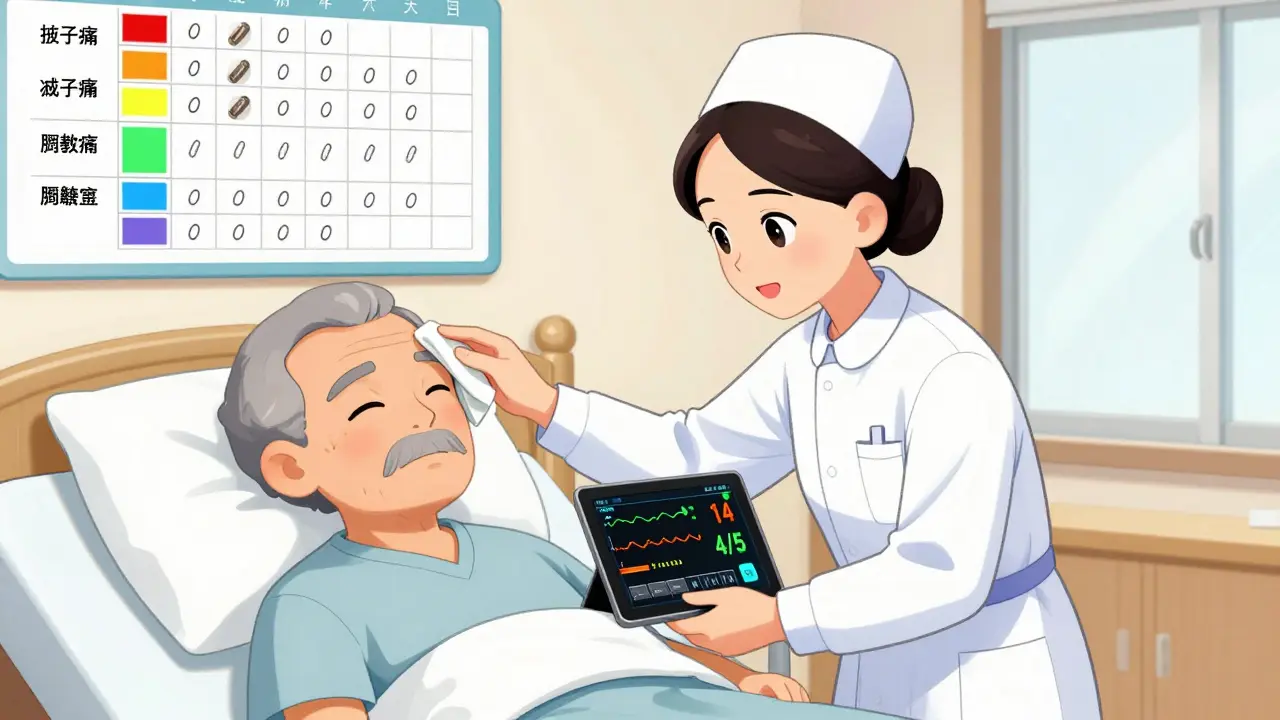
Good symptom control doesn’t happen by guessing. It starts with asking the right questions-and writing down the answers. In the NHS North West guidelines, every pain report must include location, type (sharp, dull, burning), what makes it worse or better, and how it affects daily life. A score from 0 to 10 isn’t just a number-it’s a lifeline. If a patient says their pain is an 8, and it drops to a 3 after medication, you know the treatment works. If it stays at 8? Something’s wrong.
It’s the same with breathlessness. Opioids like morphine are the gold standard, backed by solid evidence. But giving too much too fast can slow breathing dangerously. That’s why nurses in hospice units check oxygen levels, respiratory rate, and level of alertness every 30 minutes when starting a new dose. One wrong step, and you’re not helping-you’re harming.
Delirium is another silent danger. A patient suddenly agitated, confused, or talking to people who aren’t there? That’s not just dementia acting up. It’s often caused by medication buildup, infection, or dehydration. Tools like CAM-ICU and RASS scores help spot it early. Haloperidol is used-but only if needed, and only at the lowest dose possible. Once the person is calm, you stop it. No lingering sedation.
More medicine isn’t always better
There’s a myth that stronger drugs mean better care. But in reality, the best care often means fewer drugs. Take bowel obstruction, a common problem in advanced cancer. Some doctors reach for octreotide, an expensive injection. But studies show it has limited benefit. Corticosteroids, cheaper and simpler, work just as well-and with fewer side effects. That’s the difference between following a protocol and thinking critically.
Same goes for dry mouth or excessive secretions. Atropine drops can help, but they can also cause confusion, especially in older adults. Sometimes, a sip of water, a moist cloth, or changing position does more than any drop ever could. Palliative care isn’t about filling prescriptions. It’s about listening, watching, and adjusting.
Even pain meds need finesse. Opioids are powerful, but they don’t work the same for everyone. Someone with kidney problems may need half the dose. Someone with a history of addiction may need non-opioid options like gabapentin or nerve blocks. The Dana-Farber Cancer Institute breaks this down into separate guides-pain, nausea, delirium-because each needs its own strategy. You don’t treat all symptoms the same way.
The invisible symptoms
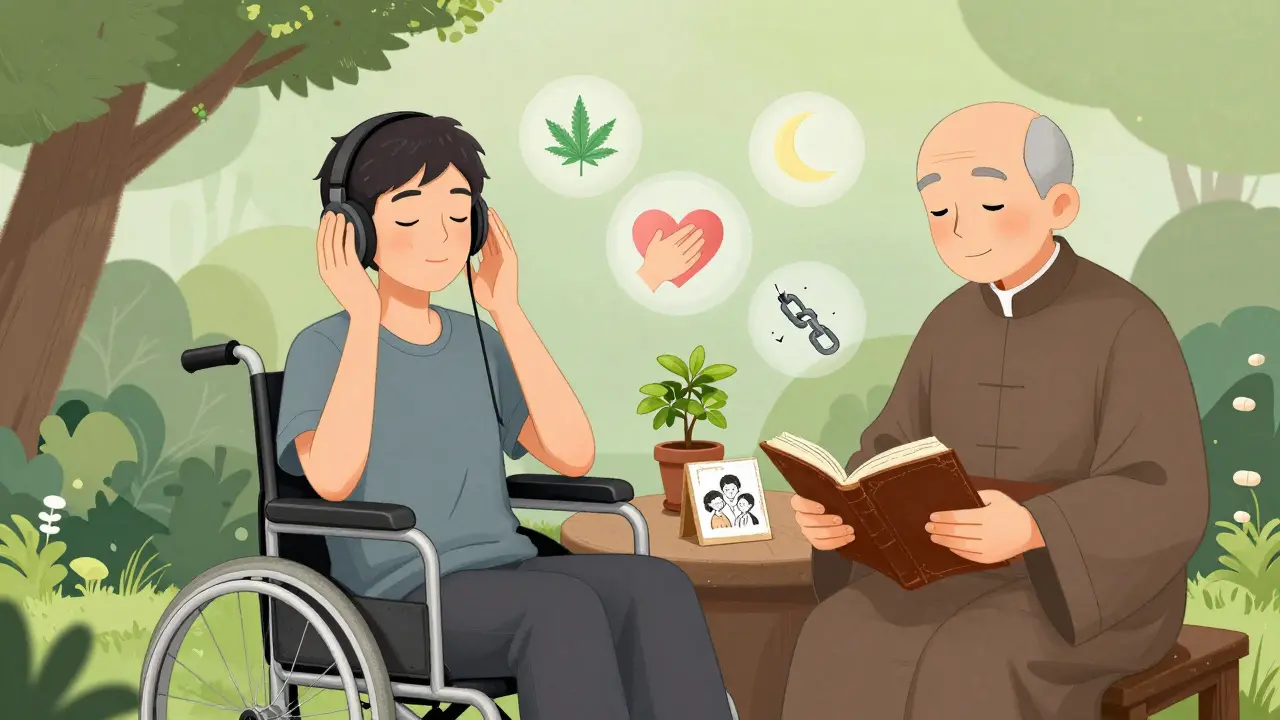
Pain isn’t the only thing that hurts. Anxiety, fear, guilt, loneliness-these are real, and they make physical pain worse. Dr. Harvey Chochinov’s research shows that when someone feels their life has lost meaning, their body reacts. They report higher pain scores. They sleep less. They become harder to comfort.
This is where palliative care goes beyond pills. A chaplain sitting quietly. A family member holding a hand. A photo album being flipped through. These aren’t luxuries. They’re medicine. The NCHPC guidelines include spiritual and psychosocial care as core domains-not as afterthoughts, but as essential parts of healing.
One nurse in Edinburgh told me about a man with lung cancer who refused pain meds because he didn’t want to miss his granddaughter’s birthday. He was in pain, but he was present. They adjusted his schedule: a small dose before she arrived, then none after. He stayed awake, held her, told her stories. That’s not a failure of treatment. That’s success.
What happens when things go wrong
Over-sedation is the biggest fear. A patient who used to chat with visitors now barely opens their eyes. That’s not peace. That’s a mistake. It usually happens when assessments stop. When nurses are rushed. When families say, “Just make them sleep.” But sleep isn’t the goal. Comfort with awareness is.
One study showed that when teams followed UPenn’s protocol-checking comfort levels every 30 minutes for unstable patients-breakthrough symptoms dropped by over half. But when they skipped assessments, over-sedation rates jumped. It’s not the drugs. It’s the lack of attention.
Another problem? Documentation. Some nurses spend more time writing in charts than talking to patients. A 2022 Fraser Health survey found that 68% of staff felt they didn’t have enough time to complete full assessments. That’s not just frustrating-it’s dangerous. If you don’t record what you’ve done, you can’t tell if it worked.
What’s changing now
The field is evolving. In 2023, Fraser Health added guidance on medical cannabis. Some patients report needing 37% less opioids when using it. But dizziness is common. So it’s not a magic fix-it’s another tool, used carefully.
Digital tools are coming too. Apps that let patients report pain or nausea from their bed, with alerts sent to nurses. Pilot programs saw symptom control improve by 18%. That’s huge for people who can’t speak clearly or move easily.
And tele-palliative care is expanding. In rural areas, 55% of counties have no specialist. Now, video visits let patients in remote towns get expert advice without driving hours. By 2027, that could reach 40% of those who need it.
But the biggest shift? Starting earlier. A landmark 2010 study found that cancer patients who got palliative care alongside chemotherapy lived 3.2 months longer-and had far better quality of life. That’s not a side effect. That’s the point.
How to get it right
If you’re caring for someone with a serious illness, here’s what you need to do:
- Ask for palliative care early. Don’t wait until things are out of control. It helps at any stage.
- Track symptoms daily. Use a simple 0-10 scale for pain, breathlessness, nausea. Write it down. Show it to the team.
- Ask about side effects. “Is this making them more tired? Confused? Nauseous?” If yes, adjust.
- Push back on unnecessary drugs. If a new medication is suggested, ask: “What’s the evidence? What are the risks?”
- Include non-drug care. Music, touch, memory books, quiet time-these are just as important as morphine.
- Speak up for presence. If your loved one wants to stay awake for a visit, fight for that. Comfort isn’t unconsciousness.
What you should know
Palliative care isn’t giving up. It’s choosing how to live-until the end. It’s not about speed. It’s about quality. It’s not about more drugs. It’s about the right ones, at the right time, for the right person.
The system isn’t perfect. There aren’t enough specialists. Documentation is heavy. Some teams still treat pain as the only problem. But the tools are there. The evidence is clear. And the goal? Simple: to help someone feel human, right to the end.
Is hospice care the same as palliative care?
No. Palliative care is for anyone with a serious illness, at any stage, and can be given with curative treatment. Hospice care is a type of palliative care for people with six months or less to live who have chosen not to pursue further curative treatments. All hospice care is palliative, but not all palliative care is hospice.
Can pain medication make someone die sooner?
When used properly, no. Opioids like morphine are given in doses that relieve pain without suppressing breathing. The goal isn’t to sedate, but to comfort. Studies show that properly managed pain medication does not shorten life. What can shorten life is uncontrolled pain, which causes stress, high blood pressure, and exhaustion.
Why do some doctors hesitate to give strong pain meds?
Fear. Fear of addiction (rare in this context), fear of side effects like confusion, fear of legal trouble. But guidelines from the NCHPC and NHS make it clear: under-treating pain is unethical. The right dose, monitored closely, is safe. Training and protocols help reduce this hesitation.
What if my family wants me to give more meds just to make them sleep?
This is one of the hardest conversations. Sedation isn’t comfort if the person can’t say goodbye, hear a voice, or hold a hand. Palliative teams help families understand that being awake and present matters. They offer alternatives: smaller doses, timed around visits, or non-drug comfort like music or gentle touch. The goal isn’t to disappear-it’s to be there, fully.
Are there alternatives to opioids for pain?
Yes. For nerve pain, gabapentin or pregabalin work well. For bone pain, bisphosphonates or radiation can help. For inflammation, steroids are effective. Non-drug options like heat, massage, or distraction with music or memories also reduce pain perception. Opioids are first-line for severe pain, but not the only tool.
How do I know if the care team is doing a good job?
Look for three things: regular assessments (pain, breathing, alertness), clear communication about why each treatment is chosen, and respect for the person’s wishes. If symptoms are tracked daily, side effects are monitored, and the patient is involved in decisions-even small ones-then the care is likely on track. If the team avoids talking about meds or dismisses concerns, it’s time to ask for a different approach.
kenneth pillet
January 17, 2026 AT 19:44Aysha Siera
January 18, 2026 AT 23:17Kristin Dailey
January 19, 2026 AT 06:57christian Espinola
January 20, 2026 AT 13:03Danny Gray
January 21, 2026 AT 02:28Wendy Claughton
January 21, 2026 AT 16:46Stacey Marsengill
January 22, 2026 AT 07:21Naomi Keyes
January 23, 2026 AT 18:10Praseetha Pn
January 24, 2026 AT 17:41Selina Warren
January 25, 2026 AT 20:41Robert Davis
January 26, 2026 AT 16:07Chuck Dickson
January 27, 2026 AT 05:02Tyler Myers
January 29, 2026 AT 00:14