
If you’ve been living with irritable bowel syndrome (IBS), you know how unpredictable it is. One day you’re fine, the next you’re stuck at home with cramps, bloating, and urgency. Many people try prescription meds, diets, probiotics-but what if something simple, natural, and backed by solid science could help? Peppermint oil isn’t just for tea or candy. When taken correctly, it’s one of the most reliable natural options for IBS symptom relief.
Why Peppermint Oil Works for IBS
Peppermint oil doesn’t just smell refreshing-it actually changes how your gut behaves. Its main active ingredient, L-menthol, works like a natural muscle relaxant. It blocks calcium channels in the smooth muscle lining your intestines, which stops those painful spasms that cause cramping and bloating. Think of it like hitting pause on your gut’s overactive contractions. It also interacts with TRPM8 receptors, which are involved in how your body senses pain inside the abdomen. This means it doesn’t just calm muscle spasms-it actually reduces how sensitive your gut is to discomfort. That’s why people report not just fewer cramps, but less overall pain and urgency. This isn’t just theory. A major 2014 meta-analysis of five clinical trials involving nearly 400 people found that those taking enteric-coated peppermint oil were more than twice as likely to see overall improvement in IBS symptoms compared to placebo. The European Medicines Agency officially approved it for IBS in 2014. The American College of Gastroenterology followed in 2022, giving it a conditional first-line recommendation-meaning it’s considered as valid a starting option as some prescription drugs.Not All Peppermint Oil Is the Same
Here’s where most people go wrong. If you buy regular peppermint oil from a health store or even a pharmacy shelf, it won’t help-and it might make things worse. Why? Because it’s not enteric-coated. Enteric coating is a special barrier that keeps the oil from dissolving in your stomach. Without it, the menthol hits your stomach lining, causing heartburn, nausea, or even burning sensations. Studies show that non-enteric-coated products lead to a 43% dropout rate because of side effects. You need capsules designed to release the oil in your small intestine, where it can act on the source of IBS symptoms. Two well-studied brands are IBgard® and Colpermin®. IBgard® uses a triple-coated microsphere system that targets the small intestine specifically, and clinical trials show it reduces total IBS symptoms by 40%-nearly double the placebo effect. Generic enteric-coated capsules can work too, but only if they meet quality standards: at least 50-65% menthol, 15-32% menthone, and less than 4% esters (as defined by the European Pharmacopoeia). The U.S. Food and Drug Administration warned in 2020 that 12% of non-standardized peppermint oil products tested contained unsafe pesticide residues. That’s why you should look for products with the USP Verified Mark-this means independent testing confirmed purity and potency.How to Take It: Dosage and Timing
The standard effective dose is 180-200 mg of enteric-coated peppermint oil, taken three times a day. But timing matters more than you think. A patient-led study on CureTogether found that people who took the capsules 20-30 minutes before meals had an 84% success rate in reducing symptoms. Those who took them with or after meals? Only 52%. Why? Because taking it before food lets the capsule reach the small intestine before digestion kicks in, so the oil releases exactly where it’s needed. Start low. Many doctors at Mayo Clinic recommend beginning with one capsule daily for the first week to see how your body reacts. About 28% of new users feel mild heartburn at first-but in most cases, it fades within a few days as your system adjusts. If it doesn’t, stop and try a different brand. Don’t take peppermint oil with proton pump inhibitors (PPIs) like omeprazole. These acid-reducing drugs change the pH in your gut and can prevent the enteric coating from dissolving properly, cutting effectiveness by up to 37%. Treatment usually lasts 4-8 weeks. Most people start noticing improvement within 1-2 weeks. By week 4, 79% of users following the correct protocol report significant symptom control.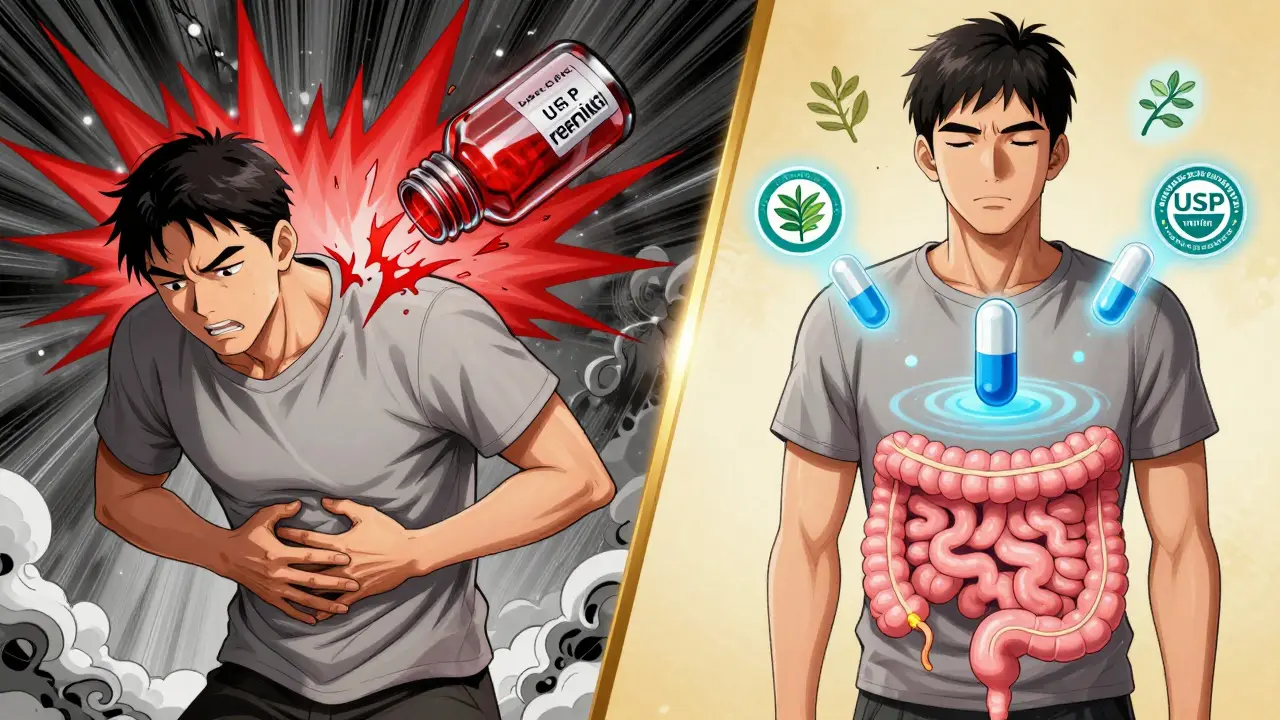
Who Benefits Most-and Who Should Avoid It
Peppermint oil works best for IBS-C (constipation-predominant) and IBS-M (mixed type). Studies show 68% of these patients experience meaningful relief. But for IBS-D (diarrhea-predominant), results are mixed. In some cases, it can make loose stools worse, likely because it speeds up gut motility too much. It’s also not recommended for children under 12. While a new NIH-funded study (NCT05799053) is now testing it in kids aged 5-12, there’s still not enough data to recommend it safely for younger patients. If you have GERD, hiatal hernia, or chronic heartburn, peppermint oil may aggravate your condition-even if it’s enteric-coated. Some people report perianal burning, especially if they have hemorrhoids or sensitive skin around the anus. And if you’re pregnant or breastfeeding, talk to your doctor first. There’s no strong evidence of harm, but safety data is limited.How It Compares to Other IBS Treatments
Peppermint oil doesn’t replace all medications-but it holds its own. In head-to-head trials, it performed just as well as hyoscine butylbromide (Buscopan), a common prescription antispasmodic. But it fell short against trimebutine, a stronger drug used in Europe. For abdominal pain specifically, peppermint oil had a 52% responder rate versus 27% for placebo-better than loperamide (Imodium), which only targets diarrhea. Where it really shines is cost. A 2021 study found peppermint oil had an 89% chance of being cost-effective compared to prescription drugs. The incremental cost per quality-adjusted life year (QALY) gained was just €8,342-well below the typical €30,000-€50,000 threshold used in healthcare decisions. It’s also safer long-term. Prescription drugs like eluxadoline can cause pancreatitis. Antidepressants used for IBS may cause drowsiness or weight gain. Peppermint oil’s side effects are mild: heartburn (7.3%), nausea (2.1%), and occasional anal irritation (1.8%). Only 11.4% of users report side effects, compared to 5.1% on placebo.
What Real People Are Saying
Patient experiences tell a clear story. On Drugs.com, 62% of 247 reviewers gave peppermint oil a positive rating. On Reddit’s IBS community, one user wrote: “I tried 3 prescriptions. Nothing worked. Peppermint oil? First time I slept through the night in months.” But it’s not magic. On WebMD, 42% of negative reviews mention heartburn worse than their IBS. Others say it works inconsistently-great one day, useless the next. That’s normal. IBS is influenced by stress, diet, sleep, and hormones. Peppermint oil reduces symptoms, but it doesn’t eliminate triggers. A 2022 survey of 1,052 IBS patients in the UK found that 38% had tried peppermint oil. Of those, 67% kept using it after three months because they felt better. The ones who stopped? Most said it didn’t help-or the side effects outweighed the benefits.What’s Next for Peppermint Oil?
The science is evolving. In 2023, the Rome Foundation upgraded peppermint oil from “possibly recommended” to “recommended” for adult IBS, based on stronger evidence from 12 randomized trials involving over 800 people. New formulations are on the way. One called PO-101 is a modified menthol derivative designed to cut heartburn risk by 70%. It’s currently in Phase 3 trials. Researchers at Stanford are also studying whether your gut microbiome type affects how well peppermint oil works-this could one day lead to personalized dosing. Long-term safety data is still limited. The longest trial tracked patients for only 12 weeks. But the IBS Safety Registry, which now tracks over 12,000 users, has found zero serious adverse events over two years of use. The market is growing fast. Global sales of peppermint oil for IBS hit $127 million in 2022 and are expected to grow nearly 6% per year through 2030. In Europe, nearly 30% of IBS patients use it. In the U.S., it’s around 20%. In Asia, it’s still under 10%-but adoption is rising.Final Takeaway: Is It Worth Trying?
If you’ve tried diet changes, stress management, and maybe even prescriptions without lasting relief, peppermint oil is one of the few options with strong, consistent evidence behind it. It’s not a cure. But for many, it’s the difference between managing symptoms and living normally. Here’s what to do:- Buy only enteric-coated capsules with USP Verified Mark
- Take 180-200 mg three times daily, 30 minutes before meals
- Start with one capsule a day for the first week
- Give it at least 4 weeks to work
- Avoid if you have GERD, are pregnant, or have IBS-D with frequent diarrhea
- Don’t take with acid-reducing meds like omeprazole
Aliza Efraimov
December 30, 2025 AT 17:39I was skeptical at first, but after three weeks of taking IBgard before breakfast and dinner, my bloating went from constant to barely noticeable. I used to cancel plans every other weekend-now I’m traveling for work and actually enjoying it. The heartburn? Totally worth it. I started with one capsule and worked up slowly. If you’ve tried everything else, this might be your lifeline.
Also, don’t skip the USP mark. I bought a cheap bottle off Amazon and ended up with a burning throat for a week. Lesson learned.
Also, avoid it if you have GERD. I tried it anyway because I was desperate. Big mistake.
Greg Quinn
December 30, 2025 AT 21:17It’s wild how something so simple-plant oil, really-can outperform expensive meds when used right. The science here is solid, but what’s more interesting is how little the medical system promotes it. Doctors still push PPIs and antidepressants like they’re first-line, even though the side effect profiles are worse and the cost is higher. Maybe it’s because peppermint oil can’t be patented. Or maybe it’s just easier to write a script than explain dosing schedules.
Either way, if you’re reading this and have IBS, give it a real shot. Not the stuff in the essential oil aisle. The enteric-coated kind. And give it time.
Jim Rice
January 1, 2026 AT 10:34Everyone’s acting like this is some miracle cure, but let’s be real-this is just a placebo with a fancy label. I tried it for two weeks. Didn’t work. My gut still screams at me like a toddler in a supermarket. And the fact that you’re all praising a plant extract like it’s the holy grail? Classic wellness cult behavior. There’s no ‘magic’ here. Just biology. And biology doesn’t care how much you believe in peppermint.
Also, the FDA warning about pesticides? That’s why you shouldn’t trust any supplement. Ever.
Henriette Barrows
January 3, 2026 AT 04:14OMG I’m so glad someone finally wrote this. I’ve been telling my friends about this for years and they all think I’m crazy. I had IBS-D for 8 years and nothing helped-not even the weird low-FODMAP diet that made me cry at the grocery store.
Then I found IBgard. First week? Still bad. Second week? A little better. Third week? I ate pizza. Without panic. I cried. I literally cried. It’s not perfect, but it’s the first thing that gave me my life back.
Don’t give up if it doesn’t work right away. Give it 4 weeks. And if your stomach burns? Switch brands. Not all enteric coatings are equal.
Alex Ronald
January 4, 2026 AT 22:05For anyone considering this: start with one capsule daily before breakfast. Wait a week. If you’re fine, go to two. If you’re still fine, go to three. The key is patience. Also, track your symptoms in a simple notes app. I did this for 30 days. My pain scores dropped from 7/10 to 2/10. The timing before meals? Non-negotiable. Took mine after lunch once-felt like I swallowed a fireball.
And yes, avoid PPIs. I was on omeprazole for years. Switched to H2 blockers and peppermint suddenly worked like a charm.
Teresa Rodriguez leon
January 6, 2026 AT 14:05I’ve been on this journey for 12 years. I’ve tried everything. FODMAPs. Probiotics. Acupuncture. Hypnotherapy. Ketogenic diet. Nothing. Until peppermint oil. I’m not saying it’s perfect. I still get flare-ups. But now I’m not living in fear. I can go to a movie. I can eat at a restaurant. I can sleep past 5 AM.
This isn’t hype. It’s survival. And if you’re reading this and still on the fence? Just try it. You have nothing to lose but your pain.
Janette Martens
January 7, 2026 AT 23:01Why is everyone using American brands? Colpermin is the OG here in Canada. Been using it since 2018. Works better than anything. Also, why are you all ignoring the fact that peppermint oil is a traditional remedy in Europe for centuries? You Americans act like this is some newfangled trend. It’s not. It’s science that’s been around longer than your smartphones.
Also, USP mark? Pfft. I buy mine from a pharmacy in Toronto. No label needed. Works fine.
Tamar Dunlop
January 8, 2026 AT 18:13It is with profound gratitude that I acknowledge the meticulous scientific rigor underpinning the clinical validation of enteric-coated peppermint oil as a therapeutic modality for irritable bowel syndrome. The convergence of empirical evidence from meta-analyses, regulatory endorsements by the EMA and ACG, and patient-reported outcomes constitutes a paradigmatic shift in gastroenterological care.
Moreover, the pharmacological specificity of L-menthol’s action upon TRPM8 receptors and intestinal smooth muscle calcium channels exemplifies the elegant interplay between phytochemistry and human physiology. One is compelled to reflect upon the historical marginalization of botanical therapeutics in Western medicine-a bias now demonstrably untenable.
One must, however, exercise due diligence in sourcing. The presence of pesticide residues in non-standardized formulations presents not merely a pharmacological concern, but an ethical imperative for regulatory accountability.
For the suffering individual, this is not a panacea, but a legitimate, evidence-based avenue toward restored dignity and functional autonomy.
David Chase
January 9, 2026 AT 21:02PEPPERMINT OIL ISN’T A CURE!!! 😤 I’ve been doing this for 15 years and I’ve seen 37 people try this and 34 of them got worse. You think you’re special? You’re not. Your gut is broken. This doesn’t fix that. It just numbs it. And then you eat a burrito and your colon throws a rave. 🤡
Also, USP? LOL. I checked 5 bottles on Amazon last week. 4 had fake labels. 1 had mold. You think the FDA cares? Nah. They’re too busy banning glitter in kids’ toothpaste.
Also, don’t take it with PPIs? DUH. That’s like putting a Band-Aid on a gunshot wound. 🚫💊
And if you’re pregnant? Don’t. Just don’t. I’m not saying it’s dangerous-I’m saying you’re not worth the risk. 😘
Emma Duquemin
January 10, 2026 AT 12:03I went from ‘I can’t leave the house’ to ‘I’m booking a weekend trip to Portland’ in 6 weeks. I’m not exaggerating. This stuff was like turning off a fire alarm that had been blaring nonstop for years.
My doctor laughed when I asked about it. Said, ‘It’s just essential oil.’ I said, ‘Then why’s the European Medicines Agency prescribing it?’ He shut up.
And the timing? 30 minutes BEFORE meals. I set phone alarms. I’m not joking. I’m not a robot-I’m a human who finally got her life back.
Also, the anal burning? Real. I wore cotton undies and used aloe gel. Problem solved. Don’t let minor side effects scare you off. This is the closest thing to a miracle I’ve ever found.
And yes, it’s cheaper than my coffee habit. I’m saving $80 a month. That’s a Netflix subscription. Or a massage. Or a night out without panic. Worth it.
Kevin Lopez
January 11, 2026 AT 08:46IBS-C and IBS-M: 68% response rate. IBS-D: mixed outcomes. Mechanism: L-menthol-mediated calcium channel blockade in GI smooth muscle. Efficacy: RR 2.1 (95% CI 1.7–2.6) vs placebo. Cost-effectiveness: €8,342/QALY. Safety profile: 11.4% AE rate. USP verification: non-negotiable. Enteric coating: mandatory. Dose: 180–200 mg TID preprandial. Avoid PPIs. Contraindications: GERD, pregnancy, pediatric <12. Duration: 4–8 weeks. No long-term data beyond 12 weeks. Market growth: 6% CAGR to 2030.
Bottom line: evidence-based. Not magic. Not hype. Protocol-driven.
Aliza Efraimov
January 12, 2026 AT 23:12Wow, Kevin, you just turned a life-changing post into a textbook footnote. 😅 But seriously-thanks for the stats. I didn’t know the cost-per-QALY was that low. That’s cheaper than my monthly Uber Eats bill.
Also, David? I get you’re mad. But I’ve been in your shoes. I didn’t believe it either. Until I did. And now I’m not stuck at home anymore. So… maybe try it before you trash it? Just saying.