Imagine having a tool that can both clear stubborn acne and reverse signs of aging. That is exactly what Retinoid Therapy is. For decades, dermatologists have relied on vitamin A derivatives to change how skin cells behave. Among the many options available, two stand out above the rest: tretinoin and adapalene. While they share a family tree, they work differently, cost different amounts, and suit different skin needs. Understanding the difference between these two powerhouses can save you months of trial and error.
Many people start their skincare journey confused by the labels. Is one better than the other? Why do some require a prescription while others sit on the drugstore shelf? The answer lies in their chemistry and how your body reacts to them. By looking at clinical data and real-world usage, we can cut through the marketing hype and see what actually works for your specific goals.
What Exactly Is Retinoid Therapy?
At its core, retinoid therapy is a treatment method using vitamin A derivatives to regulate skin cell turnover. Think of your skin as a constantly renewing surface. As we age, or when we deal with acne, that renewal process slows down or gets clogged. Retinoids step in to speed things up. They bind to specific receptors in your skin cells, telling them to behave more like younger, healthier cells.
This process isn't instant. It takes time for the skin to adapt. Dermatologists often call this the "retinization period." During the first few weeks, you might notice dryness, peeling, or even a temporary increase in breakouts. This is normal. Your skin is essentially shedding the old to make way for the new. Studies show that consistent use for 8 to 12 weeks is usually required before you see significant clinical improvement. Patience is just as important as the product itself.
Deep Dive: Tretinoin
Tretinoin is a first-generation retinoid and the gold standard for anti-aging and severe acne. Synthesized in 1954 by Dr. Albert Kligman and Dr. James Fulton, it was the first of its kind to receive FDA approval for acne in 1971. You might know it by its brand name, Retin-A. Tretinoin is unique because it is the active form of vitamin A (retinoic acid). This means it doesn't need to convert inside your skin to work; it hits the target immediately.
This potency makes it incredibly effective for photoaging. A 2018 double-blind study found that 0.05% tretinoin cream produced a 42% improvement in fine wrinkles after 24 weeks. It works on both the surface and deeper layers of the skin, remodeling collagen and elastin. However, this depth comes with a cost. Because it penetrates so well, it is more likely to cause irritation. Common side effects include redness, scaling, and stinging. In clinical trials, irritation scores for tretinoin averaged 3.4 on a 0-10 scale, compared to lower scores for newer generations.
Availability is another factor. Tretinoin is prescription-only in the United States. You can find it in concentrations ranging from 0.01% to 0.1%. There are different formulations, like creams, gels, and lotions. The microsphere formulation, known as Retin-A Micro, releases the medication slowly. This helps reduce irritation, narrowing the gap between it and gentler options. Despite the need for a doctor's visit, it remains the top choice for those over 35 seeking anti-aging benefits.
Deep Dive: Adapalene
If tretinoin is the veteran, Adapalene is a third-generation synthetic retinoid designed for stability and tolerability. Developed by Galderma Laboratories and approved in 1996, it changed the game by becoming available over-the-counter (OTC) at 0.1% concentration in 2016. Unlike tretinoin, adapalene is a naphthoic acid derivative. Its chemical structure makes it more stable when exposed to light and air. This means it doesn't degrade as quickly on your shelf or during the day, though nighttime use is still recommended.
Adapalene is often the starting point for new users. A 2021 clinical review noted that it is better tolerated by sensitive skin types. It primarily targets the epidermal layer, which is great for clearing acne but less effective for deep wrinkles. In a multicenter trial of 150 patients, adapalene 0.1% showed a 69-74% reduction in acne lesions after 8 weeks. This was statistically equivalent to tretinoin 0.025% but with significantly lower irritation scores (2.1 versus 3.4). For someone with sensitive skin or acne-prone skin, this lower irritation profile is a massive advantage.
You can find adapalene in OTC stores as Differin Gel. Prescription strength goes up to 0.3%. The higher concentration shows 30% greater efficacy in comedolytic activity (breaking down blackheads and whiteheads) according to a 2018 study. Because it is stable, it can be safely combined with benzoyl peroxide, a common acne fighter that usually degrades other retinoids. This combination is found in products like Epiduo, which demonstrated 81% acne clearance at 12 weeks in a 2023 study.
Comparing Tretinoin and Adapalene
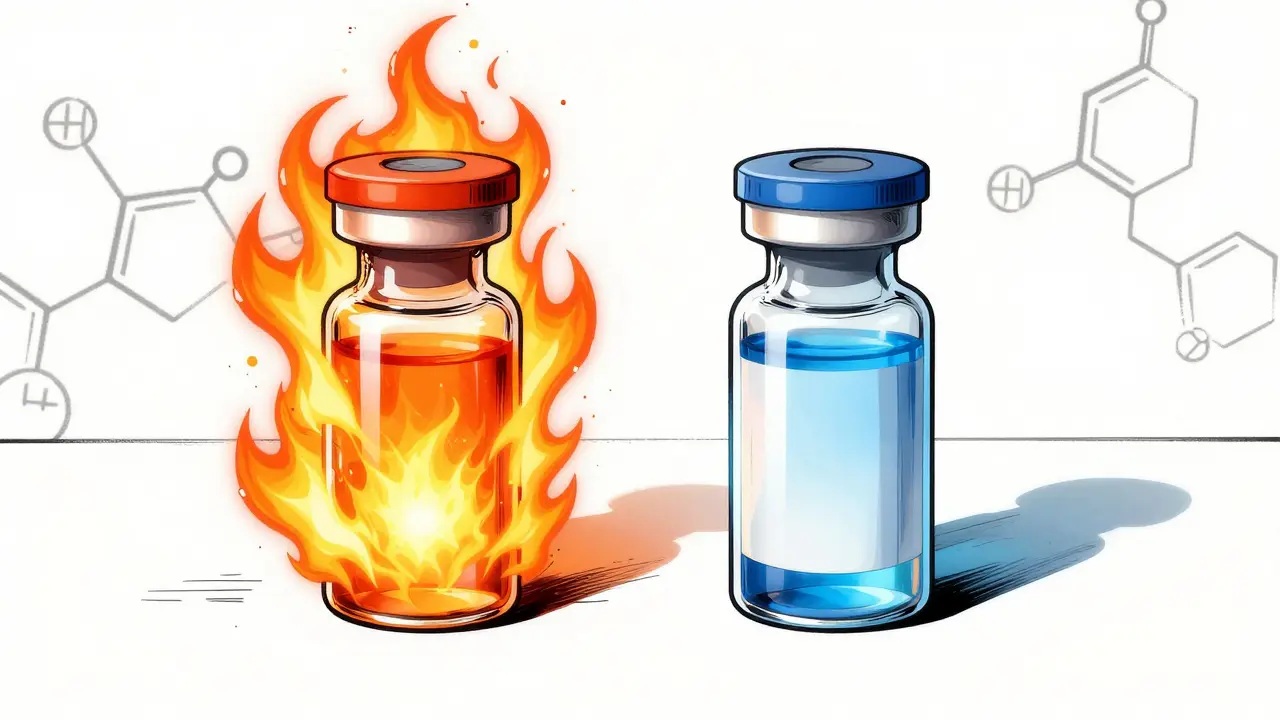
Choosing between the two often comes down to your specific skin goals and tolerance. While both clear acne, their strengths diverge when it comes to aging and side effects. The table below breaks down the key differences based on clinical data and user reports.
| Feature | Tretinoin | Adapalene |
|---|---|---|
| Generation | First-generation | Third-generation |
| Primary Use | Anti-aging, severe acne | Acne, mild aging |
| Availability | Prescription only | OTC (0.1%) & Prescription (0.3%) |
| Irritation Risk | High (Score 3.4/10) | Low (Score 2.1/10) |
| Stability | Unstable in light/air | Stable in light/air |
| Wrinkle Improvement | 42% (24 weeks) | 35% (24 weeks) |
| Avg. Cost (US) | $45.75 (Rx) / $10-20 (Insured) | $14.99 (OTC) |
Managing Side Effects and the Purge
Starting any retinoid comes with a learning curve. The most common complaint is initial irritation. Data from user reviews shows that 78% of adapalene users and 92% of tretinoin users report some level of irritation at the start. This is often called the "retinoid purge." It happens because the product speeds up cell turnover, bringing underlying clogs to the surface faster than usual.
For tretinoin, this purge can last 10 to 14 days. For adapalene, it is typically shorter, around 3 to 7 days. To manage this, many users adopt the "sandwich method." This involves applying a layer of moisturizer, then the retinoid, then another layer of moisturizer. A 2022 clinical trial found this technique reduces irritation by 47%. Another strategy is the "buffering technique," where you apply moisturizer before the retinoid to dilute its impact slightly.
Photosensitivity is a major risk with both. Retinoids make your skin more vulnerable to UV damage. Failure to use sunscreen increases adverse events by 3.2 times according to a 5-year retrospective study. You must apply a broad-spectrum SPF 30+ daily. Without it, you risk burning, hyperpigmentation, and undoing the anti-aging benefits you are trying to gain.

How to Build a Routine
Consistency beats intensity. You don't need to use the product every night immediately. The standard protocol suggests applying a pea-sized amount to clean, dry skin 2-3 nights a week initially. As your skin tolerates it, you can increase frequency over 8 to 12 weeks. A 2023 survey found that 63% of patients discontinued treatment within the first 4 weeks due to improper expectations about the adjustment period.
Here is a practical routine to follow:
- Cleanse your face with a gentle cleanser and pat dry.
- Wait 10-15 minutes for skin to fully dry (applying to damp skin increases irritation).
- Apply a pea-sized amount of retinoid to your entire face, avoiding the eye area and corners of the nose.
- Follow with a hydrating moisturizer.
- In the morning, cleanse and apply sunscreen immediately.
If you experience severe peeling or burning, take a break for a few days and resume with less frequency. Do not mix retinoids with other active ingredients like AHAs, BHAs, or Vitamin C in the same routine initially. This can compromise your skin barrier.
Cost and Accessibility
Price is often a deciding factor. Prescription tretinoin averages $45.75 per tube without insurance, though insurance coverage often reduces this to $10-20. Adapalene, being OTC, costs around $14.99 for a standard tube of Differin Gel. While tretinoin is cheaper with insurance, the cost of the doctor's visit adds up. For those without insurance, adapalene offers a much lower barrier to entry.
Documentation quality also varies. Adapalene's OTC labeling provides clearer usage instructions, with an 87% comprehension rate in FDA testing compared to 62% for prescription tretinoin labeling. This clarity helps users avoid mistakes that lead to irritation and discontinuation.
Future of Retinoid Therapy
The landscape is evolving. In 2022, the FDA approved Altreno, a 0.05% tretinoin lotion that showed 35% less irritation than conventional tretinoin. Experts predict the next decade will see therapy personalized through genetic testing. This would help predict individual irritation responses, optimizing the choice between tretinoin and adapalene for each patient. Despite new options, both of these remain foundational due to over 50 years of safety data.
Can I use tretinoin and adapalene together?
No, you should not use them together. Both are retinoids and work on the same receptors. Using both will increase the risk of severe irritation and damage your skin barrier without providing extra benefits. Choose one based on your needs.
Which is better for wrinkles?
Tretinoin is the gold standard for wrinkles. Clinical studies show it improves fine lines and collagen production more effectively than adapalene, which is primarily designed for acne treatment.
How long does it take to see results?
Most users need 8 to 12 weeks of consistent use to see significant improvement. For anti-aging benefits, it may take 6 to 12 months to see full results.
Is adapalene safe during pregnancy?
No, retinoids are generally not recommended during pregnancy. Both tretinoin and adapalene carry FDA Category C warnings. You should consult your doctor before using them if you are pregnant or trying to conceive.
Can I use retinoids in the morning?
It is best to use them at night. Tretinoin degrades in sunlight, and retinoids increase sun sensitivity. Night application ensures stability and maximizes efficacy while minimizing UV damage risks.
Whether you choose the proven power of tretinoin or the gentle stability of adapalene, the key is consistency. These are not overnight fixes. They are long-term investments in your skin health. By understanding how they work and managing the initial adjustment period, you can achieve clearer, smoother skin that lasts for years.