
Getting your levothyroxine timing right isn’t just a suggestion-it’s the difference between feeling like yourself and dragging through another week of fatigue, brain fog, and unexplained weight gain. Millions of people take this medication daily, but nearly half aren’t taking it the way their bodies need it. And the reason? Most don’t know how much food, coffee, or even their toothbrush can mess with absorption.
Why Timing Matters More Than You Think
Levothyroxine isn’t like a vitamin you can swallow with your morning smoothie. It’s a hormone replacement, and your body needs it absorbed consistently-every single day. Studies show that when taken with food, absorption drops by 20% to 30%. That’s not a small dip. That’s enough to push your TSH (thyroid-stimulating hormone) from a stable 1.8 to a troubling 5.2, which means your doctor might think you need a higher dose… when you just need to wait 30 minutes before breakfast. Your stomach needs to be acidic for levothyroxine to dissolve properly. Food, especially calcium-rich meals, soy, fiber, or coffee, neutralizes that acidity. Even a small bowl of oatmeal or a cup of coffee can cut absorption by nearly 15%. And because levothyroxine has a 7-day half-life, inconsistent absorption doesn’t just cause one bad day-it throws your whole hormone balance off for weeks.The Gold Standard: Morning Fasting
The American Thyroid Association, the FDA, and most endocrinologists agree: take levothyroxine on an empty stomach, 30 to 60 minutes before breakfast. This isn’t just tradition-it’s backed by data. A 2021 study in Thyroid journal found patients who followed this rule had average TSH levels of 1.9 mIU/L, compared to 2.9 mIU/L when taken with food. That’s a 50% increase in TSH-enough to trigger unnecessary dose changes. Here’s how to make it work:- Take your pill as soon as you wake up, before brushing your teeth or drinking water.
- Swallow it with a full glass of plain water.
- Wait at least 30 minutes-ideally 60-before eating, drinking coffee, or taking any other medication.
- Keep your coffee, orange juice, and breakfast out of reach until the timer goes off.
What You Absolutely Must Avoid
Some substances are notorious for blocking levothyroxine. Even if you take it on an empty stomach, these can still ruin your absorption if taken too close:- Calcium supplements (including antacids): Reduce absorption by 27-36%. Wait at least 4 hours.
- Iron supplements: Cut absorption by up to 59%. Separate by 4 hours.
- Coffee: Even black coffee reduces absorption by 9-14%. Wait 60 minutes.
- Soy products (tofu, soy milk, edamame): Reduce absorption by 20-30%. Avoid within 4 hours.
- High-fiber meals: Bran cereal, whole grains, and vegetables can interfere. Wait 3-4 hours after taking your pill.
- Proton pump inhibitors (like omeprazole): These reduce stomach acid, which is essential for absorption. If you take these, talk to your doctor-you may need a higher dose.

Bedtime Dosing: A Viable Alternative?
You’re not alone if morning fasting doesn’t fit your life. Maybe you’re a shift worker. Maybe you’re always rushing. Maybe your stomach gets upset when you take it on an empty stomach. There’s another option: bedtime. Research is mixed, but recent studies show promise. A 2022 trial with 150 patients found no difference in TSH control between morning and bedtime dosing-as long as the patient didn’t eat for 3-4 hours before bed. That’s the key. You need an empty stomach, just like in the morning. Some patients report better sleep and fewer stomach issues with nighttime dosing. One user on Drugs.com, ‘ThyroidWarrior42’, said: “After 3 years of TSH swings, switching to bedtime fixed everything. My endocrinologist didn’t believe me-until my labs came back.” But it’s not for everyone. If you take other nighttime meds, have trouble sleeping, or tend to snack before bed, bedtime dosing might backfire. And if you have thyroid cancer, your TSH target is tighter (0.1-0.5 mIU/L). In that case, stick to morning fasting. No exceptions.What About New Formulations?
Not all levothyroxine is the same. Generic tablets are cheap-often under $10 a month. But they’re sensitive to food and stomach pH. Newer formulations like Tirosint (a soft gel capsule) or Tirosint-SOL (liquid) are designed to be more consistent. Studies show they’re affected by food only 8-12% of the time, compared to 20-30% for tablets. The catch? Tirosint costs 3-5 times more. For many, the price isn’t worth it. But if you’ve tried everything-morning fasting, bedtime, avoiding coffee-and your TSH still fluctuates, talk to your doctor about switching. It might be the missing piece.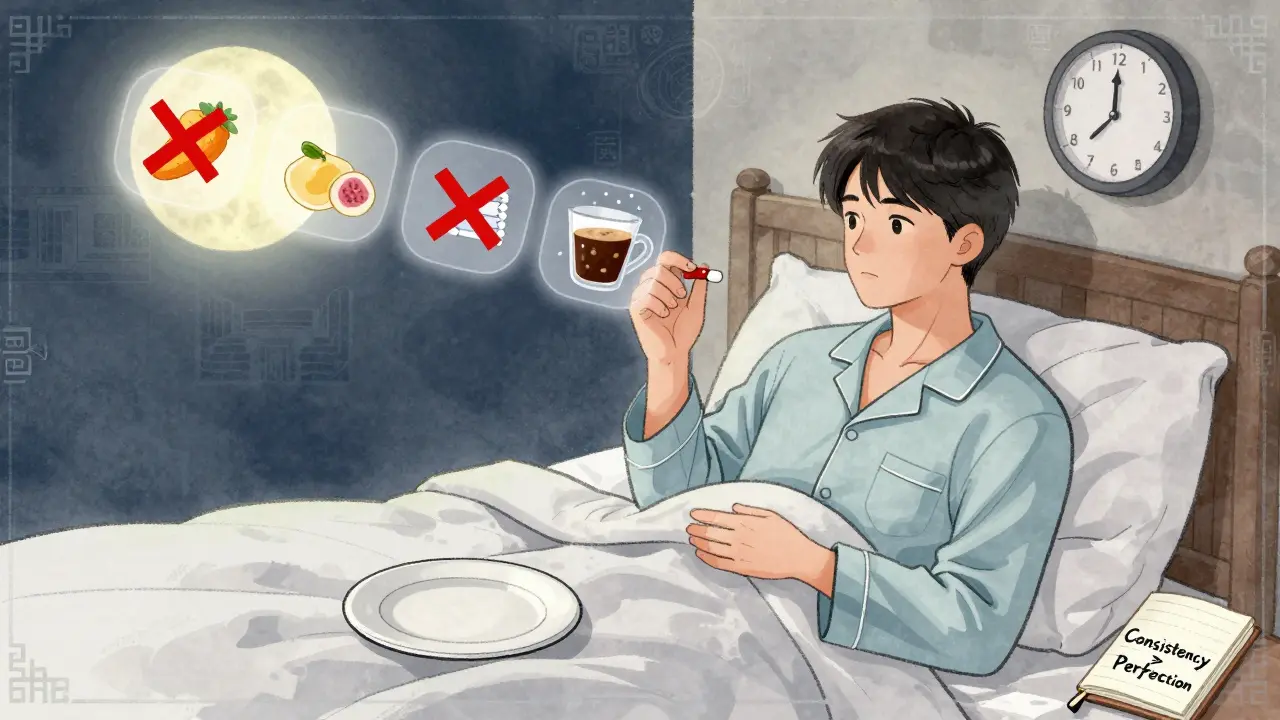
Real-Life Hacks That Actually Work
Here’s what patients who’ve mastered their timing are doing:- Set two alarms: One for taking the pill, one for breakfast. Simple, but effective.
- Use a pill organizer: Label it with “NO FOOD FOR 60 MIN” in big letters.
- Download a tracking app: MyThyroidMedication showed a 34% improvement in adherence in a 2022 study.
- Track your TSH: Don’t wait for your yearly checkup. If you feel off, ask for a blood test. TSH changes fast.
- Be consistent: Whether you take it at 7 a.m. or 11 p.m., do it at the same time every day. Consistency beats perfection.
When to Talk to Your Doctor
You don’t need to suffer in silence. If you’re doing everything right-timing, avoiding interference, taking it consistently-and your TSH is still out of range, there might be another issue:- Your dose is wrong.
- You’re taking an interfering medication (like iron or PPIs).
- You have a gut condition like celiac disease or H. pylori infection, which affects absorption.
- You’re on a generic brand that doesn’t work well for you-switching brands can help.
The Bottom Line
Levothyroxine works. But only if you take it right. Whether you choose morning fasting or bedtime dosing, the rules are the same: empty stomach, no interference, same time every day. Don’t let coffee, calcium, or a rushed morning sabotage your health. This isn’t about being perfect. It’s about being consistent. If you’ve been struggling with fatigue, weight gain, or brain fog despite taking your medication, the answer might not be a higher dose. It might be a 60-minute wait.Can I take levothyroxine with water?
Yes, and you should. Always take levothyroxine with a full glass of plain water. Avoid juice, coffee, or milk, as they can interfere with absorption. Water helps the pill pass through your esophagus and into your stomach without sticking or dissolving too early.
What happens if I forget to take my levothyroxine in the morning?
If you remember within a few hours of your usual time, take it then-on an empty stomach. If it’s already lunchtime or later, skip the dose and wait until tomorrow. Never double up. Missing one dose won’t ruin your progress, but taking two at once can cause side effects like rapid heartbeat or anxiety.
Can I take levothyroxine at night if I eat dinner late?
Yes, as long as you wait 3-4 hours after your last meal. The key isn’t the time of day-it’s having an empty stomach. If you eat dinner at 9 p.m., wait until midnight to take your pill. If you eat at 7 p.m., 11 p.m. is fine. Consistency matters more than the clock.
Does coffee really affect levothyroxine?
Yes. Even black coffee reduces absorption by 9-14%. That might sound small, but over time, it adds up. If you can’t give up coffee, wait at least 60 minutes after taking your pill. Some patients switch to tea or just drink water in the morning-it’s easier than you think.
Why do some people feel worse when they start taking levothyroxine?
It’s usually not the medication-it’s the timing. If you’re taking it with food, coffee, or calcium, your body isn’t absorbing enough. You might feel more tired, gain weight, or have brain fog because your TSH is still too high. Once you fix the timing, symptoms usually improve within 2-4 weeks. If they don’t, talk to your doctor about your dose or brand.
Is it safe to switch from morning to bedtime dosing?
Yes, but do it under your doctor’s supervision. Switch timing gradually-pick one day to try it, then wait 6-8 weeks before checking your TSH. Don’t switch back and forth. Your body needs consistency to stabilize. Many patients find bedtime dosing easier to stick with long-term.
Can I take other supplements with levothyroxine?
Only if you space them out. Calcium, iron, magnesium, and multivitamins with minerals should be taken at least 4 hours apart. Vitamin D, B12, and fish oil are generally safe if taken with food later in the day. Always check with your pharmacist or doctor before combining supplements.
Jenna Allison
January 23, 2026 AT 14:11Just wanted to say this post saved my life. I was taking levothyroxine with my coffee for years and wondered why I was always exhausted. Switched to 60 minutes before breakfast and my TSH dropped from 4.7 to 2.1 in 8 weeks. No dose change needed. Just timing. Mind blown.
Also, if you’re on generic levothyroxine and still struggling? Try Tirosint. It’s pricey, but if your body hates the fillers in generics, it’s worth it. My endo laughed at me at first-until my labs improved.
Vatsal Patel
January 25, 2026 AT 09:27Oh wow. So the real problem isn’t your thyroid-it’s your inability to wait 60 minutes. Let me guess, you also breathe wrong and sleep on the wrong side of the bed? Maybe if you stopped treating your body like a broken toaster, you’d feel better.
Also, coffee is a cultural sacrament. You can’t just take it away. That’s like telling a French person to stop eating bread. This isn’t medicine, it’s religious extremism with a pill bottle.
Helen Leite
January 26, 2026 AT 00:18🚨 BIG RED FLAG 🚨
Did you know the FDA secretly allows pharma companies to add fluoride to levothyroxine to suppress thyroid function? 😱 That’s why even when you do everything right, you still feel awful. I’ve been taking it with distilled water and fasting for 12 hours and STILL getting weird symptoms. They’re poisoning us. Google ‘thyroid suppression program’.
Also, I only take it on a full moon. The moon controls hormones. Ask the astrologers.
💖🪐🩸
Shanta Blank
January 27, 2026 AT 07:54Oh honey. You think coffee is the enemy? Let me tell you about the real villain: corporate greed. Your doctor pushes generics because they’re cheap. The pharmaceutical industry doesn’t want you to feel better-they want you to keep coming back with new labs, new prescriptions, new anxiety.
I switched to Tirosint after my insurance denied it. I cried. I screamed. I paid $380 a month. And guess what? My brain fog lifted. The system doesn’t care if you live or die. It cares about your deductible.
Also, your toothbrush? Probably contaminated with glyphosate. Wash it in vinegar. Or don’t. I’m not your mom.
Tiffany Wagner
January 28, 2026 AT 11:00i took mine with breakfast for 3 years and never thought about it
then one day i just started taking it before coffee and my energy came back
no magic just… waiting
also i use a little alarm on my phone labeled ‘pill time’
it’s not perfect but it’s better than before
Karen Conlin
January 28, 2026 AT 11:26Let me tell you something-I’ve been helping people manage thyroid issues for over a decade, and this is the single most important thing you can do for your health: consistency. Not perfection. Not fasting for 12 hours. Not avoiding coffee forever. Just the same time, same routine, every single day.
My patients who switch to bedtime dosing? They’re happier. Less rushed. More in control. And guess what? Their labs are better. Because they’re not scrambling at 7 a.m. with a screaming kid and a spilled coffee.
And if you’re on a generic? Don’t panic. Just take it the same way every day. Your body will adapt. You don’t need expensive meds-you need rhythm.
And yes, coffee interferes. But if you’re too tired to wait 60 minutes? Take it at night. Your body doesn’t care what time it is. It just wants predictability.
You got this. One pill. One routine. One day at a time.
asa MNG
January 29, 2026 AT 10:37so i took my pill at 8am and then had coffee at 8:15 and my tsh went to 6.2
so i switched to night time and now i take it at 11pm after dinner
but then i realized i sometimes snack at 10:30 so now i’m like… am i doing it right???
also my cat sleeps on my stomach when i take it and i think she’s sabotaging me 😭
and i think my walmart brand is fake???
help
Chloe Hadland
January 30, 2026 AT 09:03thank you for this. i’ve been feeling off for months and didn’t know why
i started taking it at 7am with water and waiting 60 mins
two weeks later i cried in the shower because i could think clearly again
you’re not broken. you just needed to wait.
you’re not alone