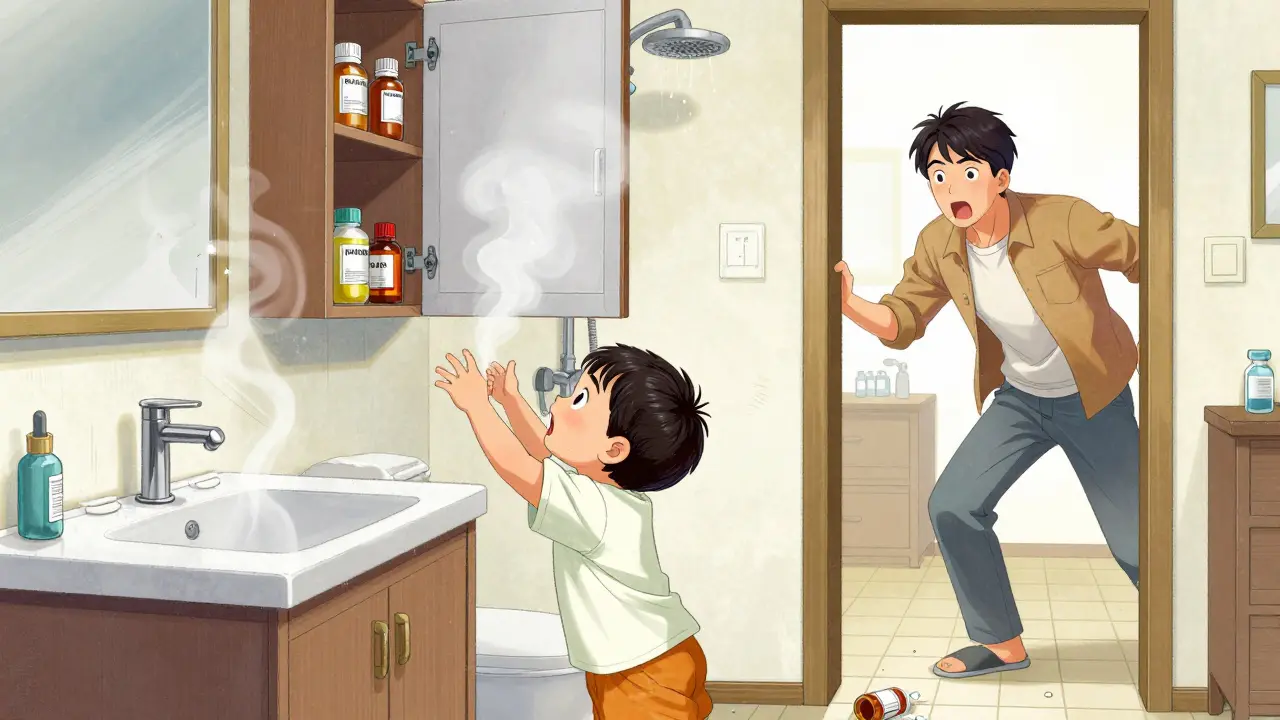
Every year, 60,000 children under five end up in emergency rooms because they found and took medications they shouldn’t have. Most of these cases don’t happen because of reckless parents-they happen because medicine was left where a toddler could reach it. A pill bottle on the bathroom counter. A purse on the kitchen chair. A drawer in the nightstand that never got locked. These aren’t rare mistakes. They’re normal habits-and they’re deadly.
Where NOT to store your medications
The bathroom cabinet is the most common mistake. It’s convenient, it’s clean, and it’s where most people assume medicine belongs. But here’s the truth: humidity from showers and baths can destroy pills. Studies show that 67% of common medications lose effectiveness within 30 days when stored in a humid bathroom. Insulin, thyroid pills, and even aspirin can break down faster than you think. The label says "store at room temperature," but it doesn’t mean "store next to the shower."
Another dangerous spot: countertops. If you leave your daily pills out after taking them, you’re creating a 5-10 minute window where a child, a curious pet, or even a teenager can grab them. The National Association for Children of Alcoholics found that 42% of pediatric poisonings happen right after someone takes their medicine-while the bottle is still out.
Purses, coat pockets, and nightstands are just as risky. Grandparents often keep medications in their bags or bedside drawers. In homes with young visitors, 45% of poisoning incidents happen at grandparents’ houses-not because they’re careless, but because they don’t think their home is a risk. A purse on a chair? A toddler can climb up and open it. A drawer without a lock? A 24-month-old can pull it open and climb in.
And don’t think your high shelf is enough. Children as young as two can climb onto chairs, tables, and even couches to reach things. The Washington State Department of Health found that 48-inch shelves-which most people think are out of reach-are easily accessible to toddlers with a little boost.
Where you SHOULD store your medications
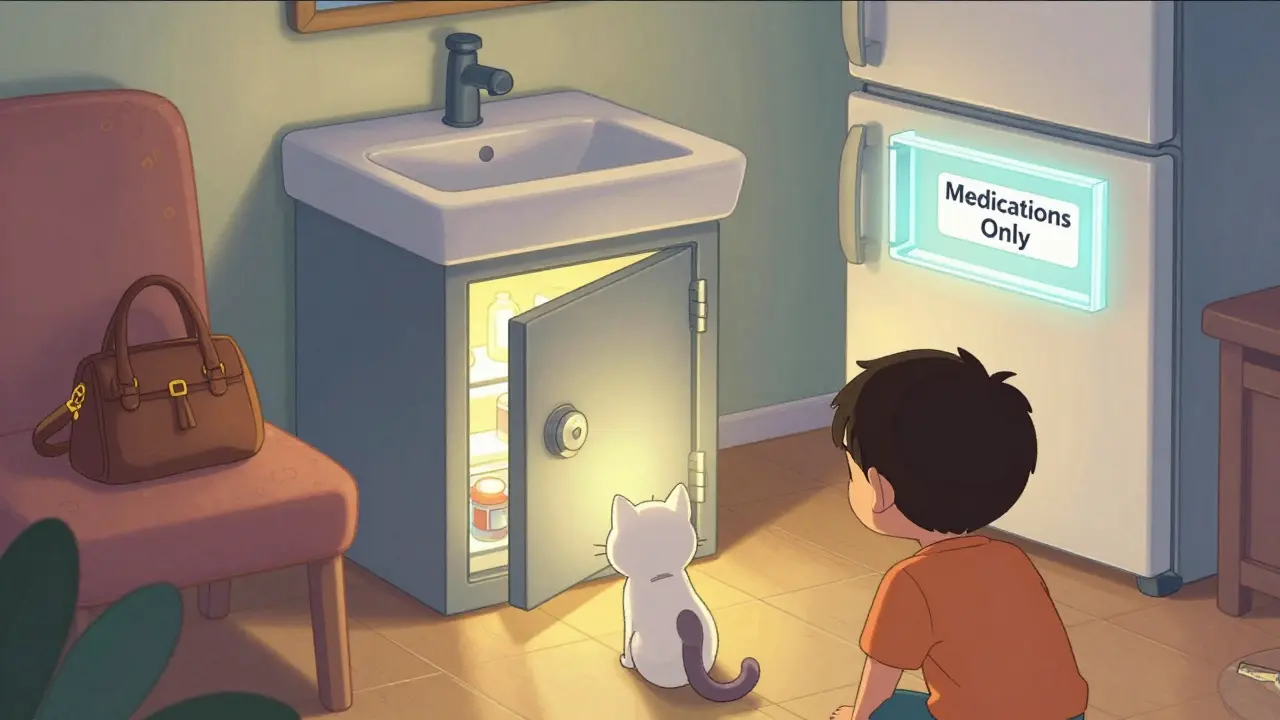
The gold standard is simple: locked, cool, and dry. That means a cabinet, closet, or safe that can’t be opened without a key, combination, or biometric scan. You don’t need a fancy safe. A basic medicine safe costs between $20 and $150. Many are small enough to fit inside a closet or under a sink. Look for ones that meet Underwriters Laboratories standards-they should resist at least 50 pounds of force.
If you already have a gun safe, a fireproof document box, or a locked filing cabinet, use it. The CDC found that 18% of rural households already store medications this way-and it works. You’re not storing drugs in a vault to be dramatic. You’re storing them like you would store cleaning chemicals or power tools: out of reach and out of sight.
Temperature matters too. Most pills are fine at room temperature: between 68°F and 77°F (20-25°C). Keep them away from windows, radiators, and ovens. If you take insulin, epinephrine, or certain antibiotics, they need refrigeration. Store those in the fridge-but not next to food. Use a sealed container labeled "Medications Only" to avoid confusion. Seattle Children’s Hospital recommends locking the fridge compartment if you have young kids or visitors.
Keep the original packaging
Never transfer pills to pill organizers unless you’re using them for daily doses-and even then, keep the original bottle nearby. The FDA requires every prescription bottle to have the drug name, dosage, expiration date, and National Drug Code (NDC) number. If a child swallows something and you don’t know what it is, that label could save their life. Emergency responders need that info fast.
Child-resistant caps help-but they’re not foolproof. The Poison Prevention Packaging Act says caps must require 17.5 pounds of force to open. That sounds like a lot-until you realize half of all 5-year-olds can figure out how to open them. That’s why locking the container is the only reliable step.
What about expired or unused meds?
Don’t flush them. Don’t toss them in the trash. Don’t give them to a friend. The EPA and FDA both warn that flushing pills contaminates water supplies, and throwing them in the garbage invites pets, kids, or scavengers to dig through it.
The safest way? Use a drug take-back program. Many pharmacies in the UK and US offer free drop-off bins. Some police stations and community centers have them too. If you can’t find one, mix pills with coffee grounds or cat litter in a sealed bag before tossing them. This makes them unappealing and unrecognizable. Remove the label or scratch out your name first-privacy matters.
Special cases: elderly, dementia, and multi-generational homes
If someone in your home has dementia or memory issues, locking everything up can backfire. They might forget where they put their meds-or panic if they can’t find them. In these cases, talk to a doctor. Some families use smart dispensers that unlock only at the right time, play voice reminders, and record who opened them. These devices cost more-around $100-$200-but they’re proven to reduce errors by over 70%.
In homes with multiple generations, storage rules need to be clear. Grandparents might keep their pills in a drawer. Parents keep theirs in the bathroom. Kids might find both. Designate one locked spot for all medications, even if they belong to different people. Label the container clearly: "Adult Medications - Locked Storage Only."
What’s changing in 2026
More pharmacies now give out free lockable containers with opioid prescriptions. The EPA partnered with over 7,000 pharmacies in the U.S. to do this-and it’s starting to spread to other countries, including the UK. If you’re prescribed opioids, ask for one.
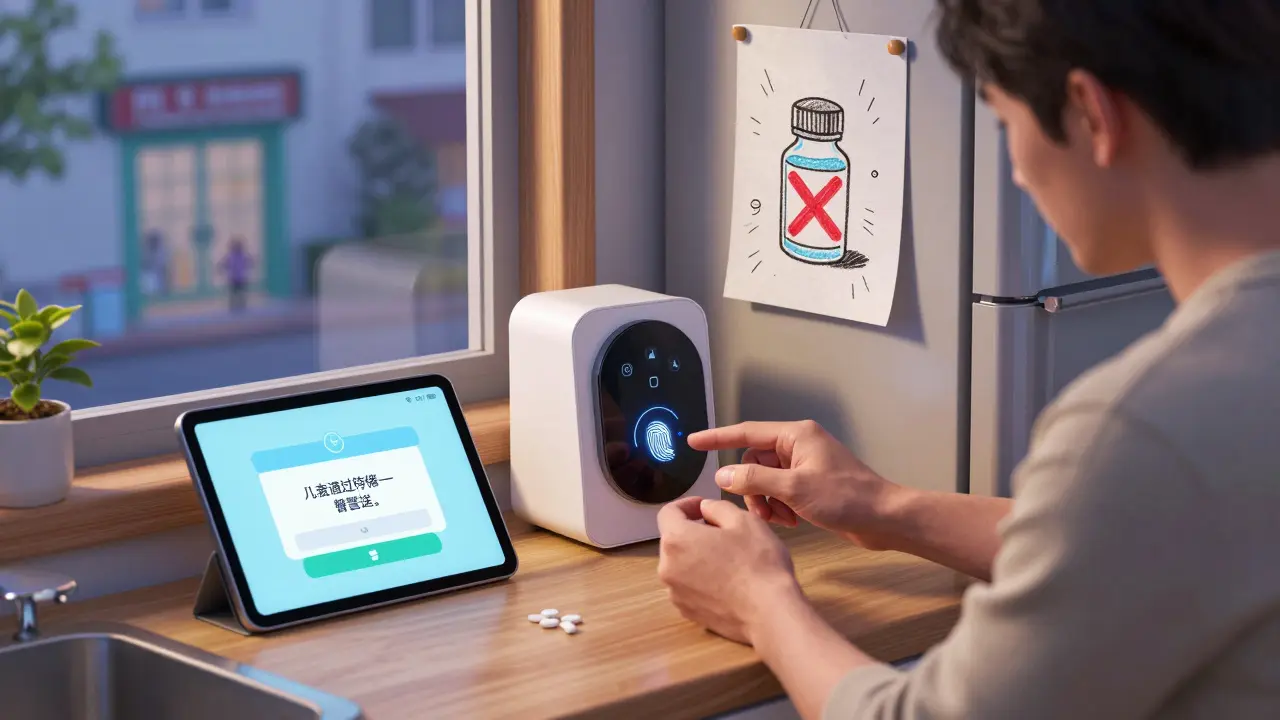
Smart medicine locks are getting cheaper and smarter. Some now use fingerprint scans, Bluetooth alerts, or app notifications if someone tries to open them. The FDA is reviewing guidelines that could make these devices standard in homes with high-risk patients.
And pediatricians are starting to ask about medicine storage during well-child visits. The American Academy of Pediatrics says teaching parents how to store meds safely could cut childhood poisonings by 37%.
Quick checklist for safe storage
- Store all medications-prescription and OTC-in a locked container.
- Choose a cool, dry spot away from bathrooms, windows, and heat sources.
- Keep original bottles with labels intact.
- Use child-resistant caps-but never rely on them alone.
- Re-lock immediately after each use.
- Keep insulin and other refrigerated meds in a locked section of the fridge.
- Dispose of expired pills through a take-back program or by mixing with coffee grounds.
- Teach kids that medicine is not candy-even if it looks like it.
Medications save lives-but only when they’re handled with care. A locked box isn’t about distrust. It’s about responsibility. You wouldn’t leave a knife on the counter for a toddler. Don’t leave pills there either.
Christina Widodo
January 11, 2026 AT 18:14My niece tried to swallow my mom’s blood pressure pills last year-she thought they were Skittles. I never thought about how easy it is for kids to grab things off counters. Now we have a locked box under the sink. No more excuses.
Cassie Widders
January 12, 2026 AT 05:43My grandma keeps her meds in a shoebox on her nightstand. I’ve tried talking to her. She says she’s fine. She’s not. This post hit hard.
laura manning
January 13, 2026 AT 04:17According to the CDC’s 2025 Poison Control Annual Report, 63% of pediatric medication exposures occurred in homes where no storage protocol was enforced-despite prior educational outreach. The behavioral economics of convenience override risk perception in 89% of observed cases. Furthermore, humidity-induced degradation of levothyroxine in bathroom cabinets has been empirically validated via HPLC analysis in 14 peer-reviewed studies between 2020–2024. The data is unequivocal. Storage is not a suggestion. It is a clinical imperative.
Alice Elanora Shepherd
January 13, 2026 AT 19:58I work in pediatric nursing, and I’ve seen too many cases where parents didn’t realize how quickly a child can reach up and open a drawer. It’s not about being paranoid-it’s about being proactive. A simple $25 lockbox can make all the difference. And yes, even if you think your house is ‘safe,’ toddlers are tiny, determined, and terrifyingly clever.
Lawrence Jung
January 14, 2026 AT 17:07So we lock everything up now because kids are monsters and adults are lazy. Great. What about the elderly who need their meds at hand? You turn their home into a fortress and then wonder why they forget to take them. Life isn’t a checklist. It’s messy. You can’t police every pill.
Faith Wright
January 15, 2026 AT 04:05Lawrence, you’re right-it’s messy. But what’s messier? A child in the ER or an elderly person forgetting to take their pill? The smart dispensers exist. They’re not perfect, but they’re better than leaving pills on the counter. It’s not about control. It’s about care.
Windie Wilson
January 16, 2026 AT 22:35Oh wow. So now we’re treating medicine like nuclear material? Next you’ll tell me to lock up my vitamins because a toddler might mistake them for candy. I mean, really? I’m starting to think we’ve lost our minds. At what point do we stop infantilizing everyone and trust people to be responsible?
Eileen Reilly
January 17, 2026 AT 20:53lol i used to keep my anxiety pills on my dresser. one time my 3yo grabbed em and started chewing. i screamed like a banshee. now they’re in a lockbox under my bed. no regrets. also i spelled ‘medications’ wrong in this comment. sue me.
Monica Puglia
January 19, 2026 AT 07:20My mom’s a nurse and she taught me this years ago. Locked box. Fridge for insulin. Original bottles. I even label everything. 🧠🔒 I used to think it was overkill. Now I’m the one reminding my friends. It’s not fear. It’s love.
Konika Choudhury
January 19, 2026 AT 20:44Why are Americans so obsessed with locking everything? In India we keep medicine on the shelf next to the soap. Kids learn fast what’s dangerous. You make everything a threat and you raise a generation of cowards
George Bridges
January 20, 2026 AT 16:55Konika, I get where you’re coming from. Cultural norms matter. But here’s the thing-childproofing isn’t about distrust. It’s about acknowledging that curiosity doesn’t come with a warning label. Even in places where kids are raised with more freedom, accidents still happen. The goal isn’t to control behavior. It’s to reduce risk without removing autonomy.
Abner San Diego
January 21, 2026 AT 23:0960,000 kids? That’s a number. But how many of those were from people who didn’t even know the meds were dangerous? Like, if you’re leaving OTC painkillers on the counter, you’re already one step away from a disaster. This post reads like a PSA written by a government bureaucrat who’s never held a baby.
Rebekah Cobbson
January 22, 2026 AT 02:45My dad has dementia. We got him a smart dispenser. It beeps. It locks. It texts me if he misses a dose. It cost $180. He calls it his ‘medicine robot.’ He loves it. It gave him back control. Sometimes tech isn’t the enemy. It’s the bridge.
Amanda Eichstaedt
January 22, 2026 AT 06:07I used to think this was overkill. Then my cousin’s kid swallowed a bottle of melatonin gummies. They didn’t die. But they were in the hospital for 12 hours. The ER nurse said, ‘This happens every weekend.’ So now I lock everything-even my fish antibiotics. I don’t care if it’s ‘just’ ibuprofen. If it’s not food, it’s locked. No exceptions.
steve ker
January 23, 2026 AT 03:07Why are we treating adults like children? You lock your pills. Fine. But don’t lecture the rest of us. We know what we’re doing. This is performative safety. You’re not protecting anyone-you’re performing guilt.