Language Barriers in Healthcare: How Communication Gaps Affect Medication Safety
When language barriers, the challenges patients face when they don’t share a common language with their healthcare providers. Also known as communication gaps in medical settings, it directly impacts how well people understand their prescriptions, warnings, and treatment plans. These aren’t just inconveniences—they’re life-threatening. A patient who doesn’t understand how to take their blood thinner, or why they can’t drink grapefruit juice with their statin, is at serious risk. Studies show that patients with limited English proficiency are twice as likely to experience medication errors compared to those who speak the same language as their doctor.
It’s not just about translating words. medication safety, the system of practices that prevent harmful drug reactions and misuse depends on clear, two-way communication. A patient might nod along during a consultation because they’re embarrassed to admit they didn’t understand, or because the provider didn’t pause to check. That’s how someone ends up taking double the dose of insulin, or skipping their antibiotic because they thought "twice daily" meant morning and night—on the same day. Even simple things like reading pill labels or understanding side effect warnings become impossible without proper language support.
patient communication, the exchange of health information between providers and patients to ensure understanding and adherence isn’t just about interpreters. It’s about whether the instructions were given in plain language, whether visuals were used, whether the patient was asked to repeat the instructions back. Many clinics still rely on family members to translate—putting the burden on children or untrained relatives who may misunderstand medical terms. That’s why trained medical interpreters, translated materials, and visual aids aren’t luxuries—they’re essential tools for safe care.
And it’s not just about English. healthcare access, the ability of individuals to obtain timely, appropriate medical services without financial or linguistic obstacles is broken for millions who speak Spanish, Mandarin, Arabic, or any of the hundreds of languages spoken in the U.S. alone. Pharmacies often don’t offer multilingual labels. Online portals are monolingual. Even drug packaging in the U.S. rarely includes instructions in other languages. That means a patient who just moved here might be taking their heart medication at the wrong time—or not at all—because they can’t read the bottle.
There’s a reason so many posts here focus on pill organizers, medication tracking, and drug interactions. Because when language gets in the way, even the best treatment plan fails. A patient with diabetes who doesn’t understand foot inspection checklists is more likely to develop ulcers. Someone on steroids who doesn’t know to monitor their blood sugar could end up in the ER. A person taking a TNF inhibitor who doesn’t realize fever and night sweats mean TB reactivation might not speak up until it’s too late.
What you’ll find below isn’t just a list of articles—it’s a practical toolkit. From how to ask your pharmacist for translated instructions, to why cultural competence matters when prescribing antidepressants, to how to update your allergy list across providers when you’re not fluent in English—these are the real-world fixes that save lives. No jargon. No theory. Just what works when the system isn’t built for you.
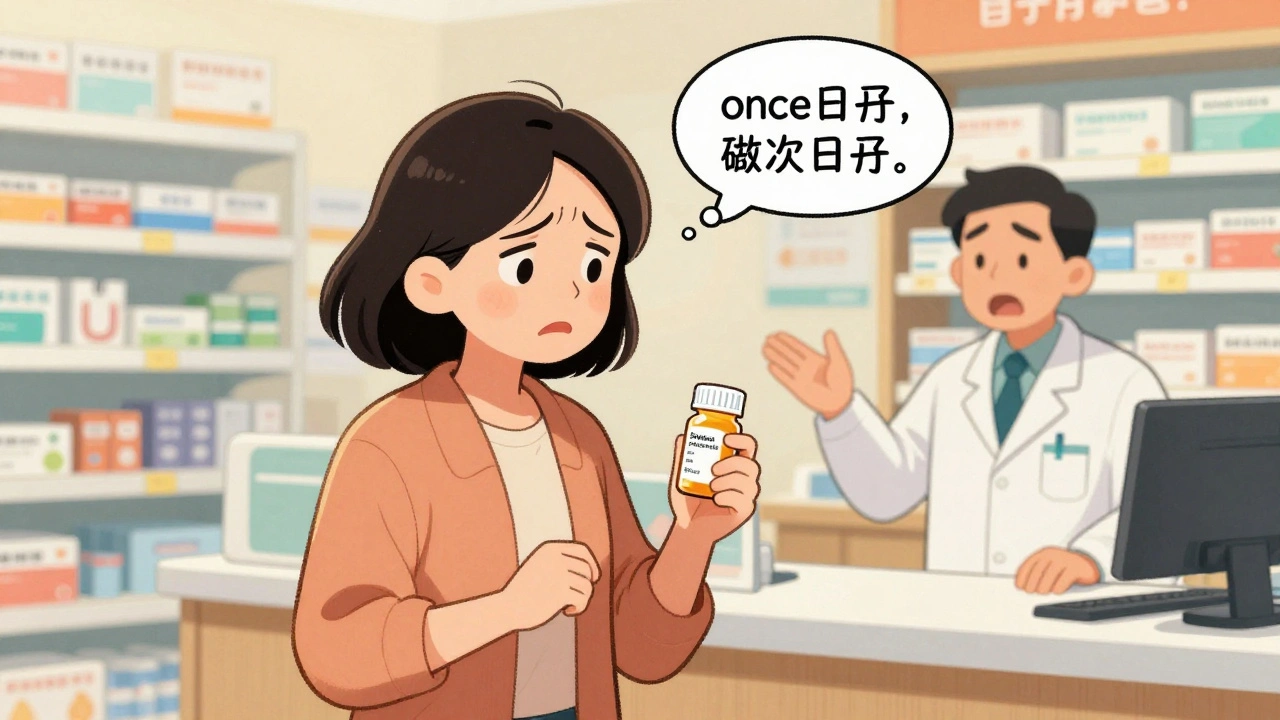
Language Barriers and Medication Safety: How to Get Help
Language barriers in healthcare lead to dangerous medication errors. Learn how professional interpreters, translated instructions, and direct observation can prevent harm-and what patients and providers can do to ensure safety.