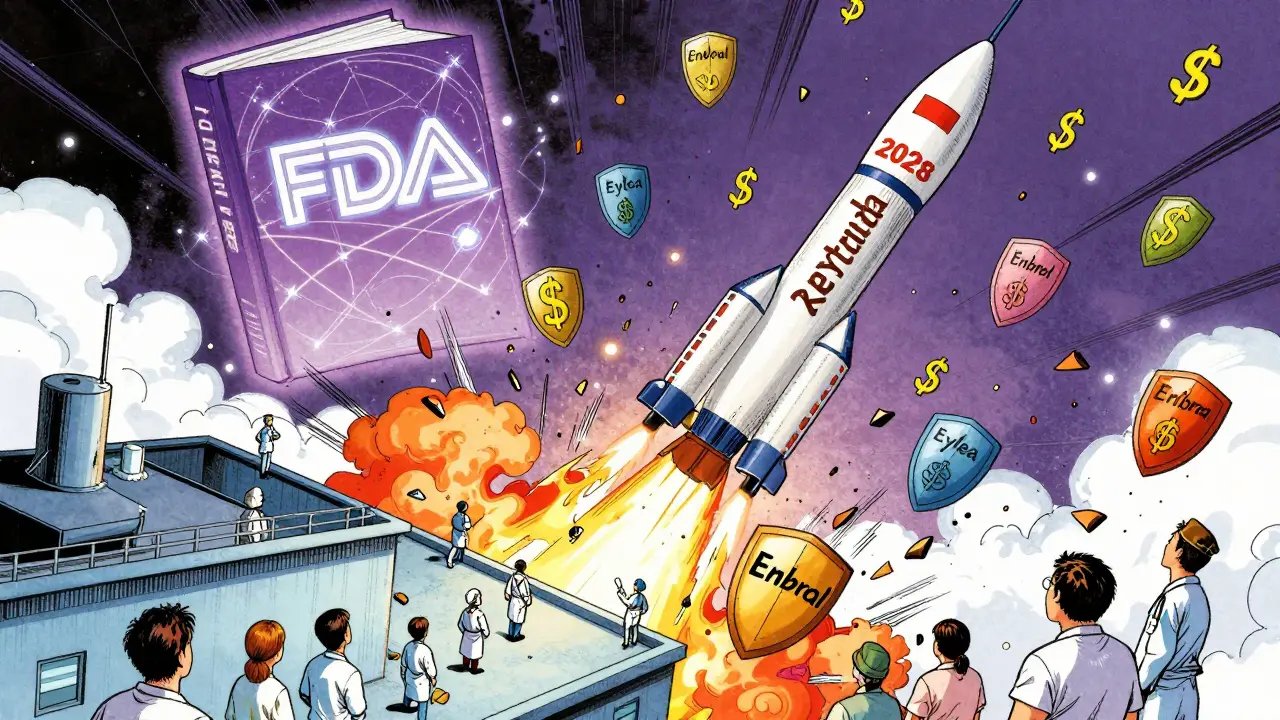
When a life-saving biologic drug loses its patent, it doesn’t just open the door for cheaper versions-it reshapes entire healthcare systems. The next five years will see more than $200 billion in annual biologic sales come under pressure from biosimilars, and the ripple effects are already being felt in hospitals, pharmacies, and patient wallets. This isn’t about generic pills. These are complex, living medicines-protein-based therapies that treat cancer, autoimmune diseases, and rare conditions. And unlike generics, which are chemically identical copies, biosimilars are highly similar but not identical. They require years of testing, billions in investment, and careful regulatory navigation. The next wave of patent expirations is here, and the stakes couldn’t be higher.
What Makes a Biosimilar Different From a Generic?
Most people think of generics as simple copies of brand-name drugs. Aspirin, metformin, or lisinopril? Those are small-molecule drugs with simple chemical structures. You can replicate them exactly. Biosimilars? They’re made from living cells-yeast, bacteria, or mammalian cells engineered to produce proteins like antibodies. Think of it like cloning a human face: you can get very close, but tiny differences in folding, sugar attachments (glycosylation), or protein shape can change how the drug works in the body.
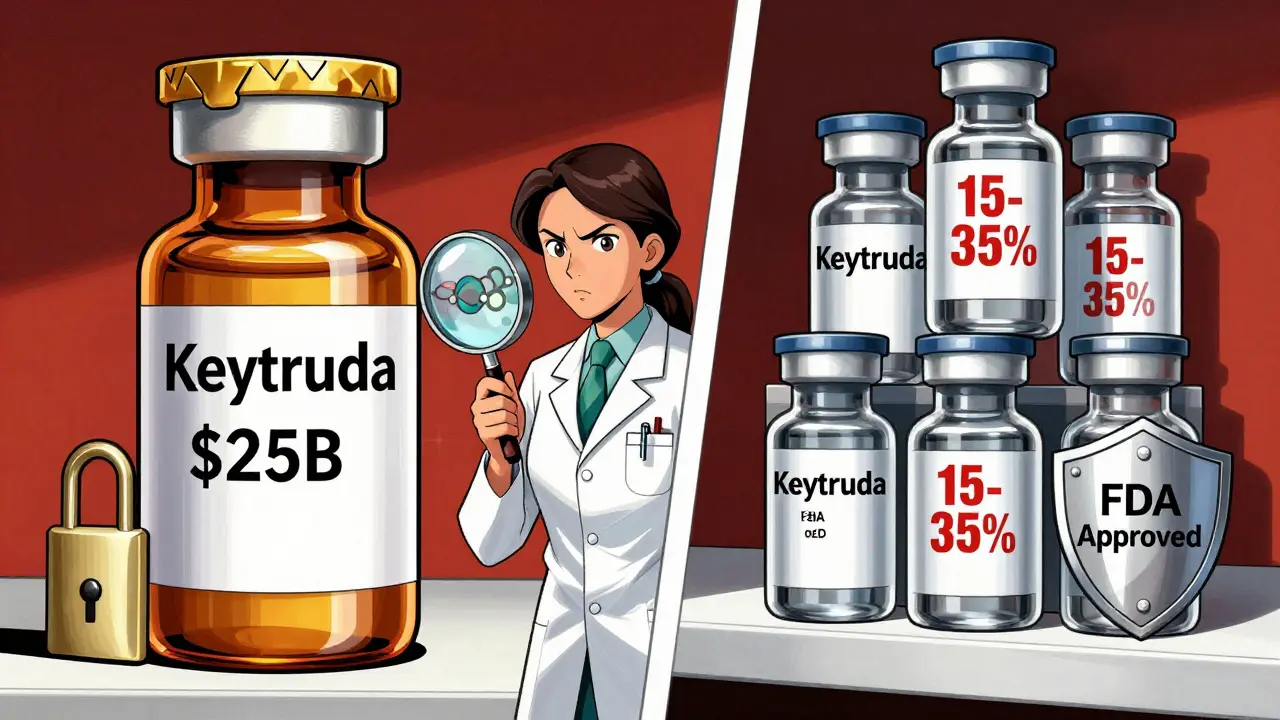
Take Keytruda (pembrolizumab, a monoclonal antibody used in cancer immunotherapy). Its reference product has over 237 patents protecting it, including ones on manufacturing processes and specific glycosylation patterns. A biosimilar must match these exactly to be approved. That’s why it took over a decade to develop, and why the first biosimilars won’t hit the U.S. market until 2028. Compare that to a generic like Ibrance (palbociclib, a small-molecule cancer drug), which became available in 2024 after a single chemical synthesis change. Biosimilars aren’t just cheaper copies-they’re scientific feats.
Which Biologics Are Losing Protection Between 2025 and 2030?
The next five years will be the biggest wave of biosimilar entries ever. Here are the top five blockbusters set to lose patent protection:
- Eylea (aflibercept) - Expiration in 2025. Used for macular degeneration. With $5.9 billion in U.S. sales in 2023, it’s already seeing biosimilar competition. Three biosimilars-Yesafili, Opuviz, and Enzeevu-were approved in 2024. Market share hit 12% in Q1 2025.
- Humira (adalimumab) - Expiration in 2023. The former top-selling drug in history. After a nine-year delay due to patent litigation, 12 biosimilars are now on the market. They captured 80% of new prescriptions within 18 months. This is the blueprint for what’s coming next.
- Enbrel (etanercept) - Expiration in 2029. Sandoz’s biosimilar launched in 2023 at a 35% discount. Already used in over 68% of new prescriptions at major hospital systems like Mass General Brigham.
- Keytruda (pembrolizumab) - Expiration in 2028. Projected to generate $25.5 billion in 2024. Fourteen companies are in Phase 3 trials. This will be the largest biosimilar entry in history-worth more than all other upcoming biosimilars combined.
- Cosentyx (secukinumab) - Expiration in 2029. A psoriasis and arthritis drug. Samsung Bioepis’ biosimilar received positive review from the European Medicines Agency in October 2025, with a 2026 EU launch expected.
These aren’t just drugs. They’re revenue engines. Merck, Bristol Myers Squibb, and Regeneron are now racing to protect their market share-not just with patents, but with rebates, patient assistance programs, and even authorized biosimilars (like Regeneron’s $1.2 billion deal with Alvotech).
How Are Biosimilars Priced? What’s the Real Savings?
Biosimilars don’t slash prices the way generics do. A generic might cost 90% less. Biosimilars? They typically launch at 15-35% below the reference product. Why? Because the development cost is 10-20 times higher than a generic. A single biosimilar can cost $150-250 million to bring to market, with 7-10 years of R&D.
But here’s the twist: even 20% savings add up fast. The RAND Corporation estimates biosimilars could save the U.S. healthcare system $250 billion over the next decade. In 2024, the global biosimilars market hit $12.7 billion-up 28% from 2023-and is projected to hit $80 billion by 2030. That’s not just savings-it’s systemic change.
Some payers are pushing hard. Cigna’s 2025 Medicare Advantage plans offer $0 copays for biosimilars versus $50 for the brand. Centene Corporation now requires biosimilars for all new patients on tumor necrosis factor inhibitors. Hospitals like Kaiser Permanente updated their EHRs to auto-substitute biosimilars for filgrastim products. But not all systems are ready. Medicare Part B pays providers based on the Average Sales Price (ASP), meaning they earn more if they use the expensive brand. That’s why it often takes 18 months after approval for a biosimilar to gain real traction.
Why Are Some Biosimilars Delayed? Patent Thickets and Legal Battles
It’s not just science. It’s law. Originator companies build “patent thickets”-hundreds of overlapping patents on manufacturing, delivery, and even storage. Humira had 237 patents, and litigation delayed biosimilar entry for nine years. The FDA’s Purple Book (a public database listing approved biologics and their patent status) is now updated daily, and a January 2025 rule requires real-time patent listing. This should reduce delays.
But settlements still happen. The Eliquis (apixaban) litigation delayed generic competition by four years. Dr. Janet Woodcock, former FDA Acting Commissioner, called these settlements a “dangerous precedent.” Meanwhile, companies like Pfizer and Novartis are forming joint ventures-Viatris, created by Pfizer and Mylan-is now a biosimilar powerhouse. The strategy? Partner with biosimilar developers to control the market instead of fighting it.
Regional Differences: Europe vs. U.S. Adoption
The U.S. and Europe are playing different games. The European Medicines Agency has approved 82 biosimilars. In some countries, over 70% of patients on biologics use biosimilars. Why? Simple: reimbursement rules favor cost savings. In the U.S., the system is fragmented. Pharmacy benefit managers (PBMs), insurers, and hospitals all have different incentives. Rebates often go to PBMs, not patients. So even if a biosimilar is cheaper, it doesn’t always reach the patient.
But change is coming. The FDA approved 17 biosimilars in 2024-up from just five in 2020. The number of active biosimilar candidates jumped 300% since 2020, with 412 in development targeting 87 reference products. The gap is closing. In 2025, the FDA released new guidance on “Analytical Similarity for Highly Complex Biologics,” making it easier to approve next-gen biosimilars for antibody-drug conjugates. This isn’t just about cost-it’s about access.
Real-World Impact: What Do Patients and Doctors Say?
At the American Society of Clinical Oncology in 2024, Dr. Laura Chow reported “excellent real-world equivalence” between Humira and its biosimilars in inflammatory bowel disease. But Dr. Richard Pazdur from the FDA’s Oncology Center noted some patients had unexpected immune reactions when switching between rituximab biosimilars and the original. That’s the tension: for most, biosimilars work fine. For a small group, the difference matters.
Patient surveys tell a mixed story. The Cancer Support Community found 78% of 1,243 respondents were satisfied with cost savings. But 34% were confused about whether they could be switched without consent. Specialty pharmacists at CVS Caremark saw a 22% drop in prior authorization denials for biosimilars in Q2 2025-meaning fewer hoops to jump through. But academic centers still struggle to track long-term outcomes across multiple biosimilar versions. One hospital system in Boston told us: “We can’t tell if a patient got biosimilar A or B because our EHR doesn’t track it.”
What’s Next? The Battle for 2028 and Beyond
The real test is Keytruda in 2028. With $25.5 billion in annual sales, it’s the crown jewel. If biosimilars capture even 50% of that market, it could cut Medicare Part B spending by $12 billion a year, according to Dr. Henry Waxman. But Merck isn’t giving up. They’re launching their own authorized biosimilar, partnering with a third party to control pricing and distribution. Other companies are rushing to file. Coherus BioSciences and Biocon Biologics are in late-stage trials.
Meanwhile, the next wave is already forming. Drugs like Tysabri, Stelara, and Dupixent are on the horizon. And with the FDA streamlining approvals and payers demanding savings, biosimilars won’t just be an option-they’ll become the default.
The future isn’t just about cheaper drugs. It’s about smarter systems. Better tracking. Transparent pricing. And real patient choice. The patent cliff isn’t a threat-it’s an opportunity. To make biologics accessible. To cut waste. To save lives. And to finally fix a system that’s been too expensive for too long.
Are biosimilars safe?
Yes. The FDA requires biosimilars to show no clinically meaningful differences in safety, purity, and potency compared to the reference product. This involves thousands of lab tests, animal studies, and clinical trials. Over 47 biosimilars are approved in the U.S., with no safety signal different from the original drugs. But for complex biologics like those used in cancer, some patients may respond differently-especially if switched mid-treatment. Always consult your doctor before switching.
Why are biosimilars cheaper than biologics but not as cheap as generics?
Biosimilars are made from living cells, requiring complex manufacturing, strict quality controls, and years of testing. A single biosimilar can cost $150-250 million to develop. Generics are simple chemical copies that cost a fraction to produce. Biosimilars aren’t meant to be 90% cheaper-they’re meant to be 15-35% cheaper, which still saves billions across the healthcare system.
Can I be switched to a biosimilar without my doctor’s approval?
In most U.S. states, pharmacists can substitute an interchangeable biosimilar without notifying the prescriber-similar to how generics work. But for non-interchangeable biosimilars, the prescriber must specify “do not substitute.” Only 12 biosimilars are currently designated as interchangeable by the FDA. Always check your prescription and ask your pharmacist if substitution is allowed.
Do insurance companies push biosimilars?
Yes. Many insurers now require biosimilars as the first choice for new patients. Cigna offers $0 copays for biosimilars. Centene mandates biosimilar use for TNF inhibitors. Medicare Part B still pays more for brand-name drugs due to its reimbursement model, but that’s changing as payers pressure providers to adopt cost-saving alternatives.
Will biosimilars replace all biologics eventually?
Not all. Some biologics have complex mechanisms that make biosimilars harder to develop-like antibody-drug conjugates or multi-target therapies. Also, originator companies are developing next-generation biologics with improved features (longer duration, fewer side effects) that won’t have biosimilar equivalents. But for established drugs like Humira, Keytruda, and Eylea, biosimilars will dominate. Expect 60-70% market share within 24 months of entry for most products.
What Should Patients and Providers Do Now?
If you’re on a biologic: don’t panic. Your current treatment won’t disappear overnight. But start asking questions. Ask your doctor: “Is there a biosimilar for my drug?” Ask your pharmacist: “Is this biosimilar interchangeable?” Ask your insurer: “Do I get a lower copay if I switch?”
If you’re a provider: update your EHR to track biosimilar use. Know which of your patients are on drugs with upcoming biosimilar competition. Prepare for patient questions. Educate your team on substitution rules. And don’t assume biosimilars are “lesser”-they’re rigorously tested and often the best financial choice for patients.
The biologics revolution isn’t coming. It’s already here. And it’s changing how medicine is delivered-one biosimilar at a time.
Leon Hallal
March 10, 2026 AT 02:21Biosimilars are just a way for big pharma to keep making money while pretending to lower costs.
Peter Kovac
March 11, 2026 AT 00:25The data on biosimilar efficacy is robust, but the real issue isn't science-it's reimbursement incentives. Medicare Part B’s ASP-based payment system actively disincentivizes substitution because providers profit more from higher-priced originators. Until that changes, biosimilars will remain underutilized despite regulatory approval.
Even when biosimilars are approved, formulary placement is often blocked by rebate structures that favor originators. PBMs negotiate behind closed doors, and patients never see the savings. This isn't a failure of manufacturing-it's a failure of economics.
The EU model works because reimbursement is centralized and tied to cost-effectiveness. In the U.S., we have 1,000 different payer rules. No wonder adoption is fragmented.
And don’t get me started on authorized biosimilars. Regeneron partnering with Alvotech isn’t innovation-it’s vertical integration to control pricing. It’s the same playbook as before, just with a new label.
The FDA’s new guidance on analytical similarity is a step forward, but it doesn’t fix the structural problem: we reward volume over value. A $25.5B drug like Keytruda shouldn’t be allowed to dominate the market with zero competition for a decade.
Meanwhile, patients are stuck in limbo. Some are switched without consent. Others are denied access because their insurer doesn’t cover the biosimilar version. This isn’t healthcare-it’s a bureaucratic maze.
We need mandatory transparency: real-time tracking of biosimilar use in EHRs, standardized substitution rules, and patient notifications. Not optional. Not delayed. Required.
And yes, I’m aware that developing a biosimilar costs $200M. But so what? That’s less than 1% of what Merck made on Keytruda last year. The return on investment is clear. The political will isn’t.
Robert Bliss
March 12, 2026 AT 03:56I’ve been on Humira for years and switched to a biosimilar last year. No issues. My doctor said it was basically the same. My copay dropped from $80 to $15. That’s life-changing.
People act like biosimilars are risky, but the science says otherwise. The FDA doesn’t approve them lightly. Thousands of patients have used them safely. I’m living proof.
APRIL HARRINGTON
March 12, 2026 AT 18:28OMG I just found out my insurance is forcing me to switch to a biosimilar and I’m terrified I’m going to die or something I mean like what if my body rejects it like what if it’s not the same I’m so mad I didn’t know this was even a thing why is no one telling us anything
Judith Manzano
March 14, 2026 AT 00:34It’s fascinating how much progress we’ve made in biosimilar development. The fact that we can now replicate complex protein structures with such precision is a triumph of modern science.
And the economic impact? Even a 20% savings on a $25B drug means billions freed up for other treatments-cancer screenings, mental health services, pediatric care. This isn’t just about drugs, it’s about equity.
Yes, there are hurdles-reimbursement models, EHR tracking, patient education. But we’ve solved harder problems. We can fix this too.
Let’s not demonize the system. Let’s improve it. Patients deserve access. Providers deserve clarity. Payers deserve efficiency. Biosimilars are the bridge.
Morgan Dodgen
March 15, 2026 AT 13:51They’re lying to you about biosimilars. The FDA? Controlled by Big Pharma. The patents? All fake. That ‘Purple Book’? A distraction. They don’t want you to know the real truth: biosimilars are made in China with substandard cells and then shipped to the U.S. under fake labels.
Ever wonder why the original drugs have 237 patents? Because they’re hiding the real manufacturing process. The biosimilars? They’re missing critical glycosylation patterns. You think that’s safe? Think again.
And don’t get me started on the ‘authorized biosimilars’-that’s just pharma spinning the same drug under a new name to keep you paying full price. It’s a scam. A multibillion-dollar con.
They’re not saving you money. They’re just moving your money from one pocket to another. And they’re doing it while you sleep.
Next thing you know, they’ll be putting tracking chips in your biosimilar vials. I’ve seen the documents. They’re already testing it.
Wake up. This isn’t healthcare. It’s control.
Philip Mattawashish
March 16, 2026 AT 22:30Everyone’s acting like biosimilars are some kind of miracle. Newsflash: they’re not. You think a protein made in a vat of yeast is the same as one made in a Swiss cleanroom? Please. You’re playing Russian roulette with your immune system.
And don’t give me that FDA approval nonsense. They approve everything now just to look good. Remember Vioxx? They said it was safe too.
Big Pharma doesn’t want you to know this, but the real reason biosimilars are only 20% cheaper is because they’re designed to be just good enough to pass inspection-not good enough to be safe.
And now they’re pushing for ‘interchangeable’ status? That’s a one-way ticket to disaster. Patients will be switched without consent. No warning. No consent. Just a different vial in your fridge.
This isn’t progress. It’s negligence dressed up as innovation.
Tom Sanders
March 18, 2026 AT 16:03So biosimilars are cheaper but not THAT much cheaper? And it takes 10 years to make one? Sounds like a lot of work for not a lot of gain.
I mean, if I’m paying $1000 a month and now I pay $800… cool? But I still can’t afford it. What’s the point?
Janelle Pearl
March 20, 2026 AT 05:36I’m a nurse in oncology, and I’ve seen patients switch from Keytruda to a biosimilar. Most do fine. But one woman cried because she thought she was being ‘downgraded’-like her treatment wasn’t good enough anymore.
We need to do better than just swap vials. We need to talk to patients. Explain it. Reassure them. The science is solid, but the fear? Real.
Let’s not just make it cheaper. Let’s make it kinder too.
Ray Foret Jr.
March 21, 2026 AT 06:05just read this whole thing and wow biosimilars are way cooler than i thought lol i always thought they were like knockoff drugs but turns out they’re like scientific masterpieces? who knew
also the part about how humira biosimilars got 80% of new prescriptions in 18 months? that’s wild. i hope keytruda does the same
my cousin is on enbrel and she’s so happy her copay dropped. i’m telling her about this
Samantha Fierro
March 22, 2026 AT 10:18As a healthcare administrator, I’ve overseen the rollout of biosimilars in our hospital system. The savings have been transformative-$4 million in one year on TNF inhibitors alone.
But the real win wasn’t the money. It was the patients who could finally afford their treatment. One woman with rheumatoid arthritis told me, ‘I didn’t have to choose between my medication and my daughter’s braces.’
That’s why this matters. Not the patents. Not the market share. The human impact.
We updated our EHRs. Trained every pharmacist. Created patient education packets. It took effort. But it was worth it.
To every provider reading this: don’t wait for policy to change. Start the conversation. Advocate. Educate. You have the power to make this better.
Stephen Rudd
March 23, 2026 AT 21:07Why are Americans so obsessed with copying drugs? In Australia we just wait for the original to go off-patent and then import from India. No biosimilars needed. No FDA drama. No ‘interchangeable’ nonsense.
You guys turn everything into a 10-year legal battle. We just buy it cheaper and move on.
Maybe you should stop trying to reinvent the wheel and just import the damn thing.
Erica Santos
March 24, 2026 AT 20:56Oh wow, biosimilars are saving billions? How poetic. The same system that priced a life-saving drug at $200,000 a year now gets to pat itself on the back for charging $160,000 instead.
It’s not a revolution. It’s a PR stunt. A slight dip in the price of exploitation.
Meanwhile, patients still die because they can’t afford the copay. The math doesn’t add up to justice. It adds up to optics.
Let’s not call this progress. Let’s call it capitalism with a smile.